
Clinical picture. R., a woman in her early forties, presented with persistent fatigue and low-grade irritability she could not attribute to any single cause. In session she described routinely agreeing to cover colleagues' shifts, then spending the following days replaying conversations and feeling quietly resentful. The clinician introduced the psychoeducational sheet on personal boundaries, inviting her to map her pattern against the porous column and identify the value underneath her discomfort, which she named as rest. Over the next fortnight she tested one pre-decided limit: no work-related messages after 7 pm. At the following session she reported transient guilt when she first held the limit, followed by a sense of steadiness she described as unfamiliar but not unwelcome.
Setting Personal Boundaries: PDF Worksheet, Tools and Exercises
A printable PDF worksheet, concrete tools, and session-ready exercises to help patients understand and apply personal boundaries in clinical practice.
Clinical vignettes
Resentment Without a Named Limit
Boundary Work in Chronic People-Pleasing
Clinical picture. M., a man in his late thirties seen for generalised anxiety, noticed that his anxiety spiked reliably after family gatherings where he had agreed to requests he had not wanted to accept. He reported apologising habitually for needing time alone and interpreting others' disappointment as evidence of his own failure. The clinician used the informational sheet to distinguish self-respect from indifference to others, and helped M. articulate one value-anchored phrase he could rehearse before the next visit: 'I won't be able to stay for the whole afternoon.' M. used the phrase two weeks later; he described a brief wave of guilt and then, noticeably, no extended replay. The work shifted toward tolerating others' reactions without assuming ownership of them.
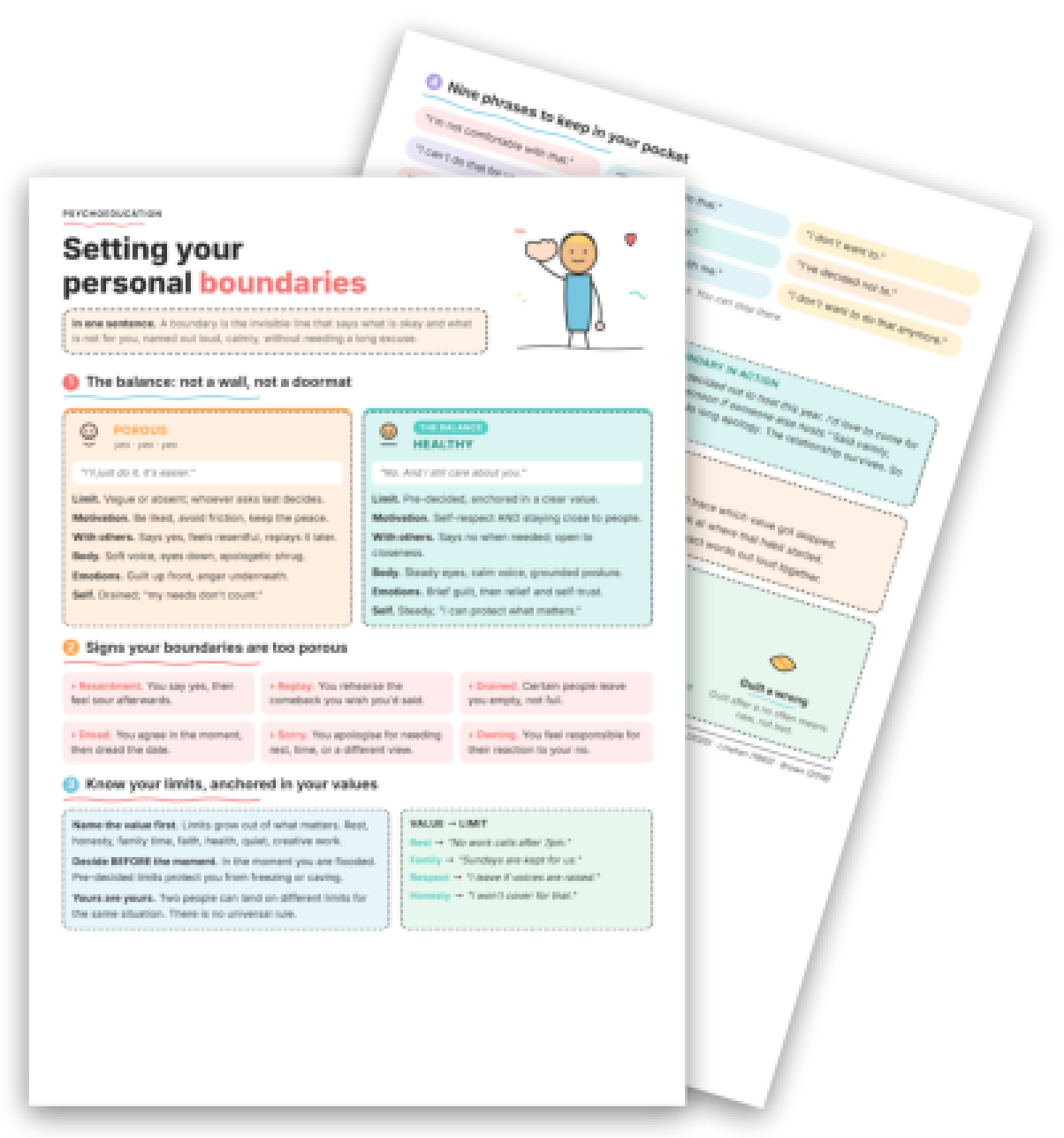
Explaining personal boundaries to a patient verbally tends to produce nodding agreement and very little behavioral change. The concept feels intuitive until the moment a relative asks a favor and the patient caves again. This fiche PDF on setting personal boundaries is a visual support designed to hold the concept steady in session, create a shared language, and leave the patient with something to carry out of the room.
Use this resource with your patients
Handout, exercises and materials ready to use, right inside SessionFuel.
Why the Concept Resists Verbal Explanation
The clinical difficulty is not that patients lack vocabulary. It is that "boundary" as they understand it sits somewhere between an aggressive refusal and a rigid wall, neither of which feels acceptable. Patients caught in self-sacrifice schemas (see the Self-Sacrifice Schema worksheet) or strong approval-seeking patterns have often been rewarded lifelong for porousness. Telling them a boundary is "healthy" rarely shifts that.
A second obstacle: the moment of decision arrives flooded with affect. The patient who intellectually knows they should say no freezes, appeases, then replays the moment for days. Oral psychoeducation explains the mechanics; it rarely provides the pre-loaded phrasing and the value anchor that protect against that freeze. That gap is exactly what this fiche addresses.
What the Fiche Contains: A Visual Anchor for the Boundary Concept
The fiche is structured across five panels, all grounded in values-based framing rather than rule-based compliance.
- The porous vs. healthy balance (Panel 1): a side-by-side visual comparing limit, motivation, relational behavior, body language, and emotional aftermath for both styles. The contrast is stark and immediate; patients can locate themselves without being told where they land.
- Six signs of porousness (Panel 2): somatic and behavioral markers, including "You apologise for needing rest, time, or a different view" and "You feel responsible for their reaction to your no." These map directly onto what patients describe in anamnesis without yet framing it as a boundary problem.
- Values-to-limit mapping (Panel 3): four concrete examples ("Rest → No work calls after 7pm", "Respect → I leave if voices are raised") that model how a limit emerges from a value, not from a rule. This is the conceptual spine of the fiche and the piece most patients need to see written down.
- Nine ready-made phrases (Panel 4): short, non-apologetic formulations the patient can rehearse in session and reference between appointments.
- A worked example (Panel 5): a family gathering scenario showing the old pattern and the boundary in action, with the closing note: "Said calmly, once. No long apology. The relationship survives. So do you."
The fiche also includes three "To discuss in session" prompts, making it a natural debrief scaffold rather than a passive handout.
> Key point: this is a visual support that facilitates the explanation of personal boundaries in session. You use it alongside the patient to make abstract concepts concrete; it is not a questionnaire to be completed alone at home.
The values-to-limit structure pairs naturally with values clarification work in ACT and with the Assertive Rights worksheet when patients need to name what they are entitled to protect.
750+ clinical tools
A library built with and for clinicians, ready to use in session and extend between appointments.
Access all the toolsHow and When to Introduce the Fiche
Timing. Introduce the fiche once the presenting pattern is visible: chronic resentment after compliance, post-hoc replay of missed refusals, somatic fatigue following relational interactions. It fits naturally after a first round of anamnesis but before structured assertiveness training such as the DBT DEAR MAN skill or the assertiveness tips and exercises.
Profiles. It is particularly well-suited to patients presenting with self-sacrifice dynamics, porous enmeshment, or boundary confusion in close relationships. It also works for patients who label themselves as "too aggressive" and who need to see that a healthy limit is neither a wall nor an attack, as the Boundary Styles fiche further unpacks.
Framing. A low-threshold introduction: "I'd like to show you something that maps out what we've been describing. It's not about changing who you are; it's about identifying where your values are asking for a line." Then walk through Panel 1 together, inviting the patient to mark where they recognize themselves.
Debrief. The three session prompts on the fiche guide the debrief: which value was skipped after the last unwanted yes, where the habit of owning the other person's reaction started, and whether a specific conversation is coming up that you can rehearse together. For patients preparing a concrete exchange, the Setting Boundaries: How to Say No worksheet and the work-life boundaries tools extend the work between sessions.
One caution: for patients with significant abandonment fears (see the Abandonment Schema fiche), the fiche's reassurance that "the relationship survives" may need explicit elaboration. The fear that a boundary will cost the relationship is often the primary maintaining factor; acknowledge it before the panel, not after.
The fiche does not replace the therapeutic frame. It makes the explanation sharper, saves relational negotiation time in session, and puts a concrete reference in the patient's hands.
Use it with your patients
Share this tool in the mobile app and follow the work between sessions.
Sources
- Katherine, A. (2000). Where to Draw the Line: How to Set Healthy Boundaries Every Day. Simon and Schuster.
- Tawwab, N. G. (2021). Set Boundaries, Find Peace: A Guide to Reclaiming Yourself. TarcherPerigee.
- Smith, M. J. (1975). When I Say No, I Feel Guilty: How to Cope, Using the Skills of Systematic Assertive Therapy. Bantam Books.
- Chernata, T. (2024). Personal Boundaries: Definition, Role, and Impact on Mental Health. Personality and Environmental Issues.
- Chernata, T. (2025). Personal Boundaries as a Factor of Psychological Well-Being. Personality and Environmental Issues.
Your session continues in your patients' pocket
Use with a patientYour resources, available everywhere
The handouts, exercises, programs and audios above: you choose which ones to make available to your patients, in the mobile app dedicated to them.
And far more than a library
The app goes well beyond resources, to support your patients every day:
Related categories
Explore other clinical resources by category.

Identity
Clinical resources for self-identity work in therapy: CBT, ACT, schema tools for clinicians addressing self-concept, core beliefs, and identity disruption.
Relationships
Clinical worksheets and tools on relational functioning: attachment, schemas, assertiveness, and communication skills for therapists. Printable PDF resources.

Understand
Clinical hub for the therapeutic aim 'Understand': worksheets and tools to build patient insight across CBT, ACT, schema therapy and more.

Build awareness
Clinical worksheets and tools to build awareness in therapy: cognitive distortions, schemas, emotions, ACT and CBT resources for practitioners.

Build skills
Skill-building resources for clinicians: printable worksheets and exercises for coping, assertiveness, and communication skills training in therapy.

Integrative
Integrative therapy clinical resources: worksheets, psychoeducation programs, and exercises for eclectic, multimodal practice across orientations.