
Clinical picture. A, a woman in her early 40s, presented with chronic exhaustion and recurring low mood following a pattern of giving in to requests at work and at home, then feeling quietly resentful. During a session focused on interpersonal difficulties, the clinician introduced the boundary-styles informational sheet and invited A to read through the three columns. A paused at the porous description and said, without prompting, that she had never seen her behaviour named so plainly. The clinician used this recognition as a starting point to explore where the style had developed and what function it had served, without framing change as urgent or straightforward.
Boundary Styles: PDF Worksheet, Tools and Exercises for Clinical Practice
A visual PDF worksheet with tools and exercises to help clinicians explain porous, healthy, and rigid boundary styles clearly during psychoeducation sessions.
Clinical vignettes
Porous Style Recognised in Session
Rigid Style Opens a Conversation About Trust
Clinical picture. M, a man in his mid-30s, had attended six sessions focused on social isolation and a reported inability to sustain friendships beyond a few months. The clinician offered the boundary-styles sheet as shared reading material, asking M to notice which descriptions felt familiar. M identified strongly with the rigid column, particularly the items around distrust and cutting off after a single disappointment. This gave the clinician a concrete, non-pathologising vocabulary to explore M's relational history, and M found it easier to discuss his behaviour when it was presented as a style with origins rather than a character flaw.
Explaining boundary styles verbally tends to produce polite nodding rather than genuine recognition. Patients hear the word "boundary" and reach for vague moral connotations, either selfishness or rigidity, rather than landing on the behavioural precision you need for clinical work. This PDF worksheet gives you a concrete, side-by-side visual to anchor the concept during the session itself.
Use this resource with your patients
Handout, exercises and materials ready to use, right inside SessionFuel.
Why Boundary Styles Resist Oral Explanation
The core clinical difficulty is that porous and rigid styles are both protective strategies, not character flaws, and patients rarely perceive their own pattern as such. Someone with a chronically porous style tends to describe themselves as "a good listener" or "someone who hates conflict"; someone with a rigid style reads their own distance as self-sufficiency. Neither label maps cleanly onto what they are actually doing interpersonally.
Trying to convey all three styles sequentially in speech asks the patient to hold multiple contrasts in working memory while also noticing themselves in the description. Most cannot do both at once. The result is a shallow recognition that dissipates before the next session. A visual support that externalises all three columns simultaneously changes the cognitive load entirely, freeing the patient to locate their own pattern rather than reconstruct it from memory.
This is also where schema-adjacent presentations compound the difficulty. Patients with approval-seeking dynamics, abandonment fears, or the attachment patterns described in the Attachment Styles in Romantic Relationships worksheet often cycle between porous and rigid depending on the relationship. Capturing that contextual variability in speech alone is cumbersome.
What the Worksheet Contains
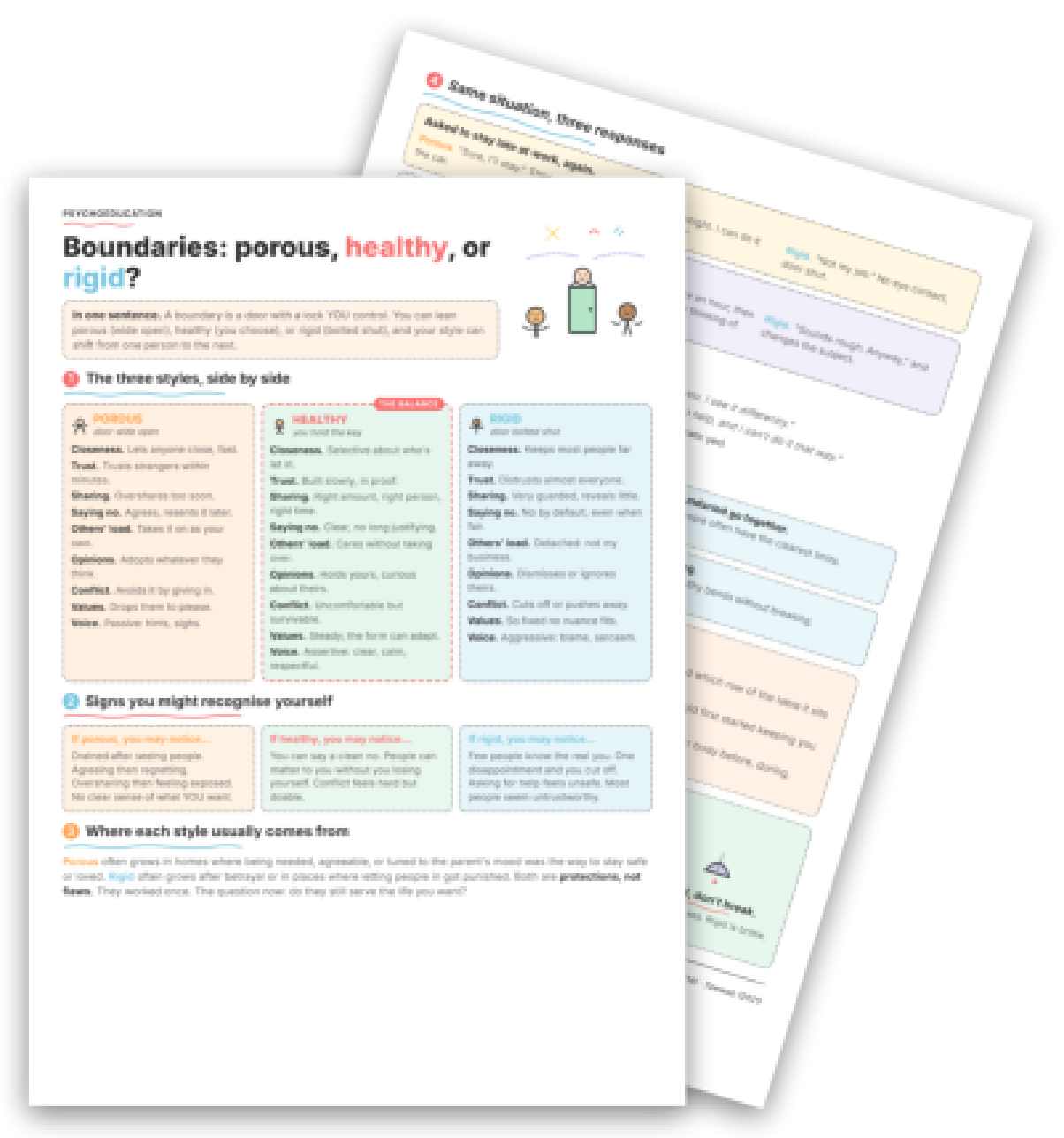
The fiche is structured across six numbered panels, all grounded in a single orienting metaphor: "A boundary is a door with a lock YOU control." That framing is deliberate; it positions the boundary as an active, personal mechanism rather than a social rule.
Panel 1 is the clinical spine of the resource: a three-column comparison table contrasting porous, healthy, and rigid styles across eight dimensions (closeness, trust, sharing, saying no, others' load, opinions, conflict, and voice). Seeing the rows side by side makes the relational logic of each style immediately legible. A patient scanning the "saying no" row reads: "Agrees, resents it later" (porous) versus "Clear, no long justifying" (healthy) versus "No by default, even when fair" (rigid). That specificity does work that no paraphrase can.
Panel 2 offers self-recognition prompts for each style, written in first-person phenomenology: feeling drained after social contact, cutting someone off after one disappointment, agreeing then regretting. You can use these in session as low-threat identification questions. Panel 3 contextualises the developmental origins of each style without pathologising: porous styles often emerging from family systems where attunement to parental mood was a survival strategy, rigid styles following betrayal or relational punishment.
Panel 4 presents the same situation rendered in three ways, a late-work request and an 11 pm crisis call, which is often where patients' recognition sharpens most. Panel 5 provides ready-made phrases the patient can borrow directly, including "Let me think about it and get back to you" as a non-automatic alternative to a reflexive yes. Panel 6 addresses common confusions: that boundaries are selfish, that rigidity signals strength, that kind and boundaried are incompatible.
The "To discuss in session" section at the close gives you three concrete debrief prompts, including asking the patient to pick one relationship and one row from the table and try one sentence from the phrase bank.
> Key takeaway: the fiche is a visual support that facilitates the in-session explanation of boundary styles; it is not a self-administered questionnaire but a shared reference the clinician uses to make a complex interpersonal notion concrete, buildable, and memorable.
Clinical library
750+ clinical tools
A library built with and for clinicians, ready to use in session and extend between appointments.
Access all the toolsSeveral resource types
Psychoeducation handouts
Understand at a glance
Interactive exercises
To do and fill in
Interactive programs
A structured path
Audios
Meditation and relaxation
Psychometric tests
Automatic scoring
When and How to Introduce It
The worksheet fits naturally in early-to-mid formulation work, once the initial anamnesis has surfaced relational patterns but before you have moved into active skill-building. For patients beginning assertiveness training or working through assertive communication exercises, it provides the conceptual map that those skills will be placed onto.
Introduce it without labelling: "I want to show you a model that a lot of people find clarifying. Have a look at this table and tell me what you recognise." Let the patient scan before you say anything. The recognition often happens faster than clinicians expect, and the affect that comes with it (relief, embarrassment, curiosity) is itself clinically informative.
For patients working on relational beliefs, pair the worksheet with the 12 Beliefs That Damage Relationships fiche or the Healthy Relationships psychoeducation program. For adolescents or young adults, assertive rights work and I-messages training integrate smoothly as next steps. For patients who oscillate between styles depending on the relationship, the Assertive Communication worksheet can help them practise the healthy column in the specific contexts where they default to porous or rigid.
One limitation worth naming: patients with significant early relational trauma may find Panel 3 activating rather than clarifying. In those cases, hold the developmental origin content for a later session and use Panels 1 and 2 first. The fiche does not replace the therapeutic frame; it makes the explanation sharper and leaves the patient with a reference they can return to between sessions.
Use it with your patients
Share this tool in the mobile app and follow the work between sessions.
Sources
- Minuchin, S. (1974). Families and Family Therapy. Harvard University Press.
- Tawwab, N. G. (2021). Set Boundaries, Find Peace: A Guide to Reclaiming Yourself. TarcherPerigee.
Patient mobile app
Your session continues in your patients' pocket
Use with a patientYour resources, available everywhere
The handouts, exercises, programs and audios above: you choose which ones to make available to your patients, in the mobile app dedicated to them.
Psychoeducation handoutsInteractive exercisesInteractive programsAudiosPsychometric tests
And far more than a library
The app goes well beyond resources, to support your patients every day:
Standardized tests
Therapy journal
Gamification
Wellbeing challenges
Introspection prompts
Therapist homework
Related categories
Explore other clinical resources by category.

Identity
Clinical resources for self-identity work in therapy: CBT, ACT, schema tools for clinicians addressing self-concept, core beliefs, and identity disruption.

Relationships
Clinical worksheets and tools on relational functioning: attachment, schemas, assertiveness, and communication skills for therapists. Printable PDF resources.

Understand
Clinical hub for the therapeutic aim 'Understand': worksheets and tools to build patient insight across CBT, ACT, schema therapy and more.

Build awareness
Clinical worksheets and tools to build awareness in therapy: cognitive distortions, schemas, emotions, ACT and CBT resources for practitioners.

CBT
CBT worksheets, cognitive restructuring exercises & behavioral tools for clinicians. Evidence-based resources for every phase of cognitive behavioral therapy.

Humanistic
Printable clinical resources for humanistic therapy: worksheets, exercises, and psychoeducation programs for practitioners using person-centered and experiential approaches.