
Clinical picture. M., a man in his late thirties, presented with recurring conflict in his relationship, describing arguments that seemed to start from nowhere. During a session focused on communication psychoeducation, the clinician introduced the three-channel framework and asked M. to recall a recent exchange with his partner. He quickly identified that his verbal content had been conciliatory ('I said it was fine') while his non-verbal behaviour, crossed arms and minimal eye contact, had signalled the opposite. Recognising the mismatch between channels gave M. a concrete vocabulary for what his partner had been reacting to, rather than the words alone. He left the session with a specific observation task: to notice, over the following week, when his body and his words were carrying different messages.
Communication: PDF Worksheet, Tools and Exercises for Clinical Practice
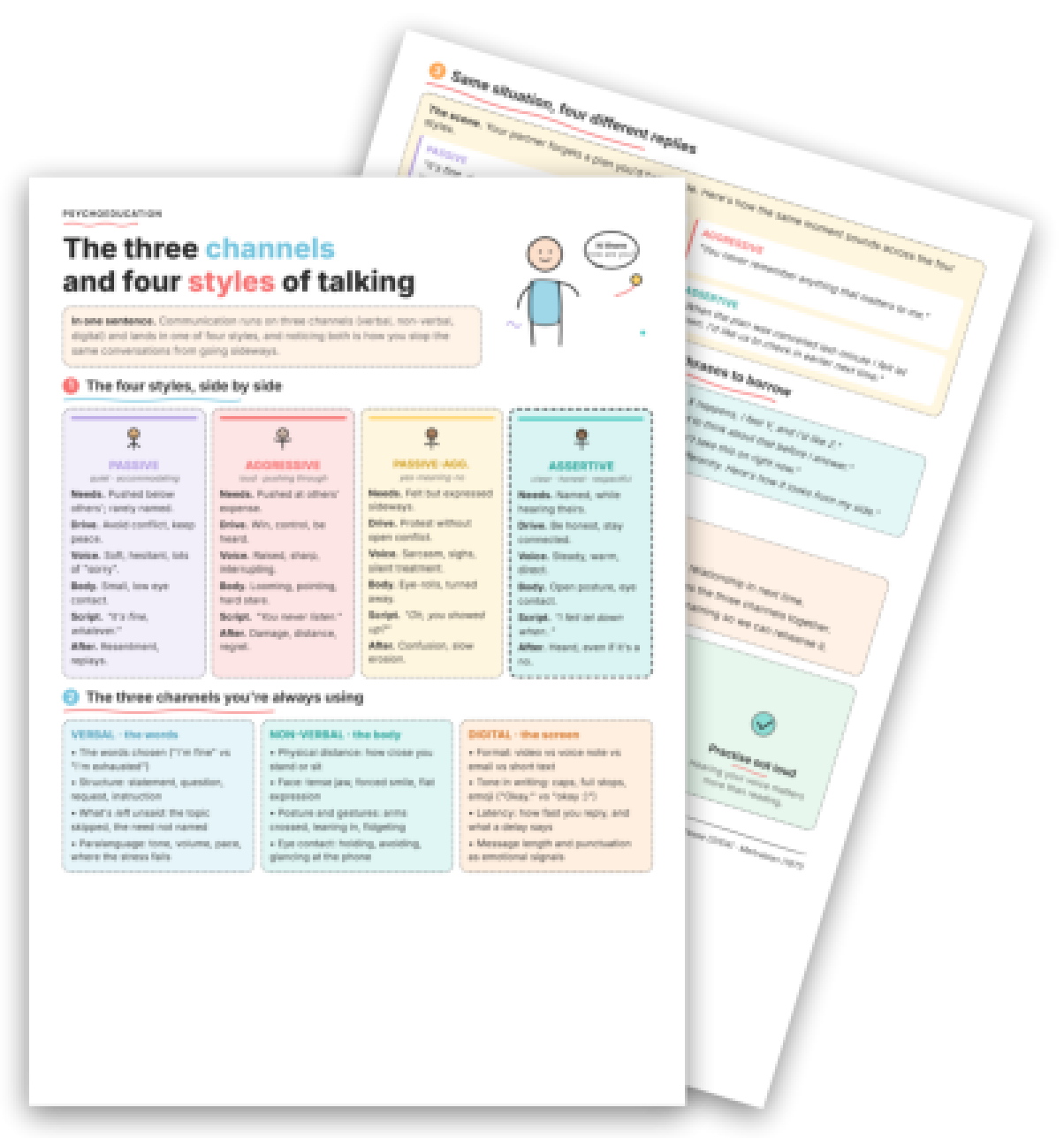
A printable PDF fiche mapping the three channels and four communication styles, designed as a visual psychoeducation aid clinicians can use directly in session.
Clinical vignettes
Naming the Channel Mismatch
Identifying Style Under Pressure
Clinical picture. K., a woman in her mid-twenties seen for generalised anxiety, reported feeling chronically unheard by colleagues yet unable to explain why her attempts to speak up fell flat. The clinician used the four-style comparison from the informational sheet as a shared reference point, reading through each profile together rather than assigning a label. K. recognised her own pattern in the passive column, particularly the hesitant voice and the aftereffect of private resentment, and noted that she had assumed assertiveness required aggression. A brief discussion of the assertive script ('I felt let down when...') normalised directness as compatible with respect. No behavioural homework was assigned at that stage; the goal was recognition before rehearsal.
Explaining communication styles verbally tends to produce polite nodding. The patient maps "assertive" onto "confident," leaves with no clearer sense of why they freeze with their manager but steamroll their partner, and the pattern repeats. This fiche PDF gives you a shared, visual vocabulary to work with right there in the room, and something concrete for the patient to take home.
Use this resource with your patients
Handout, exercises and materials ready to use, right inside SessionFuel.
Why Communication Is Difficult to Convey Without a Visual
The difficulty is not conceptual. Most patients can define "passive" in the abstract. The problem is self-recognition. Without a side-by-side comparison, patients rarely identify their own default style accurately: they underreport aggression, misread passive-aggression as politeness, and overestimate assertiveness. Verbal description leaves the four styles as separate, floating ideas. The patient who says "I just stay quiet to keep the peace" does not spontaneously connect that to the bodily posture, the sarcasm that follows two hours later, or the resentment that accumulates, the full pattern only becomes visible when it is laid out all at once.
The fiche also covers digital communication as a distinct channel, which oral psychoeducation almost never addresses. For patients whose relational friction lives largely in text threads and deliberately delayed replies, this addition alone can shift recognition substantially, and it opens a conversation about passive-aggressive communication patterns that might not surface otherwise.
750+ clinical tools
A library built with and for clinicians, ready to use in session and extend between appointments.
Access all the toolsWhat the Fiche Contains: A Side-by-Side Map of Styles and Channels
The fiche is organized in five sections. The first and most immediately useful presents the four styles (passive, aggressive, passive-aggressive, assertive) as parallel columns, each broken down by needs, drive, voice quality, body language, typical script, and aftermath. The column format is the point: a patient can place a finger on one row, "Voice: soft, hesitant, lots of 'sorry'", and scan across all four styles in a single glance, which spoken description cannot replicate. This layout does the comparison work that you would otherwise have to narrate.
The second section maps the three channels: verbal, non-verbal, and digital. Under the verbal channel the fiche explicitly names "What's left unsaid: the topic skipped, the need not named," and under digital it highlights "Latency: how fast you reply, and what a delay says." Both are communication acts patients recognize instantly but have rarely named as such. Pairing this section with assertive body language or active listening skills work gives you a complete multi-channel picture.
The third section puts the same scenario, a partner who forgets a shared plan, through all four styles at once, from "It's fine, don't worry about it" (passive) to "When the plan was cancelled last-minute I felt let down. I'd like us to check in earlier next time" (assertive). Having all four responses on the same page makes the contrast concrete without requiring any commentary from you.
Section four lists six signs of imbalance (difficulty saying no to specific people, dominating conversations without noticing, replaying exchanges, texts that sit on read because the reply feels heavy). Section five offers ready-to-use assertive phrases including "I'd need to think about that before I answer" and "I see it differently. Here's how it looks from my side," which pair well with your existing work on I-Messages or LACE empathic assertion.
> Key takeaway: This fiche is a visual support that facilitates the explanation of communication styles in session. It is not a self-report questionnaire to fill in alone. You navigate it together with the patient; they leave with a concrete reference rather than an abstract concept.
Use it with your patients
Share this tool in the mobile app and follow the work between sessions.
When and How to Introduce This Fiche
This fiche fits naturally from the second or third session onward, once you have a working formulation and the patient has named at least one relational difficulty. It is well suited to patients presenting with relational avoidance, chronic conflict, assertiveness deficits, or somatic complaints that track closely with interpersonal stress. It also works as an entry point for couples work, alongside tools such as the Couples Communication program or Nonviolent Communication.
A low-threshold introduction: "I'd like to show you a map of different ways people communicate under pressure. Let's see which column feels most familiar to you." Avoid framing it as a diagnosis. The goal in that first pass is recognition, not labeling.
Debrief by asking which style the patient recognizes under stress, which they aspire to, and, crucially, whether the style varies by relationship. The fiche's "To discuss in session" prompts give you three ready-made debrief questions, including: "When an assertive phrase feels physically hard to say out loud, that's worth naming so we can rehearse it." That observation alone can open the door to behavioral rehearsal or role-play within the same session.
One limit worth flagging: patients with significant social anxiety may find the assertive column activating rather than motivating at first contact. For those profiles, exploring social anxiety and reflective listening work may need to come before assertiveness rehearsal. The fiche is a starting point for psychoeducation, not a prescription for immediate behavioral change.
The fiche does not replace the therapeutic frame; it makes the explanation faster, clearer, and leaves the patient with a reference they can return to between sessions.
Your session continues in your patients' pocket
Use with a patientYour resources, available everywhere
The handouts, exercises, programs and audios above: you choose which ones to make available to your patients, in the mobile app dedicated to them.
And far more than a library
The app goes well beyond resources, to support your patients every day:
Related categories
Explore other clinical resources by category.

Identity
Clinical resources for self-identity work in therapy: CBT, ACT, schema tools for clinicians addressing self-concept, core beliefs, and identity disruption.
Relationships
Clinical worksheets and tools on relational functioning: attachment, schemas, assertiveness, and communication skills for therapists. Printable PDF resources.

Understand
Clinical hub for the therapeutic aim 'Understand': worksheets and tools to build patient insight across CBT, ACT, schema therapy and more.

Build skills
Skill-building resources for clinicians: printable worksheets and exercises for coping, assertiveness, and communication skills training in therapy.
CBT
CBT worksheets, cognitive restructuring exercises & behavioral tools for clinicians. Evidence-based resources for every phase of cognitive behavioral therapy.

Anxiety
Clinical hub for anxiety disorders: CBT and ACT worksheets, psychoeducation sheets, and exercises for assessment and treatment across the anxiety spectrum.