
Clinical picture. M., a man in his early forties, presented with recurrent conflict in his relationship, describing episodes in which he shouted at his partner over minor domestic oversights. During a session focused on psychoeducation, the clinician introduced the iceberg worksheet and walked through the three layers together with M., mapping his shouting (behavior) to a feeling of exhaustion and being invisible (emotion), and then to an unmet need for recognition and shared responsibility (underlying need). M. expressed surprise that the worksheet framed his outbursts not as a character flaw but as a clumsy signal pointing to something legitimate. Over the following week he reported one episode in which he caught the emotion before escalating and named his need directly to his partner, with a modest but noticeable shift in the exchange.
Behavior, Emotion, Underlying Need: PDF Worksheet, Tools and Exercises
A visual PDF worksheet, clinical tools, and worked exercises to help patients decode what drives their reactions, from surface behavior down to the unmet need beneath.
Clinical vignettes
Unpacking Anger at a Partner
Chronic People-Pleasing in Session
Clinical picture. T., a woman in her late twenties referred for anxiety, described a pattern of agreeing to additional work tasks she did not want, then feeling resentful and depleted. The clinician used the iceberg sheet as a shared reference point, inviting T. to identify the visible behavior (saying yes), the emotion firing beneath it (fear of rejection, anxiety), and the deeper layer (a need for belonging and to feel valued). T. noted that she had always attributed the pattern to weakness; reframing it as a protective response to a real need shifted her self-critical narrative slightly. She left with the worksheet to track one instance before the next session, with no expectation beyond observation.
When a patient arrives saying "I don't know why I exploded like that" or "I always do this and I hate myself for it," the behavior-emotion-need chain is almost impossible to convey through verbal explanation alone. This fiche PDF gives you a structured visual to trace that chain out loud, together, in the consulting room.
Use this resource with your patients
Handout, exercises and materials ready to use, right inside SessionFuel.
Why this concept resists explanation in session
The clinical difficulty here is layered. Patients arrive anchored at the behavioral surface: they report what they did, reproach themselves for it, and loop. The emotion layer is already harder to access, partly because it fires fast and partly because many patients have learned to skip it. The underlying need is further still, the layer they are, as the fiche puts it, "least aware of."
When you explain this verbally, patients tend to hear a linear sequence rather than a depth structure. They understand the logic but cannot feel into it. The concept of a legitimate need driving a clumsy behavior lands as a thought, not as genuine relief. Without a visual anchor, the insight dissolves between sessions.
This is also where understanding what drives emotional reactions becomes clinically relevant: naming an emotion correctly is a prerequisite for identifying the need beneath it. When both steps stay abstract, the psychoeducation stalls at intellectual acquiescence.
> Key point: The fiche is a visual support that facilitates the explanation of the behavior-emotion-need chain directly in session. It is not a self-administered questionnaire; it is an in-session psychoeducation tool that you and the patient work through together, leaving them a concrete reference to take home.
What the fiche contains: layers, needs, and worked scenarios
The resource is organised into four panels, each building on the last.
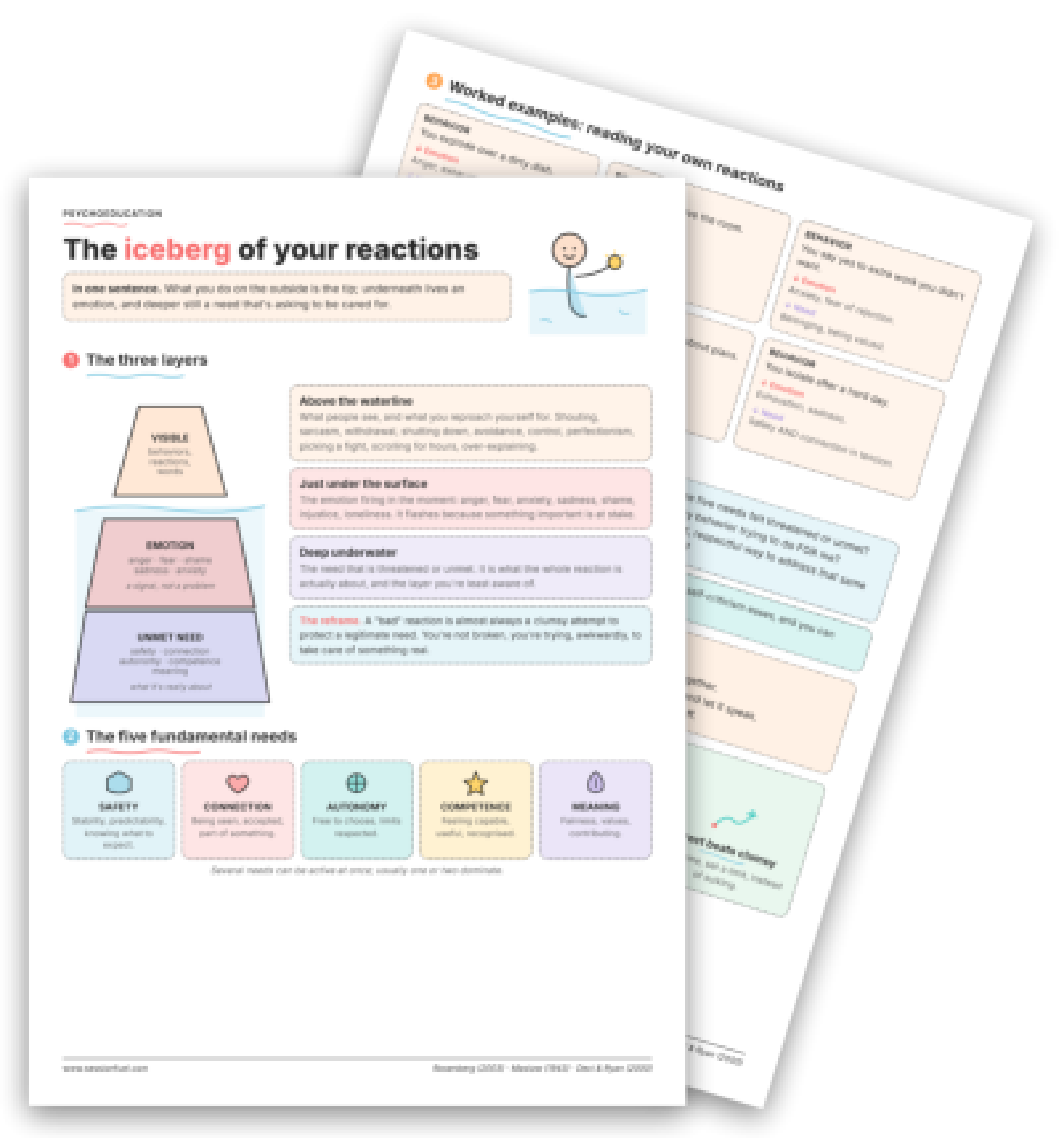
Panel 1 presents the iceberg metaphor with three named layers: VISIBLE (behaviors, reactions, words), EMOTION (anger, fear, shame, sadness, anxiety, described as "a signal, not a problem"), and UNMET NEED (safety, connection, autonomy, competence, meaning). The visual stacking makes the depth structure immediately legible, something a spoken description almost never achieves in a first explanation.
Panel 2 names and defines the five fundamental needs, with a brief clinical note that several can be active simultaneously. This maps closely onto the frameworks of Rosenberg (CNV) and Deci & Ryan (autodétermination), grounding the model in a theoretical lineage your patient does not need to know by name but that you can reference in supervision.
Panel 3 is the most immediately useful in session: six worked examples each running behavior → emotion → need. A patient who explodes over an unwashed dish maps to anger and exhaustion, then to "feeling seen, sharing the load." Becoming controlling about plans maps to anxiety, then to safety and predictability. These concrete scenarios allow you to say: "Does any of these feel familiar?" and let the patient recognise their own pattern rather than having it assigned to them. This is a meaningful shift in the therapeutic interaction. You can then move directly to mapping the same chain for an episode from their own week as a natural next step.
Panel 4 provides seven guided reflection questions the patient can use independently, including an emotion-intensity rating (0-10), a body-sensation check, and the pivotal question: "What was my behavior trying to do FOR me?" The fiche also includes a "To discuss in session" checklist, which primes the patient to return with specific material rather than arriving without an agenda. For work on reactive patterns where assertive communication via I-messages is a target skill, this panel builds the self-observation foundation that makes that work possible.
750+ clinical tools
A library built with and for clinicians, ready to use in session and extend between appointments.
Access all the toolsWhen and how to introduce the fiche
This worksheet fits naturally from session two onward, once the anamnèse has surfaced at least one recurrent behavioral pattern. It is particularly indicated when a patient presents with shame around a reactive behavior, chronic interpersonal conflict, or a tendency toward harsh self-criticism after losing control.
To introduce it without pathologising, you might say: "I'd like to look at this together, it's a way of understanding what's actually happening underneath a reaction, not to judge it but to make sense of it." Resist handing it over before doing the first layer verbally with the patient; the visual confirms and organises what you've already begun to name together.
On debrief, the most informative patient response is not intellectual agreement but something softening: a pause, a breath, a "that actually makes sense" said quietly. The fiche notes this explicitly, "something softens inside", which you can use as a compass for whether the need-level has genuinely been reached. If the patient stays at the behavior or emotion layer, the work continues.
It pairs naturally with adaptive coping work, with emotion regulation psychoeducation, and for anger-presenting patients, with the anger iceberg format or anger self-reflection exercises. In a CBT framework, the behavior-emotion-need chain also dovetails with the ABC model, giving patients two complementary lenses on the same event.
One limit to flag: patients with significant alexithymia may need more preparatory emotion-labelling work before the middle layer becomes accessible. In those cases, the basic emotions worksheet and body scan tools are useful prerequisites. The fiche itself does not replace that groundwork; it consolidates it once the patient has enough interoceptive vocabulary to work with.
The fiche does not replace the therapeutic frame. It makes one core explanation clearer and leaves the patient a map they can return to alone, which is precisely its clinical value.
Use it with your patients
Share this tool in the mobile app and follow the work between sessions.
Sources
- Rosenberg, M. B. (2003). Nonviolent Communication: A Language of Life. PuddleDancer Press.
- Maslow, A. H. (1943). A Theory of Human Motivation. Psychological Review, 50, 370-396.
- Greenberg, L. S. (2002). Emotion-Focused Therapy: Coaching Clients to Work Through Their Feelings. American Psychological Association.
- Ryan, R. M., Deci, E. L. (2017). Self-Determination Theory: Basic Psychological Needs in Motivation, Development, and Wellness. Guilford Press.
Your session continues in your patients' pocket
Use with a patientYour resources, available everywhere
The handouts, exercises, programs and audios above: you choose which ones to make available to your patients, in the mobile app dedicated to them.
And far more than a library
The app goes well beyond resources, to support your patients every day:
Related categories
Explore other clinical resources by category.

Anxiety
Clinical hub for anxiety disorders: CBT and ACT worksheets, psychoeducation sheets, and exercises for assessment and treatment across the anxiety spectrum.

Identity
Clinical resources for self-identity work in therapy: CBT, ACT, schema tools for clinicians addressing self-concept, core beliefs, and identity disruption.

Emotions
Clinical resources on emotion regulation: worksheets, coping tools, CBT, REBT, and ACT exercises for therapists working across diagnoses and age groups.

Relationships
Clinical worksheets and tools on relational functioning: attachment, schemas, assertiveness, and communication skills for therapists. Printable PDF resources.

Cognition
Printable cognitive therapy worksheets and clinical tools for therapists: CBT, ACT, schema work, defusion, distortions, and belief restructuring.

Understand
Clinical hub for the therapeutic aim 'Understand': worksheets and tools to build patient insight across CBT, ACT, schema therapy and more.