
Clinical picture. R., a man in his late thirties, presented with recurrent shame and social withdrawal following any critical feedback from supervisors, a pattern that had begun to affect his attendance and performance reviews. The clinician introduced the guided exercise, asking R. to name the unhealthy emotion (shame), its most frequent trigger (a manager's corrective comment), and his habitual response (leaving the office early and avoiding colleagues for days). R. identified disappointment as the healthier alternative he could realistically tolerate, and selected one concrete behavior: staying at his desk for the remainder of the shift after receiving feedback, rather than leaving. At the next session he reported having used this anchor twice, describing a modest but noticeable reduction in the pull toward withdrawal.
Unhealthy to Healthy Emotions: A Guided Clinical Exercise
Help patients identify a destructive emotional pattern, name its trigger, and choose the behavior that moves them toward a healthier response.
Clinical vignettes
Chronic Shame After Workplace Criticism
Unhealthy Anger Driving Relationship Ruptures
Clinical picture. T., a woman in her mid-forties, described explosive anger that consistently followed any perceived dismissal by her partner, resulting in hours of hostile silence or abrupt departure from the home. Using the exercise, she mapped the sequence: unhealthy rage as the target emotion, feeling ignored during disagreements as the trigger, and leaving the flat and refusing contact for the rest of the evening as her habitual response. She chose annoyance as the healthier emotion she was willing to aim for, and identified staying in the room and stating her need aloud as the corresponding behavior. Over the following two weeks she attempted this once, described the effort as considerable, and noted that the rupture on that occasion lasted under an hour rather than an entire day.
Why this is genuinely hard to work with verbally
Most patients arrive with a vague but urgent complaint: they keep reacting in ways they hate, and they cannot understand why stopping feels impossible. The difficulty is not a lack of insight. It is that naming an unhealthy emotion, tracing it to a specific trigger, and then imagining a different behavioral outcome requires a kind of slow, deliberate self-observation that verbal conversation in a session rarely produces alone. The heat of the moment is gone by the time you meet again. Recall is selective, retrospective, and shaped by shame.
This is exactly the gap that structured between-session reflection is designed to fill. Rooted in the REBT distinction between healthy and unhealthy emotional responses, the exercise "I'm sick of feeling this way!" invites patients to do the cognitive and emotional mapping work on their own, close to lived experience, at their own pace. It connects naturally to the broader question of how emotions motivate actions and why the same trigger can lead to radically different outcomes depending on the emotional state it lands in.
Use this resource with your patients
Handout, exercises and materials ready to use, right inside SessionFuel.
What the exercise contains
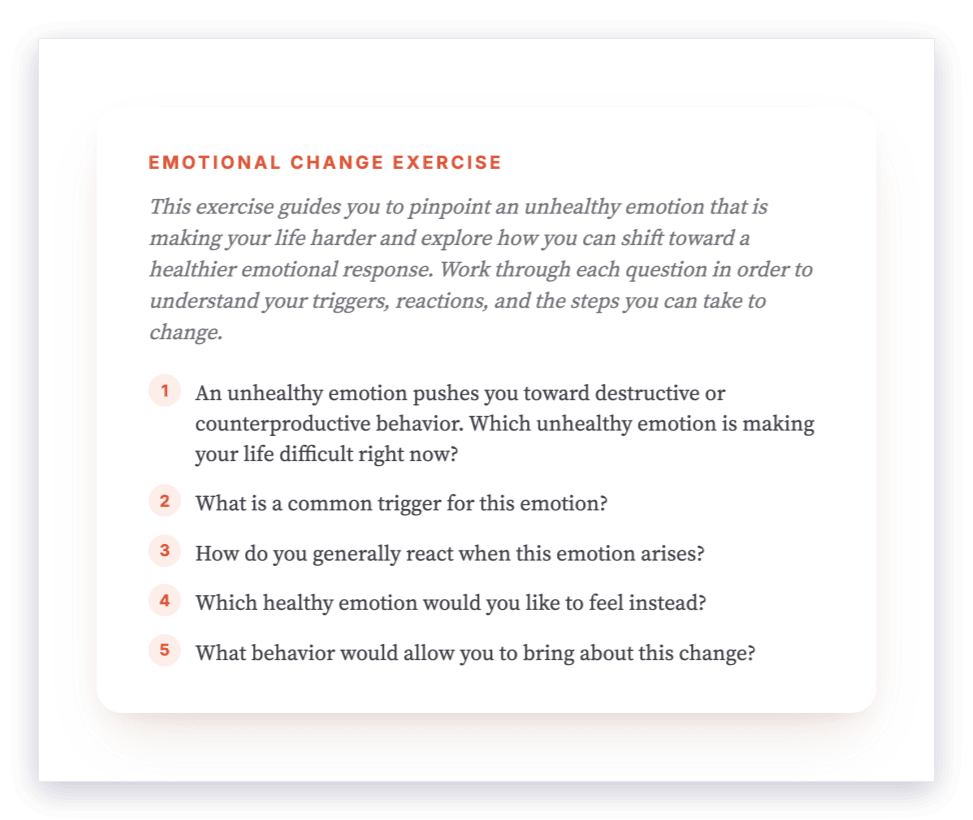
The exercise moves through five tightly sequenced questions:
- Which unhealthy emotion is currently making life difficult?
- What is a frequent trigger for it?
- How does the patient typically react?
- Which healthy emotion would they want to feel instead?
- What behavior would help produce that change?
This sequence is not incidental. It follows a clear clinical logic: name the problem emotion, locate it in context, examine the automatic response, articulate a valued alternative, and identify the behavioral lever. The patient is not asked to perform change; they are asked to think it through. Questions 4 and 5 together are particularly powerful: asking someone to name a desired emotion before naming a behavior reverses the usual order of conversation and anchors the goal in felt experience rather than abstract intention.
Used alongside tools like Feel, Reflect, Act Differently or Identifying Emotional Triggers, this exercise builds a cumulative map of the patient's emotional landscape over time.
The image above lists all five questions in order. This is a static preview only, the full guided exercise, with patient-facing instructions and space to write responses, is experienced by the patient directly in the app, not here in this image.
Key insight: The real clinical value of this exercise is in questions 4 and 5 taken together, naming a desired healthy emotion before choosing a behavior gives the goal an emotional anchor, not just a cognitive one.
This exercise is available to patients through the mobile application that is the dedicated patient-side interface of SessionFuel: the clinician assigns it as homework, and the patient completes it directly on their phone, on their own, between two consultations.
750+ clinical tools
A library built with and for clinicians, ready to use in session and extend between appointments.
Access all the toolsUse it with your patients
Share this tool in the mobile app and follow the work between sessions.
How to assign and debrief this as between-session work
This exercise suits patients who are emotionally literate enough to name more than one feeling, and who are already motivated to change a specific pattern, whether that involves maladaptive coping, reactive anger, avoidance, or a recurrent destructive behavior. It works well mid-treatment, once a basic shared vocabulary exists.
When introducing it, keep the framing simple: "Between now and our next appointment, I'd like you to spend a few minutes with these questions. There are no right answers, I'm interested in what comes up for you." Avoid loading it with expectations. The exercise is most useful when patients approach it with genuine curiosity rather than a desire to produce a correct response.
When the patient returns, the debrief is where the clinical work deepens. Pay attention to how specific or how vague their trigger description is, that gap often points toward the next piece of work. Notice whether question 5 produces something behavioral and concrete, or something that sounds more like a wish. If the target healthy emotion in question 4 is unfamiliar to the patient, that itself becomes material: the Emotion Regulation Psychoeducation program or the Behavior, Emotion, Underlying Need framework can extend the conversation. For patients where the identified emotion is anger-related, pairing this exercise with Guided Anger Self-Reflection sharpens the work considerably.
For patients struggling with frustration specifically, the Frustration Tolerance exercise offers a natural companion that addresses tolerance-building directly. And where rigid personal rules seem to drive the unhealthy emotion, Demandingness in REBT opens the underlying belief layer that question 5 alone cannot reach.
The concrete production the patient brings back, five written answers, drafted between sessions, on their own terms, gives the next consultation a grounded starting point rather than a reconstructed memory.
Your session continues in your patients' pocket
Use with a patientYour resources, available everywhere
The handouts, exercises, programs and audios above: you choose which ones to make available to your patients, in the mobile app dedicated to them.
And far more than a library
The app goes well beyond resources, to support your patients every day:
Related categories
Explore other clinical resources by category.

Anxiety
Clinical hub for anxiety disorders: CBT and ACT worksheets, psychoeducation sheets, and exercises for assessment and treatment across the anxiety spectrum.

Mood
Evidence-based worksheets and clinical tools for mood disorders: CBT, ACT, and positive psychology resources for psychologists and therapists.

Identity
Clinical resources for self-identity work in therapy: CBT, ACT, schema tools for clinicians addressing self-concept, core beliefs, and identity disruption.

Emotions
Clinical resources on emotion regulation: worksheets, coping tools, CBT, REBT, and ACT exercises for therapists working across diagnoses and age groups.

Behaviours
Clinical hub for behaviors in therapy: worksheets and tools for coping, eating disorders, CBT formulation, and maladaptive behavioral patterns.

Cognition
Printable cognitive therapy worksheets and clinical tools for therapists: CBT, ACT, schema work, defusion, distortions, and belief restructuring.