
Clinical picture. A, a 34-year-old with generalised anxiety, reported spending most evenings reorganising her workspace rather than drafting the reports her role required. She described the unfinished tasks as "a fog" she could not enter, and noted feeling briefly relieved each time she found a reason to postpone. The clinician introduced the psychoeducation sheet on procrastination, focusing on the avoidance-guilt loop, and invited her to name aloud what the task was triggering before she next reached for a distraction. At the following session, A reported that simply saying "I am avoiding this because I am afraid of being judged" had created a small but perceptible pause before the escape impulse; she had opened the document twice that week, written two sentences each time, and experienced less guilt by the end of those evenings.
Procrastination: PDF Worksheet, Tools and Exercises for Clinical Practice
A printable PDF worksheet clinicians can use in session to explain the avoidance loop, identify four drivers, and build concrete behavioral levers with patients.
Clinical vignettes
Naming Avoidance in Anxiety-Driven Delay
Lowering the Bar in Paralytic Perfectionism
Clinical picture. M, a 28-year-old postgraduate student, presented with low mood and mounting academic arrears; he had not written a single paragraph of his thesis in three months, though he had produced multiple detailed outlines. The informational sheet helped him recognise the perfectionism driver: every attempt to start was preceded by a silent rule that the first draft had to be adequate. The clinician and M agreed on a structured two-minute commitment, writing one sentence of any quality, before closing the laptop. Over the following fortnight M reported that the rule change did not remove discomfort but did reduce the threshold enough to produce several pages; his mood ratings at session showed a modest improvement, which he attributed partly to reduced guilt rather than to the writing itself.
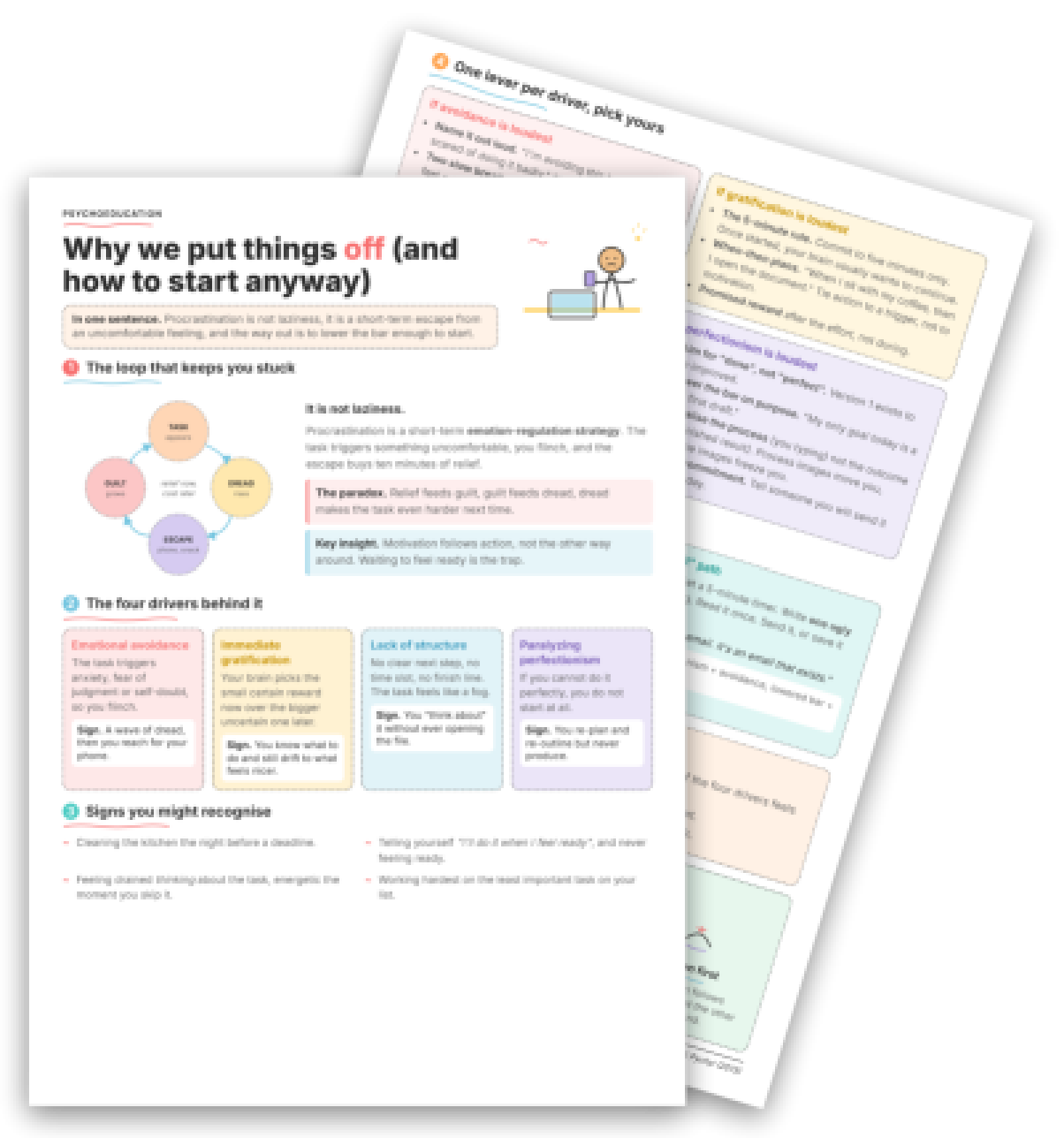
Patients who procrastinate rarely lack insight into the pattern. What they lack is a functional model of why it persists despite full awareness. This fiche PDF on procrastination gives you a visual structure to make that mechanism concrete in session, shorten the psychoeducation phase, and send the patient home with a map rather than just advice.
Use this resource with your patients
Handout, exercises and materials ready to use, right inside SessionFuel.
Why Procrastination Stays Slippery When Explained Verbally
The standard oral explanation, "you're avoiding discomfort," tends to land as an accusation rather than a mechanism. The patient agrees, feels momentarily understood, and returns the following week with the same pattern intact. The gap between insight and behavior change is precisely where a shared visual model earns its place.
The difficulty is compounded when the primary driver is paralyzing perfectionism rather than simple emotional avoidance. Patients who are stuck because they cannot bear producing imperfect work rarely identify as procrastinators at all; they see themselves as thorough or demanding. Without a diagram that names their specific pattern, they leave session still confusing freezing with laziness. The same confusion arises in presentations dominated by all-or-nothing thinking, where the cognitive distortion and the avoidance behavior reinforce each other invisibly.
For patients whose procrastination is maintaining a broader clinical picture, such as adaptive versus maladaptive coping patterns or ongoing motivational loss, an oral explanation of the cycle rarely produces traction on its own.
What the Fiche Contains: A Visual Map Clinicians Can Walk Through in Session
The fiche PDF opens with a five-node avoidance loop, rendered as a diagram: TASK appears → DREAD rises → ESCAPE (phone, snack) → GUILT grows → relief now, cost later. Seeing the cycle drawn out lets the patient locate their own entry point rather than hearing about the cycle in the abstract. Some arrive at the DREAD node; others present already anchored in GUILT. The visual makes that distinction immediate and discussable.
The second panel names four drivers with concrete behavioral signs:
- Emotional avoidance: a wave of dread before reaching for the phone
- Immediate gratification: drifting toward what feels nicer even when the next step is clear
- Lack of structure: "thinking about" the task without ever opening the file
- Paralyzing perfectionism: re-outlining endlessly without producing anything
The specificity of these behavioral signs is clinically useful: patients recognize themselves without feeling categorized.
The fourth panel offers one lever per driver, written for practical application. For gratification-driven patterns: the 5-minute rule and when-then plans. For structural deficits: time-blocking and micro-step decomposition. For perfectionism: "lower the bar on purpose" and process visualization over outcome visualization. A concrete scene comparison (the avoidance path versus the "ugly draft" path on the same email task) shows the mechanics in action. The fiche closes with a "To discuss in session" prompt list, which turns the take-home into structured preparation for the next appointment and gives you a ready-made debrief entry point.
> To keep in mind: this fiche is a visual support that facilitates the explanation in session; the avoidance loop diagram and the four-driver grid give the patient a shared clinical vocabulary and a concrete reference they can return to, not a self-assessment questionnaire to fill out alone.
750+ clinical tools
A library built with and for clinicians, ready to use in session and extend between appointments.
Access all the toolsWhen and How to Introduce the Fiche in Practice
The fiche fits naturally from the second or third session, once the presenting complaint is established and the alliance is solid. It is particularly productive when the patient has already named a pattern without being able to shift it, or when behavioral avoidance is maintaining a broader presentation, such as depression and situational avoidance, social anxiety, or a lack of self-control schema.
A low-threshold introduction: "I'd like to show you a diagram of what tends to happen when we put things off, and see whether any part of it looks familiar." This frames the fiche as exploratory, not prescriptive, and sidesteps the implicit accusation embedded in purely verbal explanations.
After walking through the loop and the four drivers together, ask the patient which driver feels loudest this week, and which specific lever they want to test on which specific task. This debrief generates a micro-behavioral commitment without requiring a full behavioral activation protocol or a complete goal-setting exercise. For patients where perfectionism is the primary driver, the fiche connects naturally to perfectionism-focused CBT work. For those where structure and habit are the bottleneck, it pairs well with building new habits or the Eisenhower priority matrix. The companion procrastination guided exercise works as a structured between-session homework follow-up once the patient has the conceptual map in hand.
A limit worth noting: for patients with significant executive functioning difficulties, ADHD, or severe anhedonia, the fiche provides useful psychoeducation but will not substitute for more intensive behavioral scaffolding. Use it as an entry point, not an endpoint.
Use it with your patients
Share this tool in the mobile app and follow the work between sessions.
Sources
- Pychyl, T. A. (2013). Solving the Procrastination Puzzle: A Concise Guide to Strategies for Change. Jeremy P. Tarcher / Penguin.
Your session continues in your patients' pocket
Use with a patientYour resources, available everywhere
The handouts, exercises, programs and audios above: you choose which ones to make available to your patients, in the mobile app dedicated to them.
And far more than a library
The app goes well beyond resources, to support your patients every day:
Related categories
Explore other clinical resources by category.
Anxiety
Clinical hub for anxiety disorders: CBT and ACT worksheets, psychoeducation sheets, and exercises for assessment and treatment across the anxiety spectrum.

Emotions
Clinical resources on emotion regulation: worksheets, coping tools, CBT, REBT, and ACT exercises for therapists working across diagnoses and age groups.

Behaviours
Clinical hub for behaviors in therapy: worksheets and tools for coping, eating disorders, CBT formulation, and maladaptive behavioral patterns.

Cognition
Printable cognitive therapy worksheets and clinical tools for therapists: CBT, ACT, schema work, defusion, distortions, and belief restructuring.

Understand
Clinical hub for the therapeutic aim 'Understand': worksheets and tools to build patient insight across CBT, ACT, schema therapy and more.

Build awareness
Clinical worksheets and tools to build awareness in therapy: cognitive distortions, schemas, emotions, ACT and CBT resources for practitioners.