
A., a 34-year-old professional referred for generalised anxiety, reported repeatedly avoiding the preparation of a quarterly report, describing a weeks-long cycle of guilt and avoidance. The clinician introduced the five-question exercise as between-session homework, asking A. to work through each prompt in writing before the next appointment. At question two, A. noted that her self-appraisal ('I am lazy and incompetent') was sustaining the paralysis rather than motivating action; recognising this shift was, by her account, the most useful moment of the exercise. By question four she had broken the report into four sub-tasks and identified a single 20-minute step she could complete that evening. At the following session she reported having completed that step and, on that basis, continued with the remaining sub-tasks across the week.
Procrastination: A Structured Guided Exercise for Clinicians
A five-question autonomous homework tool helping patients name the stuck task, challenge self-criticism, and commit to one concrete first step.
Clinical vignettes
Naming the Task, Easing the Block
Reconnecting Task to Broader Goal
M., a 28-year-old doctoral student presenting with low mood and chronic task avoidance, had delayed submitting a chapter draft for several months and expressed a sense that the work 'no longer meant anything.' During a session the clinician walked through the exercise questions aloud with M., pausing at question three to explore how the chapter connected to his longer research goal and his original reasons for enrolling in the programme. This reframing shifted his stated stance from 'pointless burden' to 'one step in something I chose.' He identified revising a single paragraph, estimated at under 30 minutes, as the immediate sub-task, and agreed to allow himself a short walk as a self-set reward on completion. He returned the following week having submitted a partial draft, noting that the reward structure felt 'less childish than expected.'
Why procrastination is harder to shift than it looks
Procrastination rarely presents as laziness. What clinicians actually see is a tangle of avoidance, self-critical rumination, and task overwhelm that patients have often been trying to willpower their way through for years. Explaining the mechanism verbally in a consultation helps to a point, but words alone rarely produce the behavioural shift. The patient leaves the session nodding and returns the following week with the same task still untouched.
Part of what makes procrastination so sticky is that patients tend to get caught in two loops simultaneously: the cognitive loop of harsh self-judgment ("I'm lazy, I'll never change") and the practical loop of staring at an undifferentiated task that feels impossible to start. Neither loop responds well to general advice. What patients need is a structured moment of guided reflection, done on their own, close enough to the stuck situation to feel real. The Procrastination: PDF Worksheet, Tools and Exercises for Clinical Practice gives you a psychoeducation anchor for the avoidance loop itself; this exercise then becomes the applied follow-through.
Use this resource with your patients
Handout, exercises and materials ready to use, right inside SessionFuel.
What the exercise contains
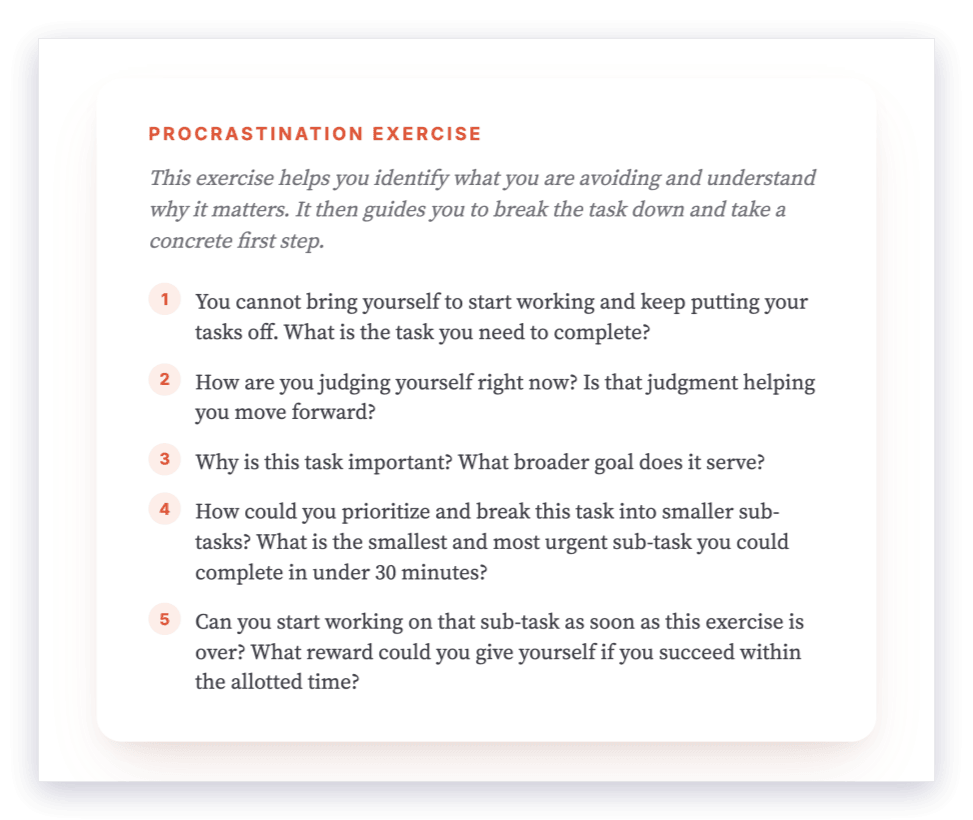
The exercise moves through five questions in a deliberate clinical sequence. The first question grounds the patient in a specific, named task, rather than the vague sense of "things I'm not doing." The second question brings self-judgment directly into view: the patient is asked how they currently evaluate themselves, and whether that evaluation is actually helping them move forward. This is the pivot, because it surfaces the self-critical voice without the clinician having to name it first.
The third question shifts register entirely: the patient reconnects with the deeper purpose the task serves, anchoring it to a goal that genuinely matters. This is the values-clarification move, related to what you might explore with Exploring Values: PDF Worksheet, Tools and Exercises for ACT Practice or SMART Goals: PDF Worksheet, Tools and Exercises for Clinical Practice in other parts of the work.
Questions four and five are purely operational. The patient is asked to break the task into sub-tasks and identify the smallest urgently manageable piece, completable in under 30 minutes. The final question adds a self-reinforcement element: the patient defines a concrete reward contingent on completing that micro-task immediately after finishing the exercise. This sequence mirrors the task-decomposition logic found in the Eisenhower Urgency-Importance Matrix and connects naturally to the behavioral scaffolding in Healthy Habit Plan: PDF Worksheet, Tools and Exercises.
The image above lists the five questions in order with a short patient-facing introduction. This image is a static preview only: the patient does not interact with it. The full guided experience, with space to write, patient-facing instructions at each step, and a comfortable mobile interface, is what the patient actually encounters when they complete the exercise on their own in the app.
This exercise is available to patients directly through the patient mobile application of SessionFuel: the clinician assigns it as homework, and the patient completes it autonomously on their phone between two consultations, at the moment that is most relevant for them.
Key insight: The clinical leverage of this exercise lies not in the task itself but in the sequence: naming the task, catching the self-judgment, reconnecting to meaning, then committing to a sub-30-minute action. That order is deliberate and mirrors the structure of effective behavioral activation.
750+ clinical tools
A library built with and for clinicians, ready to use in session and extend between appointments.
Access all the toolsUse it with your patients
Share this tool in the mobile app and follow the work between sessions.
How to integrate it as between-session homework
This exercise suits patients who acknowledge the procrastination pattern but feel stuck when it comes to translating insight into action. It works well across anxiety, depression, ADHD presentations, and perfectionism, particularly where Changing Avoidance: PDF Worksheet, Tools and Exercises for Clinical Practice has already established a shared language around the avoidance loop.
Introduce it when a patient mentions a specific task they have been putting off. You do not need to spend long on it in the consultation: name the exercise, explain that it will walk them through a structured reflection on their own, and ask them to complete it between sessions, ideally the next time they notice the urge to defer the task again.
When they return, the material they have produced becomes clinically rich. The self-judgment recorded in question two often reveals automatic thoughts worth exploring with Stop Overthinking: PDF Worksheet, Tools and Exercises for Clinical Practice or the Accepting Mistakes: A Guided Self-Compassion Exercise. The reward the patient chose in question five tells you a great deal about their self-permission patterns. Whether they actually completed the micro-task is almost secondary: the attempt, the obstacles, and the feeling afterward are the clinical content.
For patients where motivation is the deeper issue, pair this exercise with the Motivational Dip: A Guided Five-Question Clinical Exercise or Goal-Setting and Motivation: A Guided Clinical Exercise. For patients where the avoidance is tied to perfectionism, the Evaluating Demanding Standards: PDF Worksheet, Tools and Exercises opens the longer-term schema work. The Weekly Behavioral Review: A Self-Monitoring Exercise for Clinicians can then serve as an ongoing accountability structure once the initial inertia has broken.
Your session continues in your patients' pocket
Use with a patientYour resources, available everywhere
The handouts, exercises, programs and audios above: you choose which ones to make available to your patients, in the mobile app dedicated to them.
And far more than a library
The app goes well beyond resources, to support your patients every day:
Related categories
Explore other clinical resources by category.

Behaviours
Clinical hub for behaviors in therapy: worksheets and tools for coping, eating disorders, CBT formulation, and maladaptive behavioral patterns.

Build skills
Skill-building resources for clinicians: printable worksheets and exercises for coping, assertiveness, and communication skills training in therapy.

Engage & motivate
Clinical hub: printable worksheets and exercises to build therapeutic engagement and motivation across ACT, CBT, and integrative practice. For clinicians.

ACT
Clinical hub for Acceptance and Commitment Therapy (ACT): worksheets, exercises, programs and audio resources for practitioners using the ACT model.

CBT
CBT worksheets, cognitive restructuring exercises & behavioral tools for clinicians. Evidence-based resources for every phase of cognitive behavioral therapy.

Anxiety
Clinical hub for anxiety disorders: CBT and ACT worksheets, psychoeducation sheets, and exercises for assessment and treatment across the anxiety spectrum.