
Clinical picture. T., a man in his mid-forties, presents with a moderate depressive episode marked by pronounced anergia and a near-total collapse of daily structure. He reports repeated failed attempts to establish a morning walk, each relying on an alarm and an act of will he describes as "empty." The clinician introduces the habit-stacking worksheet, asking T. to identify one anchor that survives his worst mornings; he names making coffee, which he does automatically regardless of mood. Together they build the formula: After I pour my morning coffee, I will put on my walking shoes and step outside for two minutes. At the following session T. reported having completed the stack on five of seven days, noting that the shoes cue alone felt less demanding than any previous approach.
Healthy Habit Plan: PDF Worksheet, Tools and Exercises
A printable PDF worksheet and visual psychoeducation tool helping clinicians explain habit stacking, reduce willpower dependence, and build durable behavioral change with patients.
Clinical vignettes
Habit Stack for Low-Motivation Depression
Stacking Medication Adherence onto an Existing Ritual
Clinical picture. M., a woman in her early thirties with bipolar II disorder, has a documented pattern of inconsistent evening medication intake, particularly during high-demand work periods when willpower is depleted by the end of the day. The clinician used the habit-stacking sheet to map her existing night-time anchors and M. identified placing her phone on charge as the most reliable one. The agreed stack was: After I place my phone on the charger, I will take my medication. The clinician noted the gap between anchor and new behavior was under ten seconds and required no additional decision. Over four weeks M. reported only two missed doses, a marked improvement from her baseline, and attributed the change to no longer relying on a reminder she could dismiss.
Telling a patient to "build a new habit" rarely produces anything useful. Without a concrete mechanism, the instruction evaporates between sessions. This Healthy Habit Plan fiche PDF gives you a visual psychoeducation tool to explain habit stacking in session, in a way that actually sticks.
Use this resource with your patients
Handout, exercises and materials ready to use, right inside SessionFuel.
Why Habit Stacking Is Hard to Convey Verbally
The core difficulty is that most patients arrive with an implicit willpower model of behavior change: motivation rises, action follows, habit forms. That model is wrong, and you know it, but correcting it in conversation alone tends to bounce off. Patients nod, then try to do "five new things from Monday," fail by Wednesday, and return with reinforced self-blame.
The deeper problem is conceptual: the idea of anchoring a new behavior to an existing automatic routine requires the patient to see two behaviors in relation, not just hear about them. When you describe this verbally, patients struggle to identify their own anchors, they underestimate how small the new habit should be, and they miss the critical timing and proximity constraints (what the fiche calls "the bridge") that determine whether the stack will hold.
This is exactly the gap the fiche PDF closes.
> To retain: the fiche is a visual support that facilitates the explanation of habit stacking in session; it gives the patient a concrete reference to take away, not a solo worksheet to complete.
What the Fiche Contains
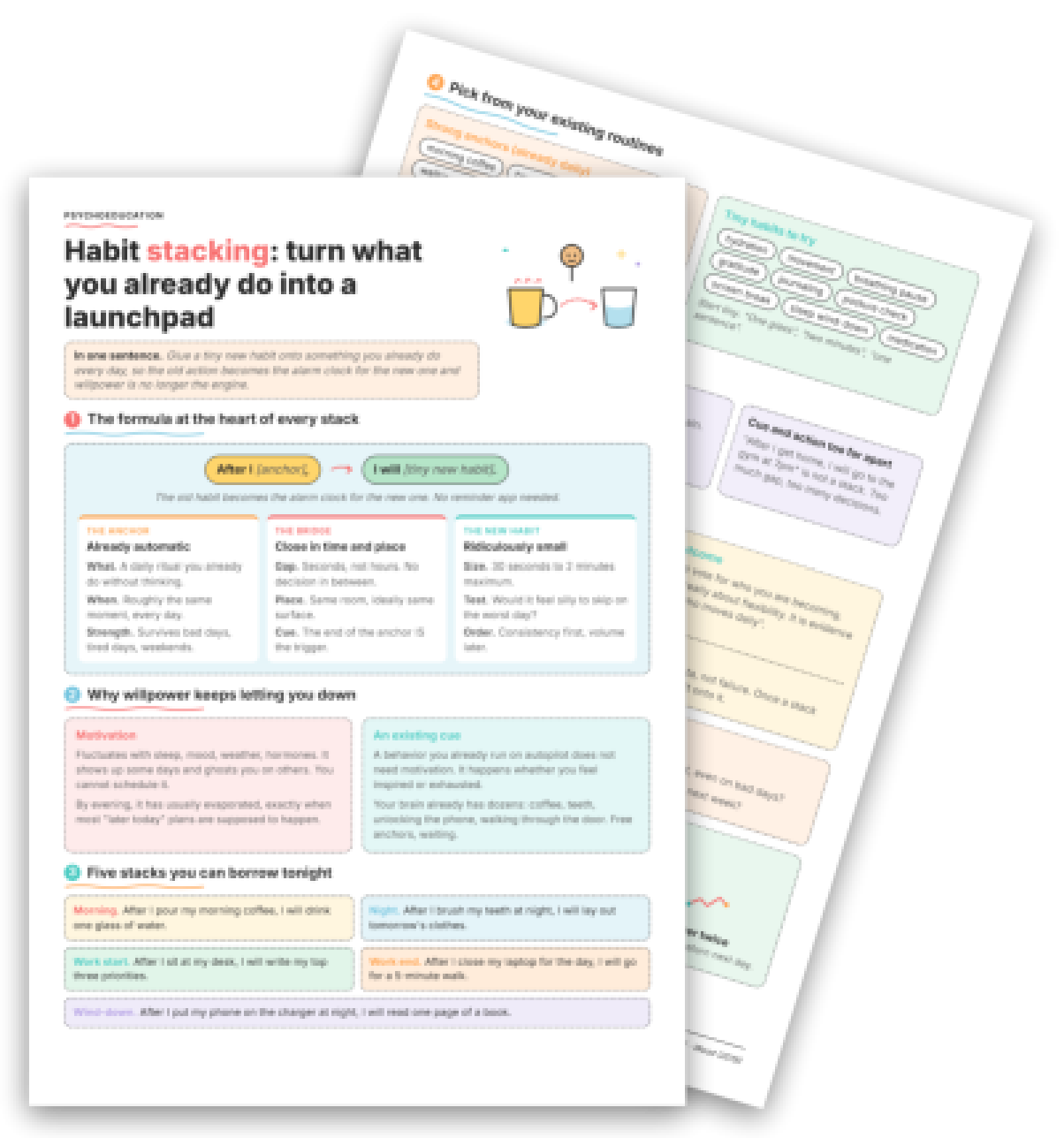
The printable is structured across six numbered panels, each targeting a specific piece of the clinical explanation.
Panel 1 presents the core formula in large format: "After I [anchor], I will [tiny new habit]." Having this visible on the table as you work lets you point to each component rather than paraphrase it, and immediately grounds the session in actionable language.
Panel 2 unpacks why willpower fails, contrasting motivation (described in the fiche as something that "shows up some days and ghosts you on others") with existing behavioral cues that fire regardless of energy or mood. This reframe is clinically valuable in any presentation involving low motivation, including behavioral activation for depression or the early phases of building new habits with anxious patients.
Panels 3 and 4 provide ready-made examples and categorized anchor lists: strong anchors (morning coffee, brushing teeth, closing the laptop) versus weak ones ("when I have time"). This visual contrast does in five seconds what a verbal explanation takes two minutes to achieve. For patients who struggle to self-identify routines, this list functions as a scaffold, useful alongside a current activity inventory if you want to map the behavioral landscape first.
Panel 5 is a troubleshooting grid covering the three most common reasons stacks fail: the anchor is not actually daily, the new habit is too large, or the temporal gap between anchor and action is too wide. You can work through this live when a patient reports that a stack "didn't work," making the session immediately corrective rather than generic.
Panel 6 addresses chain maintenance and identity, introducing the "never miss twice" rule and a brief values-based frame ("each tiny stack is a vote for who you are becoming"). Four end-of-week reflection questions close the fiche, supporting between-session self-monitoring without requiring a separate homework tool.
For patients struggling with procrastination or loss of motivation, this identity reframe often carries more therapeutic weight than the behavioral formula alone.
750+ clinical tools
A library built with and for clinicians, ready to use in session and extend between appointments.
Access all the toolsWhen and How to Introduce the Fiche
The fiche fits most naturally from the second or third session onward, once you have a baseline picture of daily routines and current behavioral patterns, ideally after using something like a behavioral activation activity menu or completing a goal-setting exercise.
It is particularly indicated in presentations where breaking an entrenched maladaptive habit is part of the treatment target, and in any context where patients have repeatedly failed at self-initiated behavior change and are attributing that failure to personal deficiency.
A neutral introduction works well: "I want to show you something about how habits actually form, because the way most people try to build them is set up to fail." Place the fiche on the table and walk through Panel 1 together. Ask them to name three things they already do every day without thinking before you propose any new behavior.
Debrief in the following session using Panel 5 as a diagnostic. If the stack held, grow it gently. If it did not, the troubleshooting grid nearly always identifies the specific mechanical failure. Pair with a structured weekly review if you want sustained monitoring across multiple weeks.
For patients with automatic avoidance and behavioral shutdown, the fiche's emphasis on ridiculously small starting behaviors is a clinical asset, not a simplification. The fiche does not replace case formulation; it makes one specific component of behavior change legible, repeatable, and reviewable between sessions.
Use it with your patients
Share this tool in the mobile app and follow the work between sessions.
Sources
- Fogg, B. J. (2019). Tiny Habits: The Small Changes that Change Everything. HarperCollins.
- Clear, J. (2018). Atomic Habits: An Easy and Proven Way to Build Good Habits and Break Bad Ones. Avery / Penguin Random House.
- Clear, J. (2020). Habit Stacking: How to Build New Habits by Taking Advantage of Old Ones.
Your session continues in your patients' pocket
Use with a patientYour resources, available everywhere
The handouts, exercises, programs and audios above: you choose which ones to make available to your patients, in the mobile app dedicated to them.
And far more than a library
The app goes well beyond resources, to support your patients every day:
Related categories
Explore other clinical resources by category.

Mood
Evidence-based worksheets and clinical tools for mood disorders: CBT, ACT, and positive psychology resources for psychologists and therapists.

Emotions
Clinical resources on emotion regulation: worksheets, coping tools, CBT, REBT, and ACT exercises for therapists working across diagnoses and age groups.

Behaviours
Clinical hub for behaviors in therapy: worksheets and tools for coping, eating disorders, CBT formulation, and maladaptive behavioral patterns.

Transitions
Clinical hub for life transitions: tools, worksheets and exercises to support psychosocial adjustment, role change and identity work in practice.

Health
Somatic health clinical resources for practitioners: worksheets, psychoeducation, and exercises for somatic symptom disorder, chronic pain, and more.

Build skills
Skill-building resources for clinicians: printable worksheets and exercises for coping, assertiveness, and communication skills training in therapy.