
Clinical picture. T., a man in his early forties, presents with a moderate depressive episode and reports feeling "always busy yet never productive." Between sessions, his clinician assigns the Current Activity Inventory: he is asked to list everything occupying his time, rank the items from most to least time-consuming, and mark each as something to reduce or increase. T. returns the following week having written eleven activities; passive screen use tops the list by a wide margin, while contact with friends and physical activity appear near the bottom, both flagged for increase. The completed inventory gives the dyad a concrete, shared starting point for behavioral activation planning rather than relying on T.'s vague retrospective account.
Current Activity Inventory: A Behavioral Time Audit Tool
Help patients rank their daily activities by time spent and identify what to reduce or increase, as structured autonomous homework between sessions.
Clinical vignettes
Mapping Avoidance Through Time Audit
Clarifying Overload in Burnout Presentation
Clinical picture. M., a woman in her mid-thirties referred for work-related exhaustion, describes her days as fragmented and hard to articulate. Her clinician introduces the Current Activity Inventory as structured homework, asking her to rank her daily activities by actual time spent and to note beside each whether it should be reduced or increased. M. completes the exercise and is surprised to find that work-related tasks, including email management outside office hours, account for the top four positions on her list, while rest and leisure activities are absent entirely. The visual ranking makes the imbalance legible to her in a way that verbal description had not, and she arrives at the next session with her own initial ideas about one item she could realistically reduce.
The clinical need: when behavior is invisible to the patient
Many patients arrive at consultations with a vague sense that "something is off" in how they spend their days, yet they struggle to articulate exactly what. Asking a patient to describe their daily activity load in verbal terms often produces an incomplete, emotionally colored account rather than a clear picture. Selective attention, cognitive distortions, and emotional weight all distort the verbal inventory a patient offers on the spot.
This difficulty is especially pronounced in depression, burnout, and chronic avoidance, where the balance between activating and depleting behaviors has quietly tilted without the patient noticing. The clinician needs a concrete, structured snapshot of how the patient's time is actually distributed, not a reconstructed narrative filtered through shame or exhaustion. Without that foundation, behavioral prescriptions risk targeting the wrong priorities entirely. Tools like the Positive Activities List and the Activity Menu for Behavioral Activation are powerful, but they presuppose that both patient and clinician share an accurate baseline picture of current time use. This exercise provides exactly that baseline.
Use this resource with your patients
Handout, exercises and materials ready to use, right inside SessionFuel.
What the exercise contains
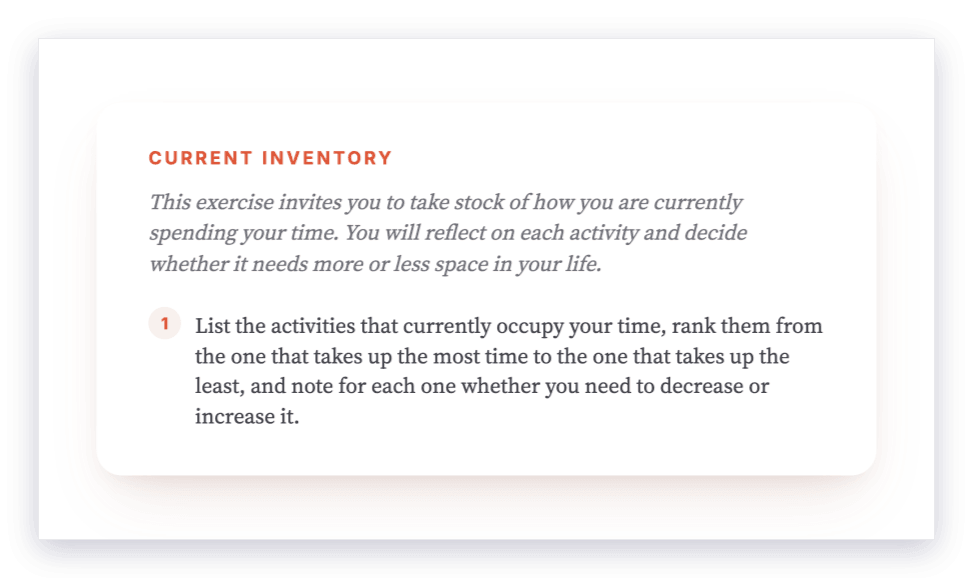
The exercise rests on a single, precise instruction: list every action currently occupying the patient's time, rank those actions from the most time-consuming to the least, and explicitly note, for each one, whether it should be decreased or increased. That last step is the clinical lever. Ranking forces concreteness and relative comparison, two operations that bypass vague self-report. Adding a decrease/increase judgment for each item transforms a passive inventory into an active appraisal, calling on the patient's own values and goals rather than on clinician interpretation alone.
The image above is a static preview of the exercise question as it appears in this article. The actual guided exercise, complete with patient-facing instructions and space to write answers, is experienced by the patient directly in the app, on their own, not in this image.
This exercise is available to your patients through the SessionFuel patient app, the dedicated mobile interface for patients of clinicians who use SessionFuel: you assign it to your patient from your SessionFuel account, and they complete it directly on their phone, at their own pace, between consultations.
Key insight: A ranked, judgment-tagged activity list gives you both a behavioral map and a window into the patient's own theory of change before any clinician framing has shaped it.
750+ clinical tools
A library built with and for clinicians, ready to use in session and extend between appointments.
Access all the toolsUse it with your patients
Share this tool in the mobile app and follow the work between sessions.
Integrating it as between-session homework
This exercise suits a wide range of presentations: depression with behavioral withdrawal, burnout with dysfunctional overengagement, work-life imbalance, and any patient who reports feeling overwhelmed or stuck without being able to say why. It is also a natural first step before assigning more targeted tools such as Weekly Activity Scheduling, Breaking Action Inertia in Depression, or the Work-Life Balance self-assessment.
Introduce it simply: tell the patient that before the next session you want a clear picture of how their time is actually organized, not how it should be, and that they will sort and evaluate each item themselves. This framing reduces performance anxiety and positions the patient as the expert on their own life, which supports therapeutic alliance.
When the patient returns with their completed inventory, the material is immediately usable. Which activities occupy the most time? Are those the same ones the patient has flagged for decrease? Discrepancies between time invested and desired direction reveal implicit avoidance, duty-driven behavior, or unexamined habits worth exploring. A patient who lists professional obligations as dominant and recreational activities as absent has handed you a ready entry point for Finding Motivation for Change or Goal-Setting and Behavior Change. A patient who tags most high-time activities for decrease but has no plan for what would replace them signals the kind of avoidance pattern addressed in Situational Avoidance in Depression.
The inventory also pairs naturally with progress-monitoring across the treatment: reassigning it several weeks later and comparing the two lists makes behavioral change concrete and visible, which supports the work done with tools like Weekly Behavioral Review or Celebrating Small Victories in Depression. For patients in burnout contexts, combining it with Identifying Patient Growth Axes or a Professional Life Assessment deepens the clinical picture considerably.
Your session continues in your patients' pocket
Use with a patientYour resources, available everywhere
The handouts, exercises, programs and audios above: you choose which ones to make available to your patients, in the mobile app dedicated to them.
And far more than a library
The app goes well beyond resources, to support your patients every day:
Related categories
Explore other clinical resources by category.

Mood
Evidence-based worksheets and clinical tools for mood disorders: CBT, ACT, and positive psychology resources for psychologists and therapists.

Identity
Clinical resources for self-identity work in therapy: CBT, ACT, schema tools for clinicians addressing self-concept, core beliefs, and identity disruption.

Behaviours
Clinical hub for behaviors in therapy: worksheets and tools for coping, eating disorders, CBT formulation, and maladaptive behavioral patterns.

Transitions
Clinical hub for life transitions: tools, worksheets and exercises to support psychosocial adjustment, role change and identity work in practice.

CBT
CBT worksheets, cognitive restructuring exercises & behavioral tools for clinicians. Evidence-based resources for every phase of cognitive behavioral therapy.

Anxiety
Clinical hub for anxiety disorders: CBT and ACT worksheets, psychoeducation sheets, and exercises for assessment and treatment across the anxiety spectrum.