
Clinical picture. T., a man in his early forties, presented with low mood and social withdrawal following an unexpected redundancy eight months prior. He described a pervasive sense of being a burden, framing it as a personal truth rather than a reaction to circumstance. The clinician introduced the structured exercise, inviting T. to consider whether external events, specifically the abrupt job loss and prior workplace bullying, might account for the belief rather than reflect his actual worth. When asked to name three recent sources of pride, T. initially struggled, then cited helping a neighbor, finishing a home repair, and attending his daughter's school event; this shift in focus produced a small but noticeable loosening of affect. By the final question, he identified one concrete action, resuming a weekly volunteer role he had abandoned, framing it as something he could do alongside the discomfort rather than waiting for it to resolve.
Feeling Useless: A Guided Cognitive and Behavioral Exercise
A structured homework tool helping patients distinguish the thought "I am useless" from fact, name its emotional weight, and commit to concrete action.
Clinical vignettes
Redundancy and the Uselessness Belief
Postpartum Withdrawal and Guided Reappraisal
Clinical picture. M., a woman in her late twenties, was referred six weeks after giving birth with depressive symptoms centered on the recurrent thought that she was failing as a mother and contributing nothing of value. During the session, the clinician used the exercise to help her label the thought as a cognitive event, not a diagnosis of her character, and to trace its roots to a history of academic pressure and early parental criticism. She identified shame and exhaustion as the dominant emotions, noting relief simply at having named them. The question about acting alongside difficult feelings, rather than waiting for them to lift, reoriented the discussion toward one feasible step: texting a close friend to arrange a short walk, which she rated as manageable even on low-energy days.
The Clinical Challenge: When Uselessness Feels Like a Verdict
The felt sense of being useless is deceptively resistant to direct challenge. Patients arrive with a belief disguised as a fact, and standard Socratic dialogue can feel thin when the sense of worthlessness is rooted in actual history, harassment, repeated failure, chronic pressure, or early trauma. Words in the consulting room are quickly overwritten by the same internal monologue waiting at home.
Three specific difficulties recur. First, patients often cannot distinguish between feeling useless and being useless; the emotion functions as proof. The Fact or Opinion worksheet and the Fact or Interpretation CBT worksheet are useful companion tools here, but they require an internal consolidation that takes time. Second, the emotional layer is often unnamed: shame, sadness, and discouragement collapse into a single gray mass labeled "uselessness." Third, motivation, or its absence, becomes a precondition rather than a consequence of action, trapping patients in passive waiting. The Depression and Behavioral Activation exercise addresses this directly, and the present exercise follows a parallel logic.
This is precisely where a structured between-session written exercise earns its place.
Use this resource with your patients
Handout, exercises and materials ready to use, right inside SessionFuel.
What the Tool Contains
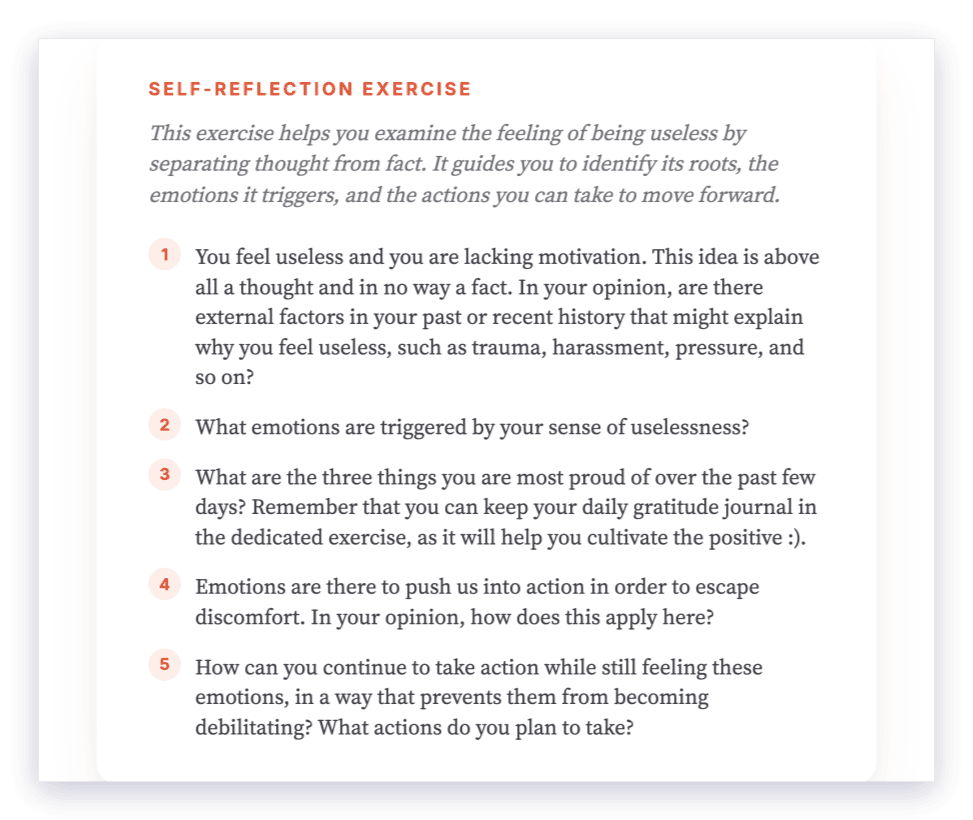
The exercise moves through five targeted questions, grounded in a CBT framework that treats "I am useless" as an automatic thought to be examined, not a situation to be accepted.
Note: this image is a static preview of the question list only. The full guided exercise, with patient-facing instructions, context, and space to write, is experienced by the patient autonomously in the app, not in this image.
Question 1 invites the patient to identify the external contextual factors (trauma, harassment, prolonged pressure) that may have generated and maintained the uselessness belief, immediately reframing it as a product of circumstances rather than a personal truth. This mirrors the work done with tools like the Longitudinal Case Formulation (5 Ps) worksheet and connects naturally to early maladaptive schema psychoeducation.
Question 2 asks the patient to name the emotions triggered by that sense of uselessness, a necessary disaggregation step before any behavioral change becomes possible. The Emotion Wheel (114 Emotions) worksheet can support this naming work in parallel.
Question 3 redirects attention toward recent sources of pride, countering the negativity bias that selective attention feeds. The question explicitly references the patient's gratitude journal if they are already using one, a concrete integration of other work. The Positive Traits Checklist and the Celebrating Personal Successes exercise pair naturally here.
Question 4 introduces the functional role of emotion as an action prompt: emotions exist to move us out of discomfort, not to paralyze us. This directly echoes the Emotions Motivate Actions worksheet and opens the transition toward behavioral commitment.
Question 5 closes the loop with a concrete action plan: how to keep moving while the difficult emotions are still present, without waiting for them to disappear first. This is the ACT-informed core of the exercise, psychological flexibility made operational through a patient's own words.
This exercise is available to patients through the mobile application that is the dedicated patient-side interface of SessionFuel: once you assign it, your patient receives it directly on their phone and completes it on their own, between your appointments, at their own pace.
750+ clinical tools
A library built with and for clinicians, ready to use in session and extend between appointments.
Access all the toolsIntegrating It Into Your Practice
This exercise suits a broad but specific population: patients presenting with low self-esteem, depressive withdrawal, post-burnout identity loss, or chronic self-criticism, contexts where the uselessness belief is prominent but not yet delusional, and where the patient has enough reflective capacity to engage with written self-examination. It fits comfortably alongside the Self-Image and Self-Esteem program and the Feeling Not Good Enough exercise.
To introduce it, a simple framing works well: "Between now and next time, I'd like you to work through a series of questions about this sense of uselessness. The point is not to talk yourself out of it, but to look at what's feeding it and what you can still do with it." That framing removes the pressure to feel better immediately, which is usually what blocks action.
When the patient returns, the richest clinical material typically sits in Question 1 (what circumstances does the patient actually recognize?) and Question 5 (how concrete and realistic are the stated intentions?). The gap between a patient's emotional narrative in Question 2 and the pride they managed to identify in Question 3 is often itself the most productive moment to slow down and examine. You can use the CBT Cognitive Model worksheet to map what the patient has written onto the S-T-E-B chain, and the Five-Column Thought Record to carry the restructuring further if needed.
For patients who struggle to identify any recent pride at all, the I Am Unique exercise offers a complementary entry point. For those whose uselessness belief traces clearly to a schema, the Defectiveness / Shame Schema worksheet and the Failure to Achieve Schema fiche add useful depth. And when motivational inhibition is the dominant presentation, the Weekly Activity Scheduling exercise translates the commitments from Question 5 into a practical weekly structure.
Use it with your patients
Share this tool in the mobile app and follow the work between sessions.
A Note on Sequencing
This exercise works best once the patient understands, at least provisionally, that thoughts are not facts, a concept worth consolidating beforehand with the Automatic Thoughts worksheet or the Inner Self-Talk psychoeducation program. For patients who need more scaffolding around the emotion-action link before tackling Question 4, the DBT Emotion Regulation Skills worksheet provides a clear preparatory frame.
Key insight: The clinical value of this exercise is not that it resolves the sense of uselessness, it is that it interrupts the passivity loop: the patient stops treating the belief as a fact, names the emotional cost, locates recent evidence of worth, and commits to action that does not depend on feeling ready first.
Your session continues in your patients' pocket
Use with a patientYour resources, available everywhere
The handouts, exercises, programs and audios above: you choose which ones to make available to your patients, in the mobile app dedicated to them.
And far more than a library
The app goes well beyond resources, to support your patients every day:
Related categories
Explore other clinical resources by category.

Mood
Evidence-based worksheets and clinical tools for mood disorders: CBT, ACT, and positive psychology resources for psychologists and therapists.

Identity
Clinical resources for self-identity work in therapy: CBT, ACT, schema tools for clinicians addressing self-concept, core beliefs, and identity disruption.

Emotions
Clinical resources on emotion regulation: worksheets, coping tools, CBT, REBT, and ACT exercises for therapists working across diagnoses and age groups.

Behaviours
Clinical hub for behaviors in therapy: worksheets and tools for coping, eating disorders, CBT formulation, and maladaptive behavioral patterns.

Cognition
Printable cognitive therapy worksheets and clinical tools for therapists: CBT, ACT, schema work, defusion, distortions, and belief restructuring.

ACT
Clinical hub for Acceptance and Commitment Therapy (ACT): worksheets, exercises, programs and audio resources for practitioners using the ACT model.