
Clinical picture. A., a woman in her early 40s, presented with generalised anxiety and a longstanding pattern of harsh self-criticism that she described as constant background noise. Her clinician introduced Lesson 1 of the psychoeducation program between sessions, asking her to work through the guided prompts on recognising judgement before their next meeting. She returned having completed the multiple-choice question about what she had judged recently, noting with some surprise that her list included her own posture, a colleague's tone of voice, and the quality of her own work within a single morning. This moment of inventory did not resolve her self-critical tendency, but it shifted her stance from one of entanglement to one of observation, which gave the clinician a concrete basis for subsequent work on automatic appraisal patterns.
Judgment Psychoeducation: A 3-Lesson Self-Reflection Program
Help patients recognize automatic judgment, practice non-judgment, and rebuild their relationship with self-criticism step by step.
Clinical vignettes
Recognising Automatic Judgement in Anxiety
Labelling Others and Relational Strain
Clinical picture. T., a man in his mid-30s, sought consultation following a period of escalating conflict with family members; he reported feeling perpetually disappointed by people close to him. During the session following Lesson 1 of the program, he shared his written response to the prompt on labels, having identified three fixed characterisations he had applied to relatives over many years without previously noticing their rigidity. He acknowledged that these labels had shaped his expectations in ways that made neutral interactions feel like repeated failures. The clinician used his observations as an entry point into discussing how judgement functions as an automatic shortcut and how the subsequent lesson on non-judgement would offer structured practice rather than an instruction to simply stop evaluating.

Use this resource with your patients
Handout, exercises and materials ready to use, right inside SessionFuel.
The Clinical Challenge: When Judgment Runs on Autopilot
Judgment is among the most ubiquitous and underexamined cognitive processes clinicians encounter. Patients caught in cycles of anxiety, low self-esteem, or relational conflict are almost always operating inside a dense web of evaluative thinking directed at themselves, others, and their environment. The difficulty is not that they judge. Judgment is adaptive and biologically grounded. The problem is that the process has become automatic, rigid, and largely invisible to them.
Explaining this verbally is harder than it looks. Abstract notions like "non-judgment" tend to land as moral instruction rather than clinical skill. Patients need guided self-observation, repeated exposure to the concept, and structured practice before the idea becomes personally meaningful. This is precisely where words alone fall short, and where a structured step-by-step program fills the gap.
750+ clinical tools
A library built with and for clinicians, ready to use in session and extend between appointments.
Access all the toolsWhat the Program Contains
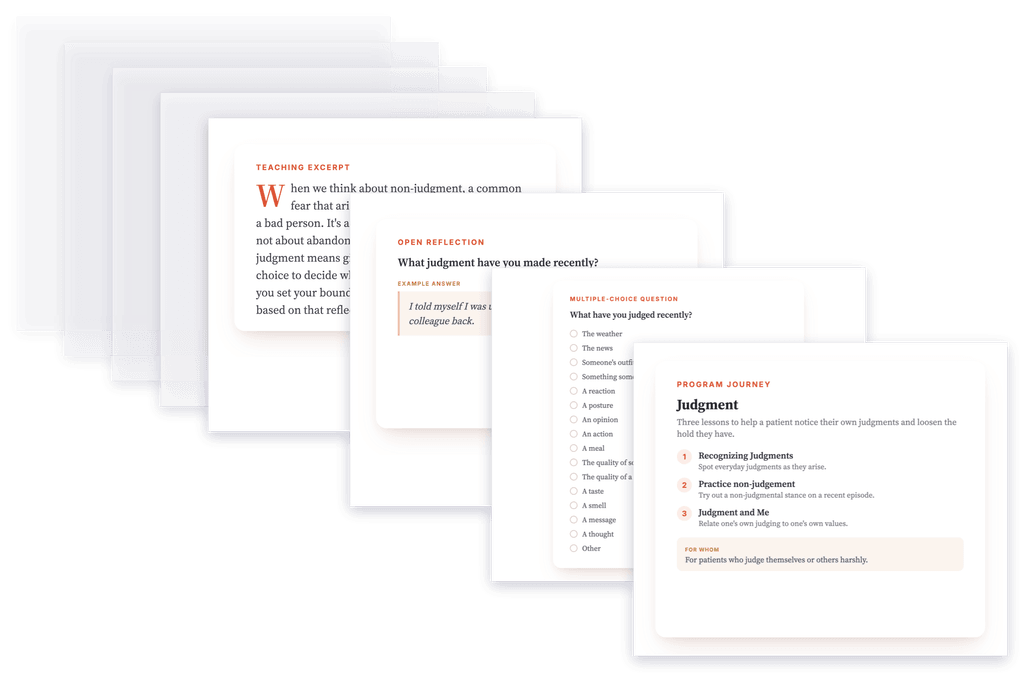
This is a three-lesson autonomous psychoeducation program built around a clear developmental arc, moving from recognition to practice to personal application.
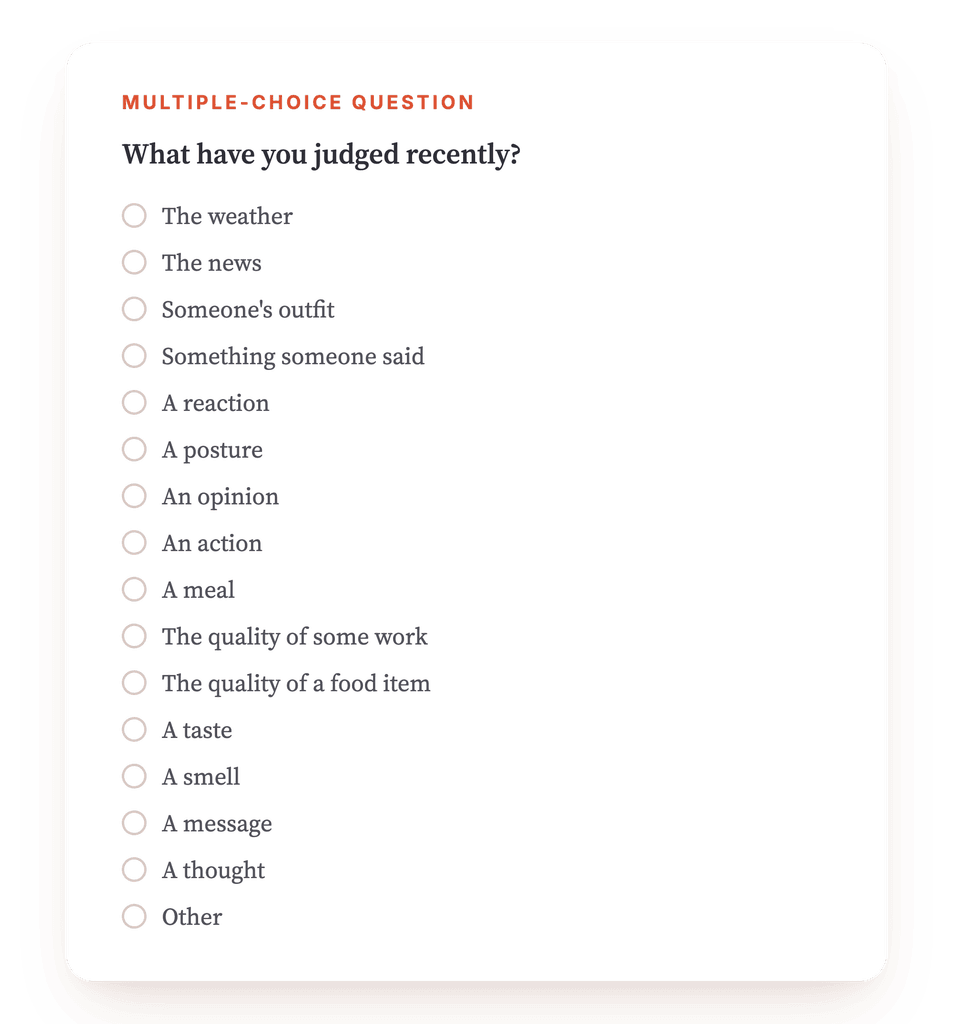
Lesson 1 - Recognizing Judgments opens the inquiry by helping patients understand what a judgment actually is, how it differs from simple observation, and how pervasive it is across daily life. Patients use multiple-choice prompts to reflect on recent judgments and the emotions those judgments triggered. The lesson introduces cognitive labels, the shorthand verdicts our minds apply to people and situations automatically. This connects naturally to clinical work on labeling as a cognitive distortion and the broader map of cognitive distortions.
Lesson 2 - Practicing Non-Judgment shifts from awareness to skill. Patients examine a specific recent judgment, interrogate its basis (facts, assumptions, projections), and assess whether it was actually necessary. The lesson introduces curiosity as an antidote to criticism and the benefit of the doubt as a concrete relational tool. This grounds easily in ACT-informed work on cognitive defusion and distancing and decentering.
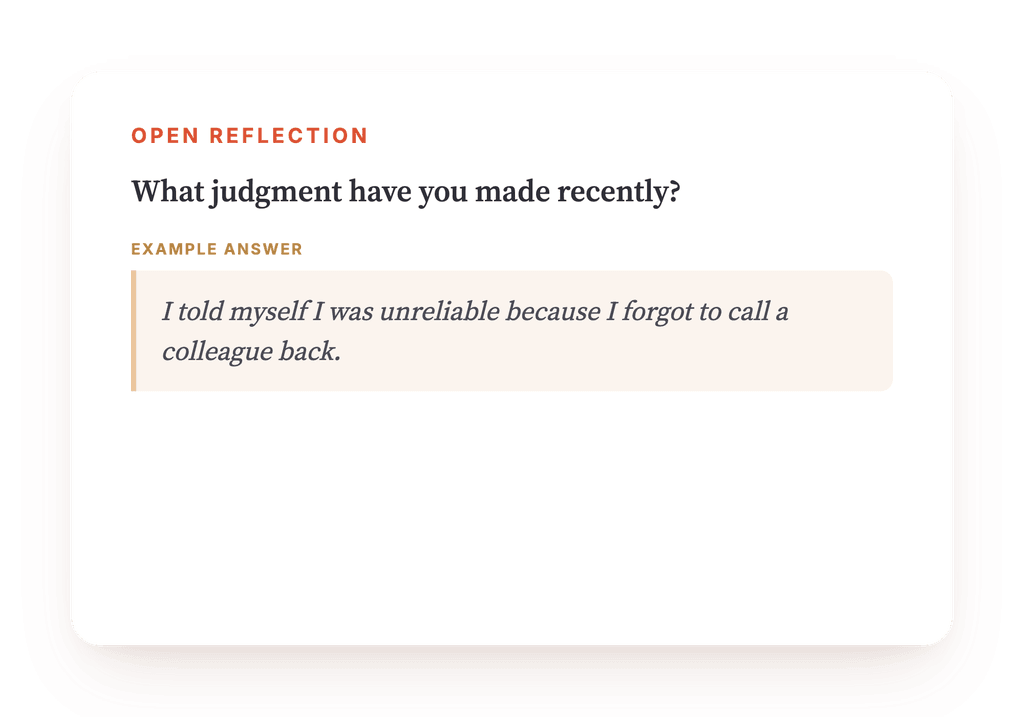
Lesson 3 - Judgment and Self turns the lens inward. Patients map the domains where self-criticism is most active and explore why self-judgment tends to be far harsher than judgments they would apply to others. Open prompts guide reflection on recent successes and failures, reframing the stance from verdict to appreciation, and from finality to growth. This lesson opens productive territory around self-blame, the inner dialogue, and a growth mindset.
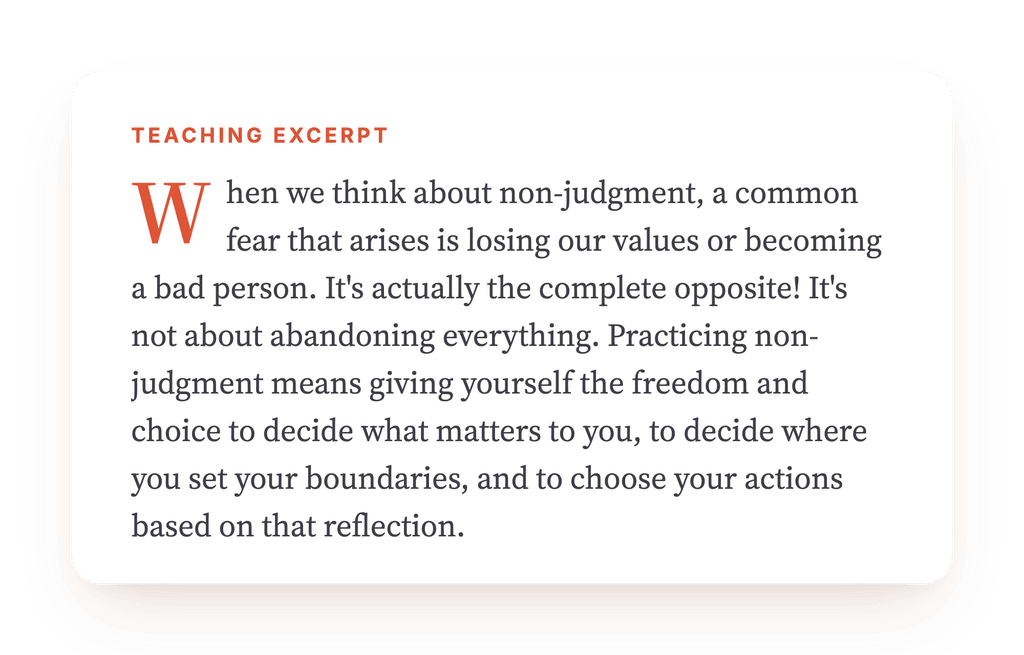
The preview images embedded here (an overview map and a couple of sample cards) show only a small fraction of the program. The complete curriculum contains many more steps, guided prompts, multiple-choice questions, and psychoeducation panels than what is visible in these excerpts.
This program is available to patients through the mobile application that is the dedicated patient-side interface of SessionFuel: once you assign it in SessionFuel, your patient completes each lesson directly on their phone, at their own pace, between your consultations.
Use it with your patients
Share this tool in the mobile app and follow the work between sessions.
Integrating the Program as Between-Session Homework
This program is designed as autonomous between-session work. You assign it as homework at the end of a consultation, and the patient moves through the three lessons independently before your next meeting.
Which patients benefit most? The program suits patients caught in rumination loops, perfectionism, or chronic self-criticism, as well as those whose relational difficulties are fuelled by rigid evaluative patterns. It also pairs well with early ACT work for patients beginning to explore psychological flexibility or acceptance-based approaches. For patients already working on automatic thoughts or core beliefs, this program provides a concrete, experiential complement.
How to introduce it: Frame it simply. "Between now and our next meeting, I would like you to work through a short program on how judgment operates in your daily life. There are three steps, and each one asks you to pause and reflect on real situations from your own experience." No prior knowledge of CBT or ACT is required.
What to do with what the patient brings back: The open prompts in Lessons 1 and 3 generate rich clinical material: how the patient judges themselves, which domains are most charged, what they notice after a recent success or failure. Use those responses as the starting point of your next consultation. They can open conversations about self-blame and personalisation, thought-emotion connections, or demanding standards that might otherwise take several consultations to surface organically.
Key insight: Because judgment is automatic and largely invisible, patients need structured self-observation before they can engage it clinically. This program builds that awareness lesson by lesson, and returns concrete, personally grounded material you can work with from the very next consultation.
Your session continues in your patients' pocket
Use with a patientYour resources, available everywhere
The handouts, exercises, programs and audios above: you choose which ones to make available to your patients, in the mobile app dedicated to them.
And far more than a library
The app goes well beyond resources, to support your patients every day:
Related categories
Explore other clinical resources by category.
Anxiety
Clinical hub for anxiety disorders: CBT and ACT worksheets, psychoeducation sheets, and exercises for assessment and treatment across the anxiety spectrum.
Trauma
Clinical hub on trauma and PTSD: assessment, differential diagnosis, treatment phases, and printable resources for practitioners. 155 chars.

Mood
Evidence-based worksheets and clinical tools for mood disorders: CBT, ACT, and positive psychology resources for psychologists and therapists.

Identity
Clinical resources for self-identity work in therapy: CBT, ACT, schema tools for clinicians addressing self-concept, core beliefs, and identity disruption.

Emotions
Clinical resources on emotion regulation: worksheets, coping tools, CBT, REBT, and ACT exercises for therapists working across diagnoses and age groups.

Behaviours
Clinical hub for behaviors in therapy: worksheets and tools for coping, eating disorders, CBT formulation, and maladaptive behavioral patterns.