
Clinical picture. M., a 34-year-old secondary school teacher, presents with generalised anxiety and reports spending several hours each day arguing internally with intrusive predictions about professional failure. During session five, the clinician introduces the defusion worksheet and walks M. through the "label the bucket" technique, inviting her to name each thought as a worrying thought or a predicting thought rather than treating it as reportage on reality. M. practises aloud, noticing a small but perceptible reduction in urgency as she sorts three recurring thoughts into their respective buckets. By the following session she reports using the technique independently on two occasions, describing the process as creating "a little gap" before she acted on an impulse to cancel a staff meeting. No claim is made about the frequency or content of the thoughts, which remained largely unchanged.
ACT Cognitive Defusion: PDF Worksheet, Tools and Exercises
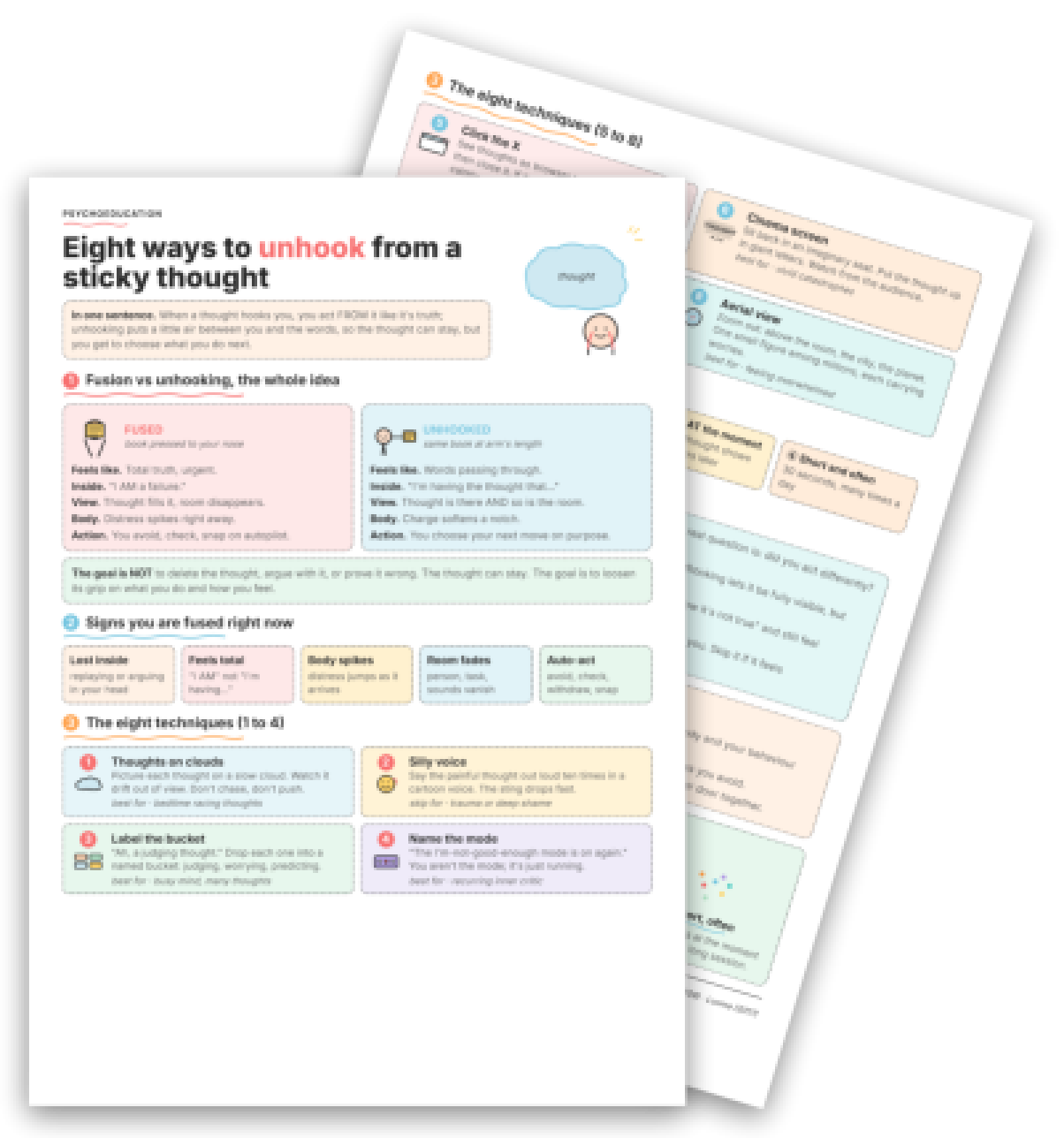
A visual PDF worksheet presenting eight defusion techniques, a fusion vs. unhooking comparison, and ready-made session prompts for ACT-informed practice.
Clinical vignettes
Labelling Thoughts in Chronic Worry
Defusion from Shame-Laden Self-Labels
Clinical picture. R., a man in his late forties referred following a depressive episode, describes a persistent fused belief stated as "I am worthless," which he reports experiencing as unambiguous fact rather than as mental content. The clinician introduces the distinction between "I am worthless" and "I am having the thought that I am worthless," drawing on the worksheet's fusion-versus-unhooking framework, and asks R. to practise the rephrased form slowly during the session. R. initially finds the exercise artificial, a reaction the clinician normalises without pressure, and they spend time comparing body-level responses to each version. Over two further sessions R. begins using the prefixed form spontaneously during check-ins, reporting that it occasionally allows him to stay in a conversation rather than withdrawing, though the thought itself continues to arise with some regularity.
Explaining cognitive defusion verbally often lands somewhere between vague and paradoxical: patients hear "just notice the thought" and either conflate it with suppression or redouble efforts to argue the thought away. This PDF worksheet on ACT cognitive defusion gives you a concrete visual anchor for one of ACT's most counter-intuitive moves, making the in-session explanation sharper and considerably shorter.
Use this resource with your patients
Handout, exercises and materials ready to use, right inside SessionFuel.
Why Defusion Resists Verbal Explanation
The core problem is that cognitive fusion is, by definition, invisible to the patient experiencing it. When someone is fully fused with "I am a failure", there is no perceptible gap between them and the thought from which to observe anything. Asking them to "step back" from something they cannot yet see as separate from themselves produces either compliance without understanding or a fresh round of self-argument.
The verbal explanation also collides with a persistent misattribution: patients assume defusion is a variant of cognitive restructuring, a challenge of the thought's content. The fiche addresses this head-on. Its Common misunderstandings panel states directly: "Isn't this just suppression? No. Suppression pushes the thought away. Unhooking lets it be fully visible, but stripped of its authority." That distinction, spoken once in session, rarely sticks. Shown in print alongside the fusion/unhooking contrast, it does.
The ACT Hexaflex worksheet can situate defusion within the broader model when you need a conceptual map first. The Psychological Flexibility resource works well as a complement once the patient has grasped this one move.
750+ clinical tools
A library built with and for clinicians, ready to use in session and extend between appointments.
Access all the toolsInside the Fiche: A Visual Roadmap for the Eight Techniques
The support opens with a side-by-side comparison, Fused vs. Unhooked, using the image of a book pressed to your nose versus the same book held at arm's length. This single diagram does something a spoken metaphor cannot: it holds both states simultaneously so the patient can glance between them and locate themselves without you having to narrate further.
From there, the fiche presents five observable signs of active fusion (replaying or arguing internally, "I AM" rather than "I'm having the thought that...", immediate body-distress spike, the room or person fading from awareness, automatic avoidance or snapping) and then a numbered menu of eight defusion techniques, each with a brief mechanism note and a "best for" or "skip for" indication:
- Thoughts on clouds: passive observation, suited to bedtime racing thoughts
- Silly voice: repeating the thought in a cartoon voice to drop its sting (contraindicated for trauma or deep shame)
- Label the bucket: categorical labelling ("judging thought", "worrying thought")
- Name the mode: externalising the inner critic as a mode that is simply "running"
- Click the X: browser-tab metaphor for short intrusive loops
- Cinema screen: dissociative distance for vivid catastrophising
- I'm having the thought that...: progressive prefixing, noted as optimal for self-criticism
- Aerial view: zooming out above the room, the city, the planet, for feelings of overwhelm
A four-step usage guide follows (pick one, try two or three, use it at the moment, keep it short and frequent: "30 seconds, many times a day"). The fiche closes with three "To discuss in session" prompts that make the between-session debrief explicit rather than left to chance.
> Key point: The fiche is a visual support that facilitates the explanation of cognitive defusion in session; it is not a self-directed questionnaire but a shared reference the clinician uses to make an abstract process concrete, leaving the patient with a tangible take-home anchor.
Use it with your patients
Share this tool in the mobile app and follow the work between sessions.
When and How to Introduce It
The fiche fits naturally once you have named the ACT frame, typically from the second or third session onward, after the patient has recognised at least one pattern of évitement expérientiel or recurring inner-critic activation. It is particularly well-suited to presentations where cognitive restructuring has stalled: the patient already "knows the thought isn't true" and remains gripped by it.
A straightforward introduction: "I'd like to show you something about what happens when a thought takes over, and eight small things you can try at the moment it does." The side-by-side visual almost always prompts recognition before you have finished the sentence.
For OCD or high-frequency intrusive thought presentations, pair the fiche with the OCD psychoeducation resource and, later, the reassurance-seeking exercise to reinforce response prevention alongside defusion. For ruminative presentations, the rumination self-monitoring exercise and the guided audio for rumination extend the work between appointments. When fusion is predominantly evaluative and metacognitive, the exercise on whether a thought is worth engaging is a natural follow-up.
One limit to honour: the Silly voice technique carries an explicit contraindication in the fiche for trauma and deep shame. For those patients, Cinema screen or Aerial view offer effective defusion without any risk of the exercise feeling dismissive of their pain. When the inner critic is the primary target, the inner speech psychoeducation program and the ACT schemas and modes worksheet provide the broader schema context that makes defusion feel meaningful rather than purely technical.
Debrief using the three session prompts printed directly on the fiche: what shifted in body and behaviour after the technique, which sticky thought keeps winning, and whether the silly voice felt wrong on a particular content. Those three questions give you everything you need to refine technique selection in the following session. The fiche does not replace the ACT formulation or the therapeutic alliance; it makes one pivotal concept legible enough that the patient can actually practise it before the next appointment.
Your session continues in your patients' pocket
Use with a patientYour resources, available everywhere
The handouts, exercises, programs and audios above: you choose which ones to make available to your patients, in the mobile app dedicated to them.
And far more than a library
The app goes well beyond resources, to support your patients every day:
Related categories
Explore other clinical resources by category.
Anxiety
Clinical hub for anxiety disorders: CBT and ACT worksheets, psychoeducation sheets, and exercises for assessment and treatment across the anxiety spectrum.

Mood
Evidence-based worksheets and clinical tools for mood disorders: CBT, ACT, and positive psychology resources for psychologists and therapists.

Emotions
Clinical resources on emotion regulation: worksheets, coping tools, CBT, REBT, and ACT exercises for therapists working across diagnoses and age groups.

Cognition
Printable cognitive therapy worksheets and clinical tools for therapists: CBT, ACT, schema work, defusion, distortions, and belief restructuring.

Build awareness
Clinical worksheets and tools to build awareness in therapy: cognitive distortions, schemas, emotions, ACT and CBT resources for practitioners.

Regulate
Clinical resources for emotion regulation: worksheets, ACT exercises, and psychoeducation tools for affect regulation across diagnoses. For clinicians.