
Clinical picture. A university student, referred to here as T., mid-20s, presented with longstanding social anxiety centred on a recurrent thought: "Everyone can see I'm incompetent." In sessions he described feeling consumed by this thought before seminars, unable to redirect attention to the task at hand. The clinician introduced the "I'm having the thought that..." prefix and the cloud visualisation from the psychoeducational sheet, practising both in session with the specific thought as the target. T. initially found the prefix exercise awkward but reported after two weeks that the thought still arose yet felt less like a verdict and more like background noise. He attended two seminars during that period without leaving early, which he attributed partly to having a concrete step to take when the thought spiked.
Thought Defusion Techniques: PDF Worksheet, Tools and Exercises
A visual PDF worksheet with eight concrete tools and exercises for explaining cognitive defusion in ACT practice, creating workable distance from sticky thoughts in session.
Clinical vignettes
Defusion With a Socially Anxious Student
Filing Rumination in a Grief Context
Clinical picture. M., a woman in her late 40s seen following bereavement, described hours lost each evening to a loop of self-critical thoughts centred on perceived failures as a caregiver. The clinician shared the "file it away" and "name the story" techniques from the defusion worksheet, framing them as ways to step back from the content without suppressing or debating it. M. identified two recurring folders, labelled in her own words as "the replay" and "the verdict," and began noting which folder was active when the loop started. Over the following fortnight she reported the evening episodes shortening somewhat, though not disappearing; she described the labelling as giving her a brief pause in which she could choose whether to engage further or redirect to another activity.
Explaining defusion verbally tends to produce polite nodding followed by a patient who, within forty-eight hours, is back obeying the same sticky thought as before. This fiche PDF gives you a structured visual scaffold to walk through the concept together in session, so the distinction between fused and defused actually lands as an experience rather than a definition.
Use this resource with your patients
Handout, exercises and materials ready to use, right inside SessionFuel.
Why Defusion Is Difficult to Explain Without a Visual Anchor
The core difficulty is phenomenological. A patient in cognitive fusion genuinely experiences their thought as reality, not as a mental event. Stating "it's just a thought" lands as dismissive rather than liberating. The ACT framework (Hayes, Strosahl & Wilson) positions cognitive defusion as the skill of altering the function of a thought without altering its content, but that distinction, stated abstractly, rarely sticks in a single exchange.
The gap widens when patients conflate defusion with positive thinking or thought suppression. They assume the goal is to feel better about the thought, or to push it away, exactly the misreading that makes the technique feel like it failed. This is especially costly with intrusive thoughts and obsessional content, where the suppression paradox is clinically central.
Patients with marked ruminative patterns present an additional challenge: their entanglement with a thought feels self-evident, not chosen. The more automatic thoughts carry strong interpretive bias, the less a spoken explanation reaches them.
What the Fiche Contains, and What the Visual Layout Shows That Words Alone Cannot
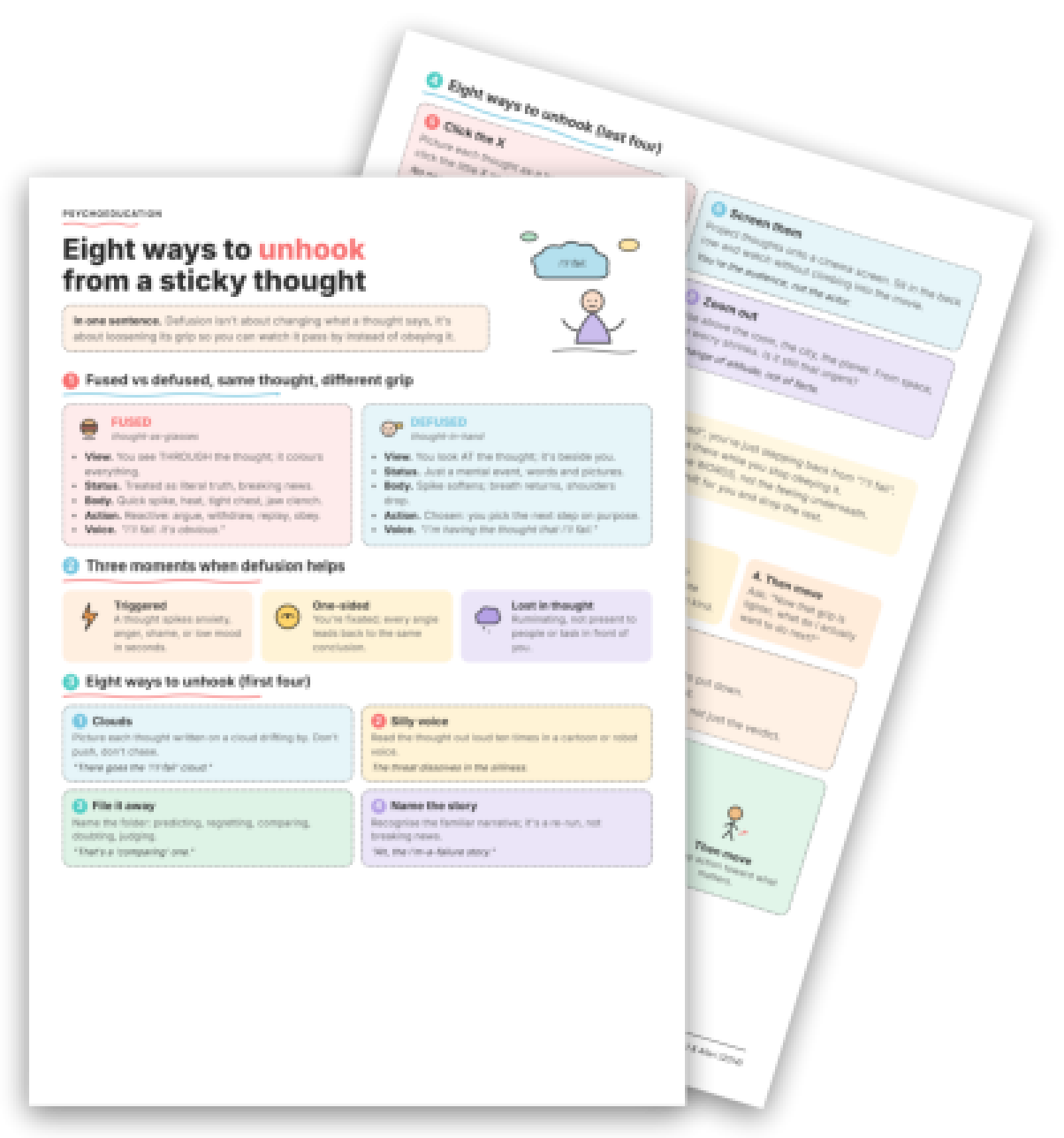
The fiche opens with a single sentence you can read aloud together: "Defusion isn't about changing what a thought says, it's about loosening its grip so you can watch it pass by instead of obeying it." That framing resets the patient's expectation before the first panel.
Panel 1 presents a side-by-side comparison of fused vs. defused states across four dimensions: view (seeing through the thought versus looking at it), status (literal truth versus mental event), somatic response, and action tendency. The "thought-as-glasses" versus "thought-in-hand" visual does what spoken explanation cannot: it shows both modes simultaneously on the same page, making the shift imaginable rather than merely thinkable.
Panel 2 names three clinical presentations where defusion work is most indicated: the thought that spikes anxiety or shame in seconds, the one-sided fixation that loops back on itself regardless of reappraisal attempts, and the ruminative drift that pulls a patient out of the present moment entirely.
Panels 3 and 4 lay out all eight unhooking techniques in concise paired format:
- Clouds and Click the X: imagery-based distancing using drifting clouds or closing browser tabs
- Silly voice and Screen them: incongruence-based techniques that dissolve the thought's authority through playfulness
- "File it away" and "Name the story": labelling strategies that build the metacognitive distance central to ACT schemas and modes work
- "I'm having the thought that..." and Zoom out: linguistic defusion and perspective-shift, the two techniques most easily practised during a conversation
Panel 5 directly corrects the three most common misreadings. The phrase "You're not pushing the thought away; you let it be there while you stop obeying it" addresses the suppression confusion before it derails practice. Panel 6 gives a four-step between-session protocol built around 0-to-10 belief and intensity ratings, keeping progress concrete.
> Key point: The fiche is a visual support that facilitates in-session explanation of defusion, not a homework sheet the patient fills out alone. The fused/defused comparison table, the technique grid, and the clarification panel give you a shared visual vocabulary before the appointment ends.
750+ clinical tools
A library built with and for clinicians, ready to use in session and extend between appointments.
Access all the toolsWhen and How to Introduce the Fiche in Session
The fiche fits naturally once you have identified at least one recurrent sticky thought with the patient and the alliance is solid enough to introduce a new relational stance toward that thought. In an ACT context, it pairs directly with the ACT Hexaflex model and integrates cleanly with the Choice Point tool, which shows concretely what defusion enables at a behavioural level. In a third-wave CBT context, it extends naturally from earlier work on distancing and decentering or from tools like Catching Your Thoughts.
A workable introduction: "I'd like to show you something about changing your relationship with this thought, rather than changing the thought itself." That single sentence reframes the patient's goal before they look at the page.
In session, walk through the fused/defused table together, then let the patient choose one or two techniques from panels 3 and 4 that feel personally usable. Not every technique fits every person, the fiche itself notes, "Pick the ones that produce a real shift for you and drop the rest." Debrief at the next appointment using the "To discuss in session" prompts embedded in the fiche: what the thought was, which tool they tried, and whether the grip changed.
For patients whose work intersects with psychological flexibility, the fiche slots naturally into the broader values-action sequence. For those where a thought's grip is fuelled by a core schema, the distance defusion creates can open the door to schema-level work, though that belongs in formulation, not in the fiche itself.
The fiche does not replace the relational understanding of why a specific thought holds such power. What it does is give the patient a concrete reference after the session, so defusion becomes something they practise rather than something they vaguely remember hearing once.
Use it with your patients
Share this tool in the mobile app and follow the work between sessions.
Sources
- Hayes, S. C., Strosahl, K. D., & Wilson, K. G. (2011). Acceptance and Commitment Therapy: The Process and Practice of Mindful Change (2nd ed.). Guilford Press.
- Harris, R. (2022). The Happiness Trap: How to Stop Struggling and Start Living (2nd ed.). Shambhala Publications.
Your session continues in your patients' pocket
Use with a patientYour resources, available everywhere
The handouts, exercises, programs and audios above: you choose which ones to make available to your patients, in the mobile app dedicated to them.
And far more than a library
The app goes well beyond resources, to support your patients every day:
Related categories
Explore other clinical resources by category.
Anxiety
Clinical hub for anxiety disorders: CBT and ACT worksheets, psychoeducation sheets, and exercises for assessment and treatment across the anxiety spectrum.

Mood
Evidence-based worksheets and clinical tools for mood disorders: CBT, ACT, and positive psychology resources for psychologists and therapists.

Cognition
Printable cognitive therapy worksheets and clinical tools for therapists: CBT, ACT, schema work, defusion, distortions, and belief restructuring.

Build awareness
Clinical worksheets and tools to build awareness in therapy: cognitive distortions, schemas, emotions, ACT and CBT resources for practitioners.

Regulate
Clinical resources for emotion regulation: worksheets, ACT exercises, and psychoeducation tools for affect regulation across diagnoses. For clinicians.

ACT
Clinical hub for Acceptance and Commitment Therapy (ACT): worksheets, exercises, programs and audio resources for practitioners using the ACT model.