
Clinical picture. A 9-year-old boy, referred to here as T., presented with generalised worry that reliably escalated at bedtime, marked by somatic complaints (stomachaches, difficulty falling asleep) and repeated reassurance-seeking from his parents. During session four, his therapist introduced the Worry Coping Cards worksheet and worked with T. to select three cards he felt willing to try: deep breathing, writing a happy ending, and listening to music. T. and the therapist practised each briefly in session so the steps were familiar before he encountered them alone at night. At two-week follow-up, T. reported using the music card on four nights and the breathing card on two, with his parents noting a modest but consistent reduction in bedtime reassurance-seeking.
Worry Coping Cards: PDF Worksheet, Tools and Exercises for Children
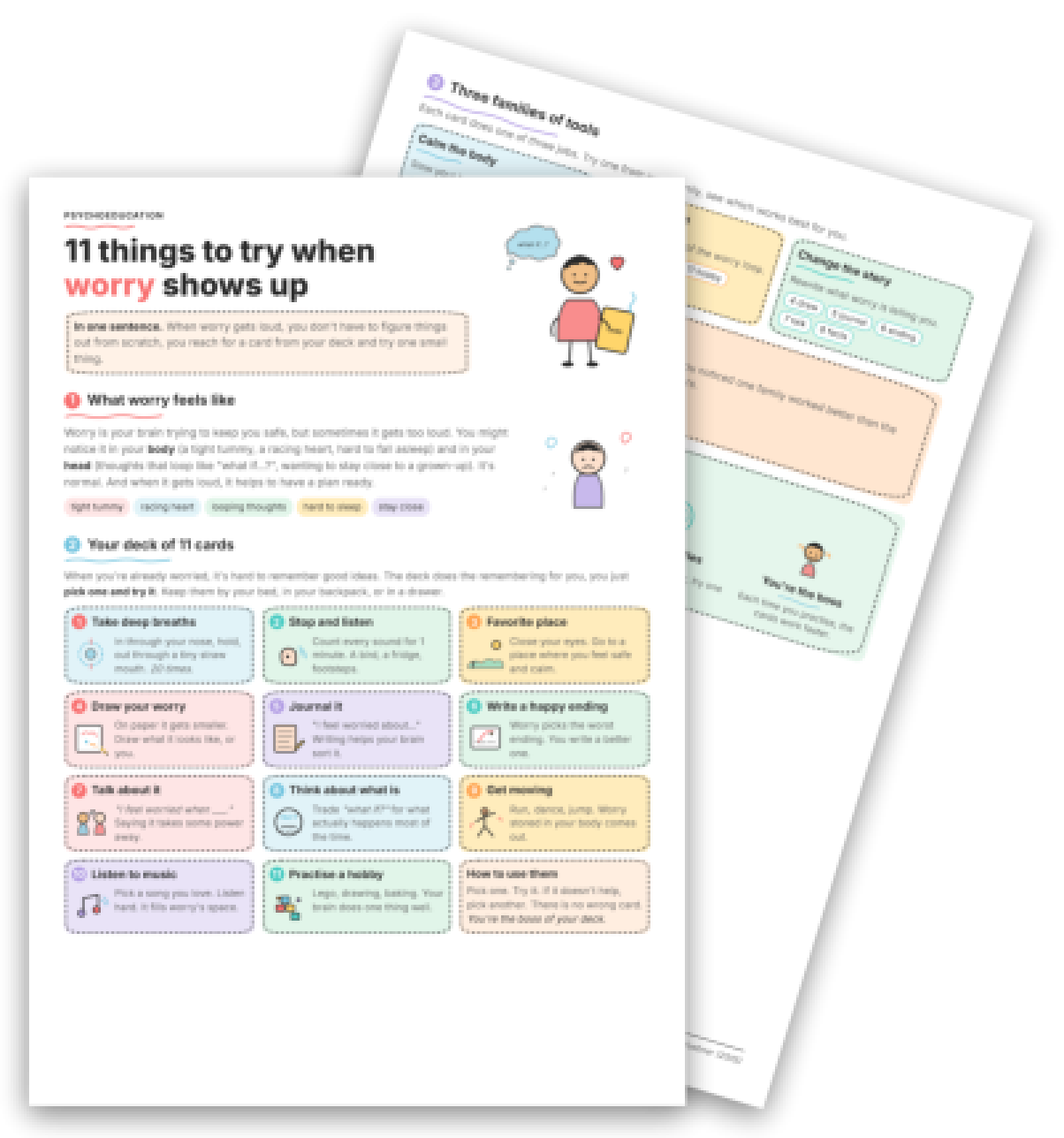
A printable PDF fiche with 11 visual coping strategies organized into three functional families, designed to help clinicians explain and hand off worry management tools to children in session.
Clinical vignettes
Coping Cards for Bedtime Worry
Portable Coping During School Transitions
Clinical picture. A 10-year-old girl, referred to here as L., was seen for anxiety centred on school transitions, including moving classrooms and unstructured break times, with prominent looping "what if" thoughts and occasional school refusal. Her therapist introduced the Worry Coping Cards as a portable tool L. could keep in her backpack, framing the deck as a way to reduce the cognitive load of problem-solving mid-anxiety. Together they identified the "stop and listen" card and the "think about what is" card as good fits for the school context, and role-played how L. might use them when worry began to build in the corridor. L. returned the following week reporting she had tried the listening card once before lunch; she described it as helping her feel "less stuck," though she acknowledged it had not fully resolved her discomfort.
Children with anxiety-driven worry rarely retrieve verbal psychoeducation from memory when the next worrying moment arrives at 9pm. This fiche PDF gives you a concrete, portable visual support to introduce worry coping strategies with the child in session and hand over something they can physically reach for between appointments.
Use this resource with your patients
Handout, exercises and materials ready to use, right inside SessionFuel.
Why Worry Psychoeducation Stalls with Children at the Verbal Level
When a child is already anxious, retrieval of deliberately learned strategies drops sharply. This is especially salient in pediatric presentations where working memory and metacognitive capacity are still developing; what the child grasped in session disappears the moment the tight tummy and looping "what if?" thoughts arrive.
Verbal explanation alone also tends to land as abstract reassurance. The child nods, agrees that worry is normal, then has no concrete action to reach for. A secondary mismatch frequently shows up with parents: they observe somatic and behavioral markers (the proximity-seeking, the sleep resistance) without recognizing them as anxiety. Showing a shared visual in session closes that gap efficiently, often in a few minutes.
The fiche answers a specific need: a prebuilt response menu the child can access without reconstructing anything from scratch, framed in language they can read independently.
750+ clinical tools
A library built with and for clinicians, ready to use in session and extend between appointments.
Access all the toolsWhat the Fiche Contains: 11 Cards Organized Into Three Functional Families
The printable opens with a panel titled "What worry feels like," mapping both somatic markers ("a tight tummy, a racing heart") and cognitive ones ("looping thoughts like 'what if...?'"), plus proximity-seeking and sleep disruption. Walking through this together in session normalizes the presentation before any intervention is named, which supports the therapeutic alliance with the child and often reframes the clinical picture for the family.
The central panel presents the 11 coping cards as a named deck, each with a brief, child-readable instruction. Card 1 specifies "In through your nose, hold, out through a tiny straw mouth. 20 times." Card 8 prompts the child to "trade 'what if?' for what actually happens most of the time." The use instruction is explicit: "Pick one. Try it. If it doesn't help, pick another. There is no wrong card." That framing actively counters the perfectionism that frequently co-occurs with pediatric anxiety, and it reduces the avoidance risk of feeling like one has to choose correctly.
The third panel organizes all 11 strategies into three functional families: Calm the body (breathwork, safe-place visualization, music), Move attention (sound-grounding, physical movement, hobbies), and Change the story (drawing, journaling, writing alternative endings, talking, fact-checking). This taxonomy is clinically precise: it maps onto distinct regulatory pathways, from bottom-up somatic regulation through to cognitive restructuring, without using that vocabulary with the child. It also gives you a quick formulation shortcut: which family the child gravitates toward tells you something about their habitual regulatory mode.
> To remember: The Worry Coping Cards fiche is a visual support that facilitates the explanation of worry management in session; the clinician walks through the three families with the child during the appointment, then hands the printable over as a between-session reference the child owns and can reach for independently.
A closing "To bring up next session" prompt section covers cards that did not work, which family felt most effective, and what was happening when worry returned more intensely. It structures your debrief without requiring extra preparation.
Use it with your patients
Share this tool in the mobile app and follow the work between sessions.
When and How to Introduce the Fiche
This fiche fits naturally from the second or third session, once somatic symptoms have been mapped and the fight-or-flight response has been explained in child-appropriate terms. It pairs cleanly with belly breathing practice for younger patients and integrates well alongside CBT psychoeducation on the thoughts-feelings-actions triangle for children. For a broader menu of strategies to build on once the deck is established, the 50 Coping Strategies for Children and Adolescents worksheet extends the work naturally.
For children aged approximately 7 to 13, a workable introduction is: "Your brain already knows how to calm down. This is a cheat sheet so you don't have to figure it out when worry is loud." Avoid framing it as homework. The deck belongs to the child.
In session, use the three-families panel to run a brief collaborative audit: which strategies has the child already tried spontaneously, and which families have they never explored? This connects immediately to their existing repertoire rather than starting from zero, and it surfaces current coping patterns to evaluate together.
For children whose worry centers on catastrophic predictions, Card 8 (facts vs. "what if?") connects directly to challenging anxious thoughts and can be extended with the "What If...? Reframing Catastrophic Worry" worksheet. Parents can receive a parallel framing through the Child and Adolescent Anxiety parent psychoeducation program, which contextualizes the same coping framework at a caregiver level. Where anxiety involves specific fears and avoidance, the fiche sits comfortably within a broader graduated exposure plan.
The fiche does not replace formulation or exposure work. It gives the child an accessible emergency protocol while that work unfolds, and it gives you a concrete debrief agenda for every session that follows.
Your session continues in your patients' pocket
Use with a patientYour resources, available everywhere
The handouts, exercises, programs and audios above: you choose which ones to make available to your patients, in the mobile app dedicated to them.
And far more than a library
The app goes well beyond resources, to support your patients every day:
Related categories
Explore other clinical resources by category.

Anxiety
Clinical hub for anxiety disorders: CBT and ACT worksheets, psychoeducation sheets, and exercises for assessment and treatment across the anxiety spectrum.

Emotions
Clinical resources on emotion regulation: worksheets, coping tools, CBT, REBT, and ACT exercises for therapists working across diagnoses and age groups.

Cognition
Printable cognitive therapy worksheets and clinical tools for therapists: CBT, ACT, schema work, defusion, distortions, and belief restructuring.

Build awareness
Clinical worksheets and tools to build awareness in therapy: cognitive distortions, schemas, emotions, ACT and CBT resources for practitioners.

Regulate
Clinical resources for emotion regulation: worksheets, ACT exercises, and psychoeducation tools for affect regulation across diagnoses. For clinicians.

ACT
Clinical hub for Acceptance and Commitment Therapy (ACT): worksheets, exercises, programs and audio resources for practitioners using the ACT model.