
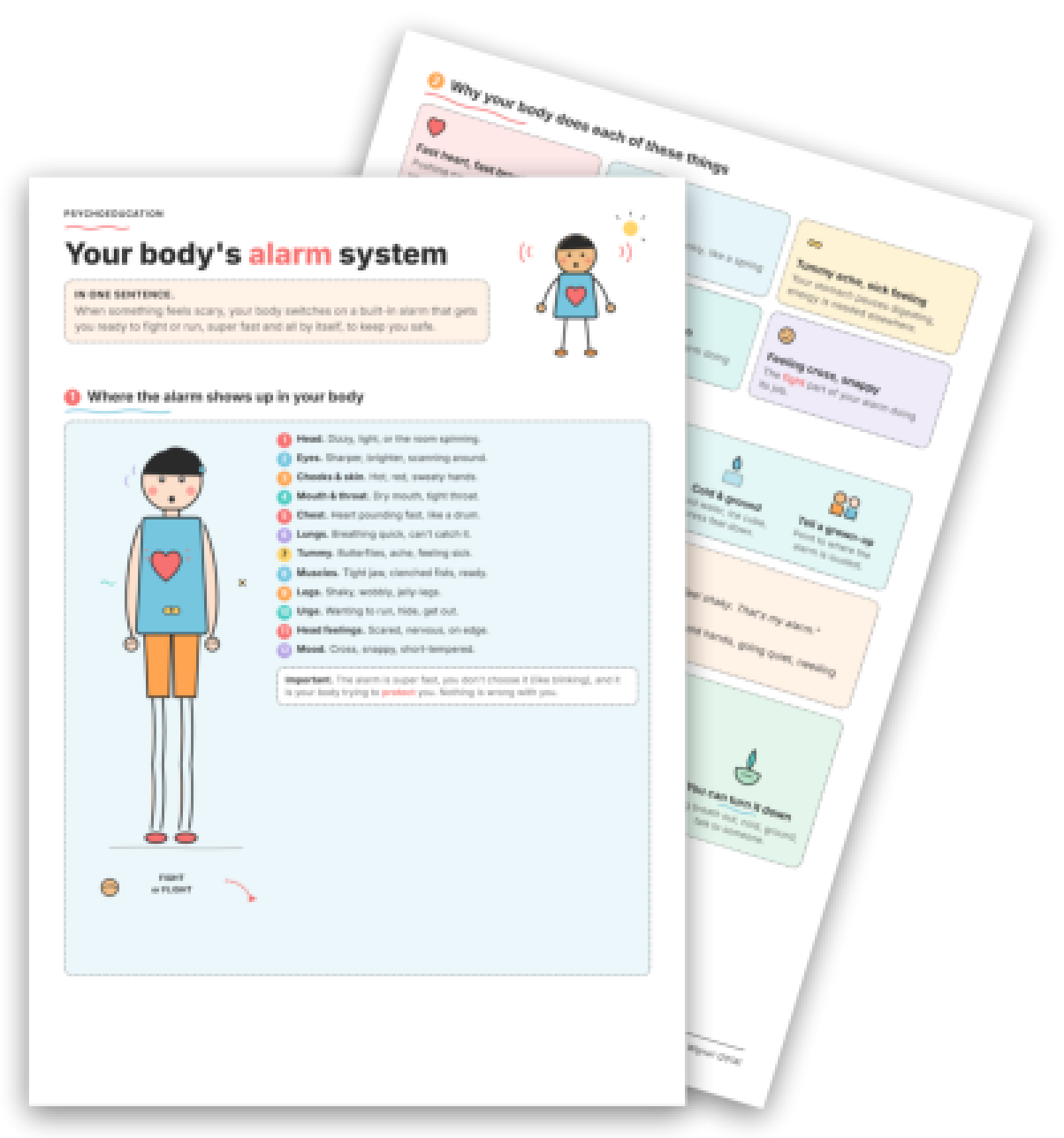
Clinical picture. T., a 9-year-old referred for generalised anxiety, reported stomach aches and a racing heart every Monday morning before school drop-off; his parents described him as uncharacteristically snappy at breakfast. The clinician introduced the fight-or-flight informational sheet, walking through the body diagram together and inviting T. to circle the sensations he recognised from Monday mornings. He identified tight muscles, a dry mouth, jelly-legs, and the urge to hide, and noted with visible relief that the sheet framed these as automatic protective responses rather than signs that something was wrong with him. Over the following two sessions, T. began using the 0-to-10 rating prompt at home, which gave his parents a shared language to prompt grounding strategies before the alarm escalated.
Fight or Flight for Children: PDF Worksheet, Tools and Exercises
A child-adapted psychoeducation PDF worksheet to help clinicians explain the body's alarm system visually, name somatic symptoms, and reduce fear of physical anxiety sensations in young patients.
Clinical vignettes
Naming the Alarm Before a School Transition
Reframing Anger as a Fight Response
Clinical picture. M., an 11-year-old seen following school-based referral for disruptive behaviour, described feeling "just angry for no reason" before incidents in the classroom, with no prior framework for understanding physiological arousal. The clinician used the sheet's explanation of the fight response, specifically the section linking a snappy mood and clenched jaw to the body's alarm system, to help M. connect her outbursts to a recognisable physical sequence rather than a character flaw. She was asked to notice the week's prompts: what happened just before, what she was thinking, and where the alarm felt loudest in her body. At the next appointment M. reported that identifying tightness in her chest and fists as alarm signals had given her a brief pause in which she could apply the slow-breath-out strategy before responding.
Explaining the sympathetic activation response to a child is one of the trickier psychoeducation tasks in clinical work with young patients. Even when the concept lands intellectually, the physical symptoms, racing heart, shaky legs, tight throat, remain frightening because the child has no map for them. This fight-or-flight PDF worksheet gives you a visual map to use directly in session, one that turns somatic fear into legible, named body data.
Use this resource with your patients
Handout, exercises and materials ready to use, right inside SessionFuel.
Why Fight-or-Flight Is So Hard to Explain Without a Visual Support
Verbal explanations of sympathetic nervous system activation tend to lose young patients quickly. The concept is abstract, the vocabulary is adult, and the moment you start explaining why the heart speeds up, you have already lost eye contact. More critically, children presenting with anxiety often interpret their physical symptoms as signs that something is physically wrong with them, rather than as a functional alarm response. This secondary fear, fearing the alarm itself, is a well-documented maintaining process in pediatric anxiety and shows up just as clearly in anxiety physical sensations work.
What children struggle most to grasp from oral explanation alone: that the response is automatic and protective, not a malfunction; that each specific sensation has a biological reason; and that the alarm, however intense, always passes. Without a concrete visual anchor, these three points rarely stick between sessions.
750+ clinical tools
A library built with and for clinicians, ready to use in session and extend between appointments.
Access all the toolsWhat the Worksheet Contains: A Structured Visual Tool for In-Session Use
The fiche PDF is organized into four clearly numbered sections, each designed for the clinician to walk through with the patient, not for the child to complete independently.
Section 1 maps twelve named body signals across a full-body reference, from "Head. Dizzy, light, or the room spinning" to "Urge. Wanting to run, hide, get out" and "Mood. Cross, snappy, short-tempered." Seeing the complete list laid out visually is consistently more powerful than hearing it described: children immediately recognize two or three signals as their own, which both validates their experience and reduces the catastrophic meaning they have attributed to it. You can pair this naturally with the Emotion Thermometers worksheet for rating intensity.
Section 2 gives a brief biological rationale for each cluster of symptoms, fast heart and breath, tight muscles, nausea, hot skin, urge to flee. This is the section where the phrase "your body is on your side, doing its job" does its clinical work: it reframes every uncomfortable sensation as purposeful rather than dangerous, which is precisely the recadrage cognitif you are aiming for.
Section 3 offers four short regulation strategies: extended exhale, drop-and-wiggle, the 5-4-3 senses exercise, cold water or grounding pressure, and talking to a trusted adult. The sensory grounding exercise complements this section well for children who need more structured practice with the 5-4-3 technique. The strategies are brief enough to rehearse in session before the child takes the sheet home.
The closing "To notice this week" block gives the child three gentle self-monitoring prompts: name the sensation aloud, rate it 0 to 10, and track what came just before. This is not a formal homework questionnaire; it is a naturalistic awareness exercise that builds interoceptive vocabulary between sessions.
> Key point: this worksheet is a visual support to facilitate the in-session explanation, not a self-administered questionnaire. The clinician leads the discussion panel by panel; the child leaves with a concrete reference they already understand.
Use it with your patients
Share this tool in the mobile app and follow the work between sessions.
When and How to Propose This Worksheet
The fiche fits naturally from the second or third session, once initial rapport is established and the presenting complaint is clear. It is particularly indicated for children with generalized anxiety, specific fears, somatic complaints without organic cause, or school-refusal presentations where physiological symptoms are a primary driver of avoidance. It also works well when supporting parents who struggle to explain their child's reactions.
A workable introduction: "I want to show you something about what happens inside your body when you feel scared. We're going to look at it together." Avoid framing it as a lesson; frame it as a shared investigation of what the child's body already does. As you go through Section 1, ask the child to point to the signals they recognize. That single act of recognition is often more therapeutic than any explanation you provide verbally.
For children with ADHD comorbidity, keep the session shorter and focus on Section 1 and one regulation strategy from Section 3. For those who track well, move into the self-monitoring prompts and debrief them at the next appointment.
The worksheet pairs usefully with 50 Coping Strategies for Children and Adolescents, the Belly Breathing for Kids worksheet, and the broader Autonomic Nervous System fiche for older adolescents who can tolerate a more mechanistic framework. The CBT for Kids: Thoughts, Feelings and Actions resource is a natural next step once the somatic map is established.
The worksheet does not replace the therapeutic relationship, and it is not sufficient on its own for children with significant trauma histories, where somatic symptoms may carry meaning that requires careful titration. In those contexts, introduce the alarm-system framing later, once the child has enough safety in the relationship to examine physical sensations without retraumatizing. For the majority of anxious children, however, having a named map of their body's alarm changes the felt experience of the next episode: they have words for what is happening, and that alone reduces the secondary fear that keeps avoidance running.
Your session continues in your patients' pocket
Use with a patientYour resources, available everywhere
The handouts, exercises, programs and audios above: you choose which ones to make available to your patients, in the mobile app dedicated to them.
And far more than a library
The app goes well beyond resources, to support your patients every day:
Related categories
Explore other clinical resources by category.

Anxiety
Clinical hub for anxiety disorders: CBT and ACT worksheets, psychoeducation sheets, and exercises for assessment and treatment across the anxiety spectrum.
Trauma
Clinical hub on trauma and PTSD: assessment, differential diagnosis, treatment phases, and printable resources for practitioners. 155 chars.

Emotions
Clinical resources on emotion regulation: worksheets, coping tools, CBT, REBT, and ACT exercises for therapists working across diagnoses and age groups.

Understand
Clinical hub for the therapeutic aim 'Understand': worksheets and tools to build patient insight across CBT, ACT, schema therapy and more.

Build awareness
Clinical worksheets and tools to build awareness in therapy: cognitive distortions, schemas, emotions, ACT and CBT resources for practitioners.

CBT
CBT worksheets, cognitive restructuring exercises & behavioral tools for clinicians. Evidence-based resources for every phase of cognitive behavioral therapy.