
Clinical picture. A, a man in his early thirties, presented with longstanding social anxiety and a pattern of going blank during work meetings, which he described as a personal failing and evidence that he was "not intelligent enough." His therapist introduced the Stone Age Brain worksheet as a shared reading exercise midway through a cognitive-behavioural course. When A read the freeze section aloud and reached the line about predators not spotting what did not move, he paused and said, quietly, "so it's actually trying to protect me." That reframe did not eliminate his freezing, but it reduced the secondary shame response and allowed him to engage more readily with the behavioural experiments that followed.
Your Stone Age Brain: PDF Worksheet, Tools and Exercises
A visual PDF worksheet and clinical tools for explaining the evolutionary roots of anxiety in session, helping patients recognise freeze, flight, and fight as ancient survival signals, not character flaws.
Clinical vignettes
Naming the Freeze in Session
Flight Pattern Recognised at Home
Clinical picture. K, a woman in her mid-forties referred for generalised anxiety and relationship conflict, reported a recurring cycle in which she would abruptly leave family gatherings and then feel guilty for days afterward. Her clinician assigned the informational sheet as between-session reading and asked her to note which alarm setting felt most familiar. K returned the following week having identified flight as her predominant pattern and, unprompted, linked the "planning the exit" description to the restless leg sensations she had previously dismissed as a physical complaint. This gave the dyad a shared, non-pathologising vocabulary that made subsequent work on avoidance more accessible and less confrontational.
Explaining anxiety as an evolutionary alarm is one of the most common psychoeducational moves in clinical practice, yet it rarely sticks when delivered verbally. Patients hear "fight-or-flight" and think they understand, but when their heart pounds during a performance review they still feel broken, not ancient. This fiche PDF on the Stone Age brain bridges that gap: it gives both clinician and patient a shared visual language for why 200,000-year-old wiring misreads a difficult email as a survival emergency.
Use this resource with your patients
Handout, exercises and materials ready to use, right inside SessionFuel.
Why "fight-or-flight" explanations often don't land in session
The core obstacle is shame. Most anxious patients carry some version of the belief that their reactivity is a character flaw. Verbal reassurance helps, but it rarely dislodges the belief quickly. The fiche opens with a single framing sentence, visually isolated so it reads before anything else: "Your anxiety is not a flaw, it's a Stone Age alarm in a modern world." Seeing it written at the top of a support, before the first explanation begins, interrupts the shame narrative in a way that oral repetition rarely achieves.
A second obstacle is that patients don't discriminate between freeze, flight, and fight as distinct response modes. They experience the cluster as undifferentiated "anxiety" and treat it as monolithic. Without naming and separating the three modes, exposure hierarchies, behavioral activation plans, and defusion exercises risk targeting the wrong maintaining process entirely. A patient predominantly in freeze who is treated as though flight is the primary mode will not respond as expected to standard graduated exposure.
The autonomic nervous system framing underpins all of this, but even clinicians comfortable with polyvagal theory find that patients need a simpler entry point before the more detailed models land. This is exactly what the fiche provides.
What the fiche contains: a four-section visual map
The support moves through four numbered sections, each self-contained enough to anchor a different moment in the session.
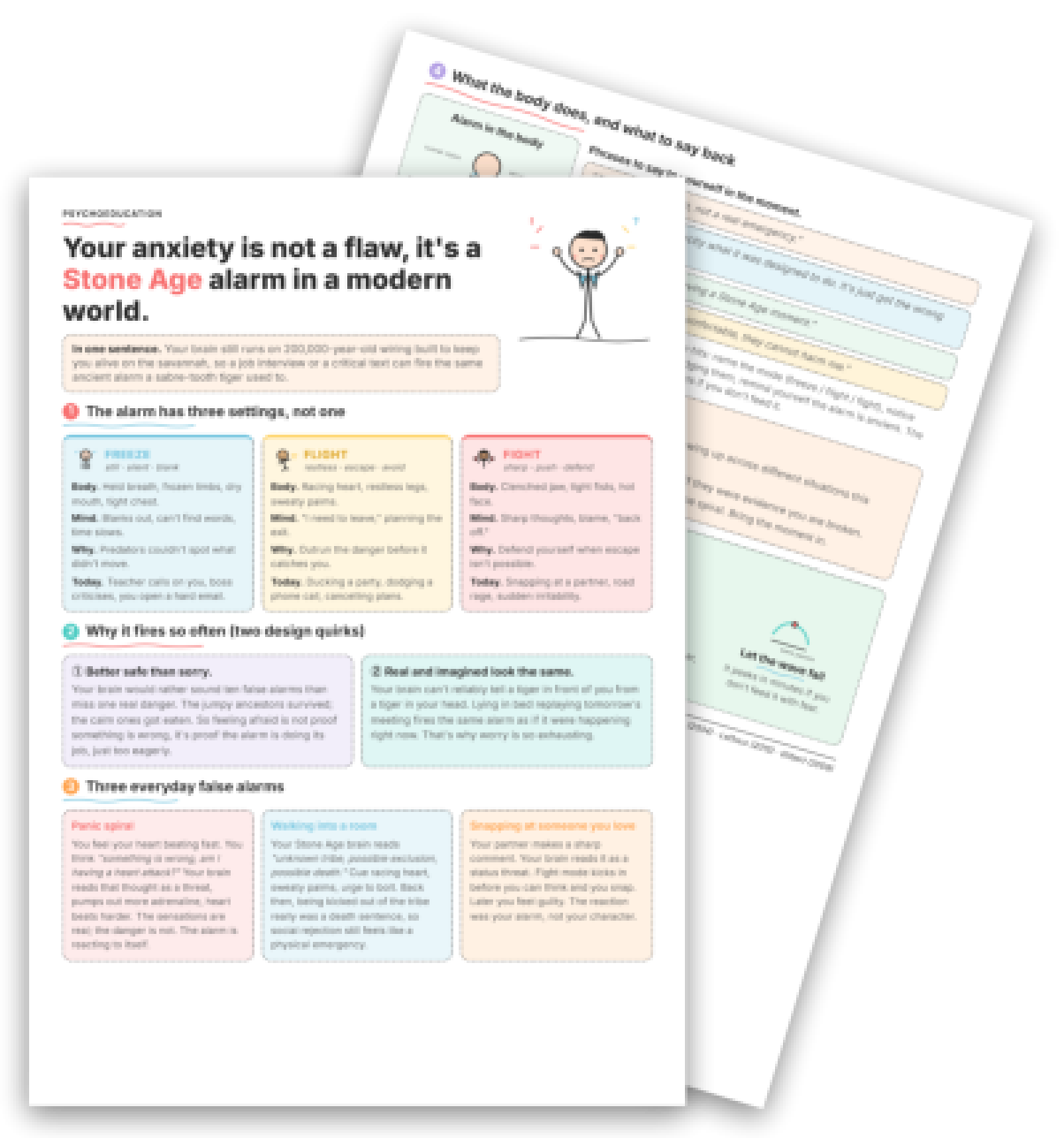
Section 1 maps the three alarm settings in parallel columns: freeze (held breath, blank mind, immobility, predators missed stillness), flight (racing heart, avoidance urge, planning the exit), and fight (clenched jaw, sharp thoughts, sudden blame). Each column shows the body response, the mental state, the evolutionary logic, and a modern trigger. The parallel layout makes comparison immediate: you can point to each column and ask "Which of these do you recognise from this week?" without reading the fiche aloud. That single gesture is faster and more precise than a verbal description of the same content.
Section 2 names two design quirks driving false alarms: the better-safe-than-sorry bias (jumpy ancestors survived; calm ones were eaten) and the brain's failure to distinguish real from imagined threat. The second quirk is clinically dense and typically takes multiple sessions to genuinely absorb verbally. Seeing it framed as a design feature, not a malfunction, changes the register for most patients.
Section 3 applies both quirks to three recognisable clinical presentations: the panic spiral (interoceptive alarm feeding on itself), walking into a room (social exclusion read as mortal threat), and snapping at a partner (status threat activating fight mode before reflection is possible). For patients working through panic maintenance cycles or social anxiety, these vignettes name the exact experience without requiring the patient to construct it themselves.
Section 4 lists body sensations ("tunnel vision", "pounding heart", "churning gut") under the label uncomfortable, not dangerous, alongside four grounding phrases and a three-step practice: name the mode, notice three body sensations without judging them, remind yourself the alarm is ancient. A final "To discuss in session" block provides three ticked prompts that set the agenda for the follow-up conversation.
> Key point: The fiche is a visual support that facilitates the explanation of the Stone Age brain in session. The side-by-side layout of freeze, flight, and fight shows, in a single glance, what several verbal explanations often cannot. It is not a questionnaire for the patient to complete alone.
Clinical library
750+ clinical tools
A library built with and for clinicians, ready to use in session and extend between appointments.
Access all the toolsSeveral resource types
Psychoeducation handouts
Understand at a glance
Interactive exercises
To do and fill in
Interactive programs
A structured path
Audios
Meditation and relaxation
Psychometric tests
Automatic scoring
When and how to introduce it
This fiche fits naturally from the second or third session onward, once you have an initial formulation and the patient has described at least one recurring anxiety episode. Three specific moments make it particularly well-placed:
- Before starting graded exposure, to normalise the physiological escalation the patient will encounter
- After a panic episode is reported, to map it onto the spiral described in Section 3, alongside Clark's cognitive model of panic if you are using a CBT framework
- When shame is obstructing progress, because the evolutionary framing depathologises the alarm response faster than most standard cognitive restructuring moves
A practical introduction: "I'd like to show you something visual that explains what we've been discussing. It's one page. Look at the three columns in the middle first, and tell me which one feels most familiar." This positions the patient as the expert on their own experience rather than a recipient of information.
The debrief matters as much as the introduction. After the patient has scanned the page, return to the three "To discuss in session" prompts at the foot. Ask specifically whether they felt shame about the sensations themselves, and whether a reframe almost worked before the spiral pulled them back. These questions open the next layer of formulation work rather than closing it. For patients where freeze is the dominant mode, the Window of Tolerance fiche extends the autonomic regulation framing into a more clinically detailed model. For patients whose fight response is most prominent, the body stress response and anger cycle tools pair naturally. With younger patients, the Fight or Flight for Children fiche offers equivalent content at an age-appropriate level.
The fiche doesn't close the psychoeducation work. It gives the patient a map they can return to between sessions, and gives you both a precise shared vocabulary for the sessions that follow.
Use it with your patients
Share this tool in the mobile app and follow the work between sessions.
Sources
- Bracha, H. S. (2004). Freeze, Flight, Fight, Fright, Faint: Adaptationist Perspectives on the Acute Stress Response Spectrum. CNS Spectrums, 9(9), 679-685.
- LeDoux, J. E. (1996). The Emotional Brain: The Mysterious Underpinnings of Emotional Life. Simon and Schuster.
- Gilbert, P. (2010). Compassion Focused Therapy: Distinctive Features. Routledge.
- Gilbert, P. (2009). Introducing compassion-focused therapy. Advances in Psychiatric Treatment, 15(3), 199-208.
Patient mobile app
Your session continues in your patients' pocket
Use with a patientYour resources, available everywhere
The handouts, exercises, programs and audios above: you choose which ones to make available to your patients, in the mobile app dedicated to them.
Psychoeducation handoutsInteractive exercisesInteractive programsAudiosPsychometric tests
And far more than a library
The app goes well beyond resources, to support your patients every day:
Standardized tests
Therapy journal
Gamification
Wellbeing challenges
Introspection prompts
Therapist homework
Related categories
Explore other clinical resources by category.

Anxiety
Clinical hub for anxiety disorders: CBT and ACT worksheets, psychoeducation sheets, and exercises for assessment and treatment across the anxiety spectrum.

Emotions
Clinical resources on emotion regulation: worksheets, coping tools, CBT, REBT, and ACT exercises for therapists working across diagnoses and age groups.

Understand
Clinical hub for the therapeutic aim 'Understand': worksheets and tools to build patient insight across CBT, ACT, schema therapy and more.

CBT
CBT worksheets, cognitive restructuring exercises & behavioral tools for clinicians. Evidence-based resources for every phase of cognitive behavioral therapy.

Compassion-focused
CFT clinical tools for practioners: exercises, programs and guided audio on shame, self-criticism, guilt and self-compassion. Ready to use in session.

Trauma
Clinical hub on trauma and PTSD: assessment, differential diagnosis, treatment phases, and printable resources for practitioners. 155 chars.