
Clinical picture. A., a 34-year-old man, presented with recurrent episodes of pounding heart, chest tightness, and shortness of breath that had led to two emergency department visits in the preceding three months; cardiac workup was unremarkable. He described a persistent conviction that something was "physically wrong" and had begun avoiding public transport and exercise. The clinician introduced the informational sheet during session two, walking through the adrenaline cascade step by step and asking A. to locate each listed sensation on his own recent episode. He noted, with visible relief, that every symptom he had feared was accounted for on the sheet. By the following session he reported using the reframe "that is adrenaline doing its job" during one episode, which shortened its duration and allowed him to stay on the train.
How Your Body Responds to Stress: PDF Worksheet, Tools and Exercises
A visual psychoeducation worksheet to explain the adrenaline cascade in session, reframe catastrophic misinterpretations of body sensations, and give patients a durable physiological reference.
Clinical vignettes
Reframing Cardiac Fear in Panic
Normalising Somatic Symptoms in GAD
Clinical picture. C., a woman in her mid-forties referred for generalised anxiety, reported chronic jaw tension, cold fingertips, and near-daily nausea that her general practitioner had attributed to anxiety but that she continued to experience as signs of undetected illness. Shame about "not being able to cope" was a secondary barrier to engagement. The clinician used the worksheet to map her specific sensations onto the physiological chain, emphasising that digestion pausing and peripheral vasoconstriction are automatic protective responses, not signs of fragility. C. said it was the first time the symptoms had been explained rather than dismissed. In subsequent sessions she was able to reference the sheet independently when new somatic complaints arose, which reduced reassurance-seeking behaviour noticeably over six weeks.
Patients who misread their own physiology during a stress response rarely get far with verbal explanation alone. The racing heart becomes "a heart attack," the shallow breath becomes "I can't breathe," and the lightheadedness becomes "I'm about to faint." Each reframe you offer verbally competes with a cascade of real sensations the patient is experiencing in real time. This PDF worksheet on how the body responds to stress gives you a concrete visual anchor for that exact moment in session.
Use this resource with your patients
Handout, exercises and materials ready to use, right inside SessionFuel.
Why the physiology of stress resists verbal explanation
The central clinical problem here is catastrophic misinterpretation of body sensations: the mechanism described by Clark (1986) and central to his cognitive model of panic. When you tell a patient that adrenaline causes a racing heart, they hear you, but the sensation itself overrides the information. Without a map showing why the sensation exists and what it actually signals, the patient's threat appraisal system keeps reassigning it to danger.
The secondary difficulty is what the fiche calls the "second wave": fear of the fear itself. Patients with panic disorder, health anxiety, or heightened interoceptive sensitivity often enter a cycle where the body sensation triggers the catastrophic thought, which amplifies the sensation, which confirms the thought. An oral explanation, however accurate, rarely interrupts that cycle on its own. A visual support that the patient can look at while you speak changes the cognitive load: they are processing an external object, not just their own internal state.
What the worksheet contains
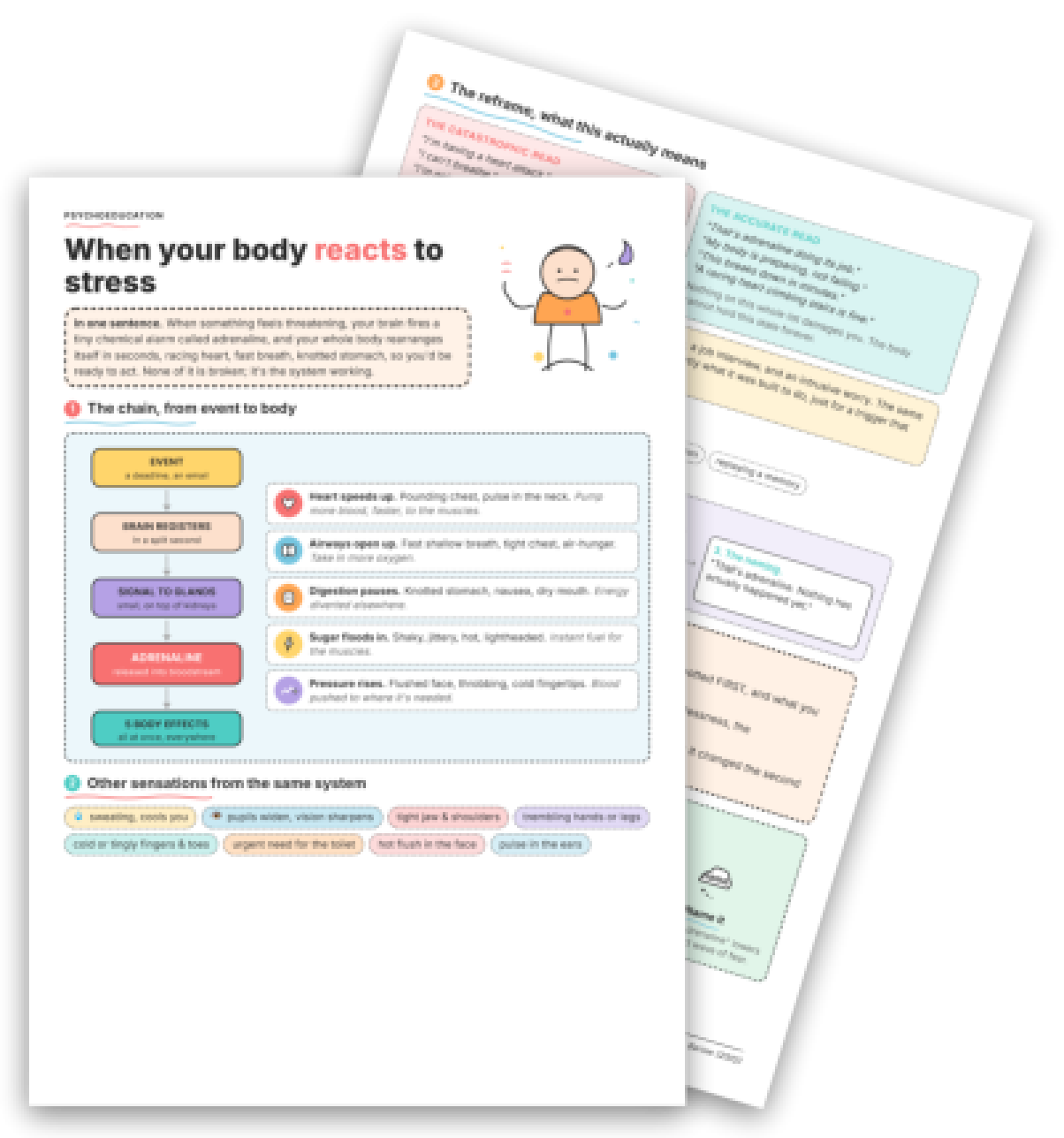
The fiche is structured around four numbered panels, each doing work that a spoken explanation cannot.
Panel 1 presents the full stress chain as a linear visual sequence: event, brain registers, signal to adrenal glands, adrenaline released, then five simultaneous body effects, each labeled with its mechanism. "Heart speeds up. Pump more blood, faster, to the muscles." "Digestion pauses. Energy diverted elsewhere." Patients often do not know these five effects are one system driven by one chemical. Seeing it laid out spatially breaks the sense that the symptoms are random or ominous.
Panel 2 lists additional sensations from the same system, including sweating, pupil dilation, jaw tension, cold fingers, and the urgent need for the toilet, many of which patients report but rarely connect to adrenaline. Clinicians working on fear of body sensations or building an interoceptive exposure hierarchy will find this panel immediately useful for mapping what the patient actually notices.
Panel 3 is the clinical core: a side-by-side reframe table contrasting the catastrophic read ("I'm having a heart attack") with the accurate read ("That's adrenaline doing its job"). This is the ACT-compatible defusion move and the CBT cognitive restructuring move in a single visual format. The fiche states plainly: "Nothing on this whole list damages you. The body cannot hold this state forever." Showing this to the patient, rather than saying it, shifts the register from reassurance to evidence.
Panel 4 offers a short list of everyday triggers and a three-step worked example: trigger (an email from the manager), body effects (heart speeds, breath shallows, stomach drops), and naming ("That's adrenaline. Nothing has actually happened yet"). A closing "To discuss in session" block provides three ready-made debriefing questions around sensation tracking and the second wave.
> Key takeaway: The worksheet is a visual support that facilitates psychoeducation in session. It is not a self-administered questionnaire. The patient reads it with you, not instead of you.
750+ clinical tools
A library built with and for clinicians, ready to use in session and extend between appointments.
Access all the toolsWhen and how to introduce it
This PDF worksheet fits naturally in an early psychoeducation phase, after the initial assessment and once a working alliance is established. It is particularly indicated for:
- Panic disorder and panic attacks, where the cycle of misinterpretation is central
- Health anxiety, where somatic sensations are chronically over-interpreted
- Social anxiety and performance contexts, where physical symptoms feel socially catastrophic
- Any patient preparing for graded exposure work who needs a solid physiological rationale before confronting avoided sensations
Introduce it with a framing like: "I'd like to show you something about what your body actually does when it detects a threat, because the sensations you're describing are all part of one system, and seeing it laid out sometimes makes the whole thing feel less alarming." Use Panel 1 to walk through the chain together, then invite the patient to identify which of the five effects they notice first. Panel 3 can anchor the reframe you have already been working toward verbally.
As a debrief for the following session, the built-in discussion questions, around which sensation felt most frightening and whether naming "adrenaline" shifted the second wave at all, feed directly into CBT self-monitoring of physical anxiety symptoms. For patients already further along, the fiche pairs well with autonomic nervous system psychoeducation and the fight-flight-freeze response worksheet, or with a broader anxiety psychoeducation program as the foundation session.
The worksheet does not replace clinical formulation. A patient with longstanding health anxiety will need more targeted work on the belief layer beneath the misinterpretation. But as an in-session visual tool, it compresses what would otherwise take twenty minutes of verbal explanation into a shared, scannable reference the patient leaves with.
Use it with your patients
Share this tool in the mobile app and follow the work between sessions.
Sources
- Cannon, W. B. (1915). Bodily Changes in Pain, Hunger, Fear and Rage: An Account of Recent Researches into the Function of Emotional Excitement. D. Appleton and Company.
- Endocrine Society. Adrenal Hormones.
- Shields, G. S., Sazma, M. A., Yonelinas, A. P. (2023). Understanding the relationships between physiological and psychosocial stress, cortisol and cognition. Frontiers in Endocrinology.
Your session continues in your patients' pocket
Use with a patientYour resources, available everywhere
The handouts, exercises, programs and audios above: you choose which ones to make available to your patients, in the mobile app dedicated to them.
And far more than a library
The app goes well beyond resources, to support your patients every day:
Related categories
Explore other clinical resources by category.

Anxiety
Clinical hub for anxiety disorders: CBT and ACT worksheets, psychoeducation sheets, and exercises for assessment and treatment across the anxiety spectrum.

Emotions
Clinical resources on emotion regulation: worksheets, coping tools, CBT, REBT, and ACT exercises for therapists working across diagnoses and age groups.

Health
Somatic health clinical resources for practitioners: worksheets, psychoeducation, and exercises for somatic symptom disorder, chronic pain, and more.

Understand
Clinical hub for the therapeutic aim 'Understand': worksheets and tools to build patient insight across CBT, ACT, schema therapy and more.

CBT
CBT worksheets, cognitive restructuring exercises & behavioral tools for clinicians. Evidence-based resources for every phase of cognitive behavioral therapy.

Trauma
Clinical hub on trauma and PTSD: assessment, differential diagnosis, treatment phases, and printable resources for practitioners. 155 chars.