
Clinical picture. R., a woman in her early 40s, presented with recurrent episodes she described as near-cardiac events: racing heart, chest tightness, and a sudden sense of unreality. Cardiac workup was unremarkable, yet she remained convinced something was physically wrong. The clinician introduced the informational sheet on nervous system regulation, walking through the body-scan section together and inviting R. to locate where she felt activation most reliably. She identified the chest and jaw without hesitation, and the framing that her system was working rather than failing visibly reduced her bracing posture mid-session. At the following appointment she reported using the slow-exhale technique twice before a work presentation, noting the sensations did not disappear but became less alarming.
Nervous System Regulation: PDF Worksheet, Tools and Exercises
A visual PDF fiche, practical tools, and concrete exercises to explain nervous system regulation clearly in session and give patients a lasting somatic reference.
Clinical vignettes
Somatic Mapping in a Panic-Prone Patient
Stuck in Mobilising Mode: A Burnout Presentation
Clinical picture. T., a man in his late 30s referred for occupational burnout, described chronic neck tension, appetite disruption, and an inability to wind down after work despite exhaustion. During a psychoeducation session the clinician used the two-mode diagram from the sheet to name what T. was experiencing: a nervous system that had lost its path back to the soothing state. T. recognised the pattern immediately and noted, with some relief, that this reframed his difficulty sleeping as a regulatory problem rather than a personal failing. The clinician introduced the extended-exhale practice as a low-threshold entry point, with the explicit caveat that one technique would not resolve burnout on its own. Over the following weeks T. used the sheet independently to track which physical cues signalled he was still in mobilising mode late in the evening.
Patients who know intellectually that "stress lives in the body" often remain completely unable to locate it in their own, or to act on it once they do. Explaining nervous system regulation orally is fast; making it genuinely usable in a patient's daily life is another matter. This PDF fiche provides the visual architecture that closes that gap, giving you a shared reference to build on across sessions rather than re-explaining from scratch each time.
Use this resource with your patients
Handout, exercises and materials ready to use, right inside SessionFuel.
Why nervous system regulation resists verbal explanation alone
The polyvagal framework (Porges, 2011), van der Kolk's somatic trauma model, and Levine's work on the body's discharge cycles have made nervous system dysregulation a clinical touchstone across trauma-informed CBT, EMDR, ACT, and body-based approaches. Yet patients rarely leave psychoeducation sessions with a genuinely embodied grasp of the concept.
The problem is predictable. When a patient experiences chest tightness, a racing heart, or a lump in the throat, the immediate cognitive appraisal is catastrophic: cardiac event, personality flaw, going mad. The idea that a protective system is doing its job, faster than thought can catch up stays abstract unless it is visually anchored to a body, a state, and a concrete action. Without that anchoring, interoceptive awareness stays low, early-warning cues go unnoticed, and the window for voluntary regulation closes before the patient can use it. The Fight-Flight-Freeze Response fiche and the Autonomic Nervous System sheet approach the same physiological territory; this fiche adds the patient-facing body map and the three-skill toolkit that make those frameworks actionable.
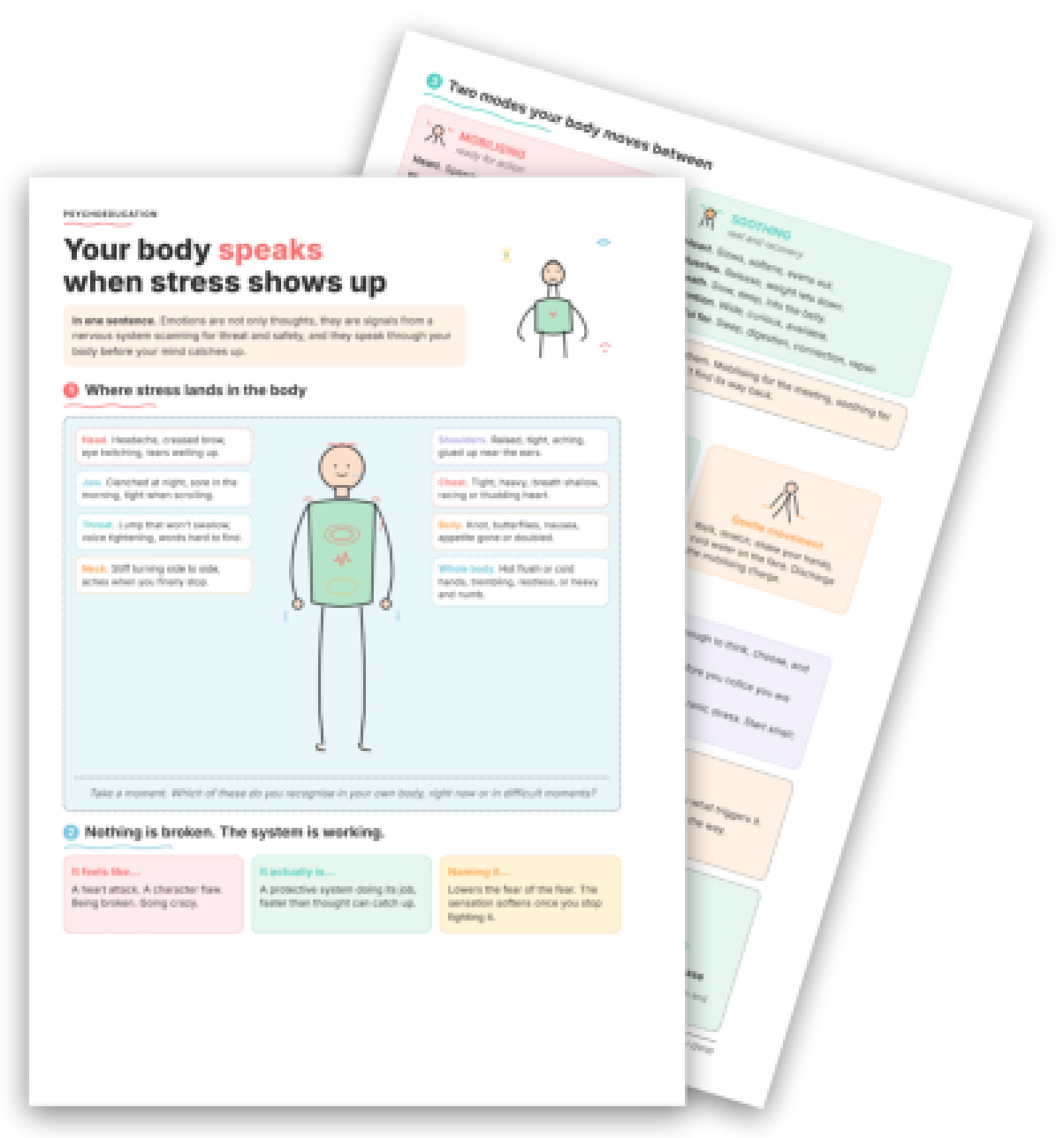
What the fiche contains: a visual support that explains the concept in session
The fiche PDF is structured in five numbered sections, each doing work that an oral explanation alone rarely does.
Section 1 maps stress onto eight specific body zones: head, jaw, throat, neck, shoulders, chest, belly, and whole body, with concrete descriptors for each ("Jaw: clenched at night, sore in the morning, tight when scrolling"). Displayed visually, this list transforms a vague sense of "tension" into a personalised checklist patients can scan in real time.
Section 2 presents a three-column reframe: "It feels like... / It actually is... / Naming it..." This panel directly targets the catastrophic misattribution that sustains fear of body sensations, which makes it particularly useful when working with panic, health anxiety, or PTSD presentations.
Section 3 contrasts two physiological modes, MOBILISING and SOOTHING, with parallel descriptors covering heart rate, muscle tone, breathing pattern, and attentional focus. The visual side-by-side makes it immediately clear that neither state is pathological. The closing line of this section is clinically precise and worth pointing to explicitly: "Health is not staying in one mode. It is being able to shift between them."
Section 4 offers three exercises grounded in the evidence: a slow exhale (4 in, 6-8 out), a 5-4-3-2-1 sensory grounding sequence, and gentle movement to discharge somatic activation. These pair naturally with grounding techniques you may already be assigning and with audio tools built around breathing and somatic settling.
Section 5 includes three "worth remembering" points covering early-warning cue identification, the clinical significance of low interoceptive awareness after chronic stress, and a calibrated goal statement: "Regulating is not making the feeling disappear." A brief "to bring into session" prompt list closes the fiche, giving patients an agenda for the next appointment.
> Key point: This fiche is a visual support that facilitates the explanation of nervous system regulation in session, not a questionnaire to complete alone. You use it to illustrate, point, and anchor. The patient leaves with a concrete reference, not a homework assignment.
750+ clinical tools
A library built with and for clinicians, ready to use in session and extend between appointments.
Access all the toolsHow and when to introduce the fiche in practice
This fiche fits naturally in early-to-mid psychoeducation, once the presenting problem is formulated and the patient has begun to notice somatic correlates of their distress. It works across a wide range of profiles: stress and anxiety presentations, trauma-related symptoms, somatic complaints without full medical explanation, and any patient where how breathing affects physiological state has come up.
A low-barrier introduction: "I want to show you a map of what your nervous system is actually doing when you feel that way. Let's look at it together." From there, Section 1 becomes a brief somatic inventory run in session, and Section 3 can open a discussion of what shifting between modes feels like for this particular patient. Section 4 gives you three exercises to model and practice before the patient takes the sheet home.
One clinical note: patients with very low interoceptive awareness, common after chronic stress or dissociative presentations, may find Section 1 confronting rather than clarifying. With those patients, start with Section 2's reframe and hold the body map for a later session. Pairing the fiche with an emotion regulation skills overview or a guided body scan audio builds the interoceptive vocabulary that makes the map meaningful over time.
The fiche does not replace the therapeutic frame. It makes one complex explanation significantly clearer and leaves the patient with a reference they can actually use between sessions.
Use it with your patients
Share this tool in the mobile app and follow the work between sessions.
Sources
- Porges, S. W. (2011). The Polyvagal Theory: Neurophysiological Foundations of Emotions, Attachment, Communication, and Self-regulation. W. W. Norton and Company.
- van der Kolk, B. (2014). The Body Keeps the Score: Brain, Mind, and Body in the Healing of Trauma. Viking / Penguin Books.
- Dana, D. (2021). Anchored: How to Befriend Your Nervous System Using Polyvagal Theory. Sounds True.
- Porges, S. W. (2017). The Pocket Guide to the Polyvagal Theory: The Transformative Power of Feeling Safe. W. W. Norton and Company.
Your session continues in your patients' pocket
Use with a patientYour resources, available everywhere
The handouts, exercises, programs and audios above: you choose which ones to make available to your patients, in the mobile app dedicated to them.
And far more than a library
The app goes well beyond resources, to support your patients every day:
Related categories
Explore other clinical resources by category.

Anxiety
Clinical hub for anxiety disorders: CBT and ACT worksheets, psychoeducation sheets, and exercises for assessment and treatment across the anxiety spectrum.

Trauma
Clinical hub on trauma and PTSD: assessment, differential diagnosis, treatment phases, and printable resources for practitioners. 155 chars.

Emotions
Clinical resources on emotion regulation: worksheets, coping tools, CBT, REBT, and ACT exercises for therapists working across diagnoses and age groups.

Health
Somatic health clinical resources for practitioners: worksheets, psychoeducation, and exercises for somatic symptom disorder, chronic pain, and more.

Understand
Clinical hub for the therapeutic aim 'Understand': worksheets and tools to build patient insight across CBT, ACT, schema therapy and more.

Build awareness
Clinical worksheets and tools to build awareness in therapy: cognitive distortions, schemas, emotions, ACT and CBT resources for practitioners.