
Clinical picture. A., a woman in her early forties, was referred eight weeks after a road traffic collision. She described her presentation as "falling apart": broken sleep, irritability with her children, and an inability to drive past the accident site. In the third session, the clinician introduced the four-family framework from the informational sheet, walking through re-experiencing, avoidance, hyperarousal, and negative shifts without hierarchy or urgency. A. identified hyperarousal as loudest for her at that point, which gave the work a concrete entry rather than an undifferentiated target. By the following session she reported a modest but notable reduction in self-blame, attributing it simply to understanding that her startle response was a nervous system reaction, not a character flaw.
Common Reactions to Trauma: PDF Worksheet, Tools and Exercises
A printable PDF fiche clinicians can use in session to map post-traumatic reactions visually, normalise them quickly, and build a shared clinical vocabulary with the patient.
Clinical vignettes
Naming the Family, Reducing the Chaos
Avoidance Recognised, Not Yet Changed
Clinical picture. T., a man in his late twenties, presented following a workplace assault with what he called "just not wanting to think about it": he had left his phone notifications off, stopped seeing friends, and was watching several hours of television each night. The clinician offered the psychoeducation sheet as a shared reading task within the session, pausing at the avoidance column. T. was visibly relieved to see scrolling and screen use listed alongside more obvious avoidance behaviours, and noted quietly that he had assumed he was coping well. No behavioural change was contracted at that stage; the session ended with T. agreeing only to notice, during the coming week, which avoidance strategies he reached for and when. That modest observational task was sufficient to begin loosening the automatic quality of the pattern.
After acute trauma, patients typically arrive with a working theory about their own reactions that is both inaccurate and emotionally costly: "I'm going crazy", "I'm weak", "This is just who I am now." Explaining re-experiencing, hyperarousal, and avoidance verbally rarely dislodges those attributions cleanly. This fiche PDF gives you a structured visual support to map post-traumatic reactions in session, together, before shame calcifies around them.
Use this resource with your patients
Handout, exercises and materials ready to use, right inside SessionFuel.
Why post-traumatic reactions resist explanation in session
The core difficulty is fragmentation. Patients experience each symptom cluster in isolation and have no frame to link them. A hyperarousal response gets labelled "anger issues" or "personality change"; behavioural and cognitive avoidance reads as laziness or indifference; the hardened beliefs embedded in negative shifts ("I am damaged", "It was my fault") solidify rapidly without a clear reframe.
The second obstacle is the maintenance loop. The way re-experiencing spikes the nervous system, which drives avoidance, which keeps the memory unprocessed, which feeds negative self-beliefs, this cycle is genuinely hard to communicate without something to point at. Verbal explanation tends to convey the components, not the architecture that holds them together. What the patient needs is not more information, but a diagram.
What the fiche contains: a four-family framework for session use
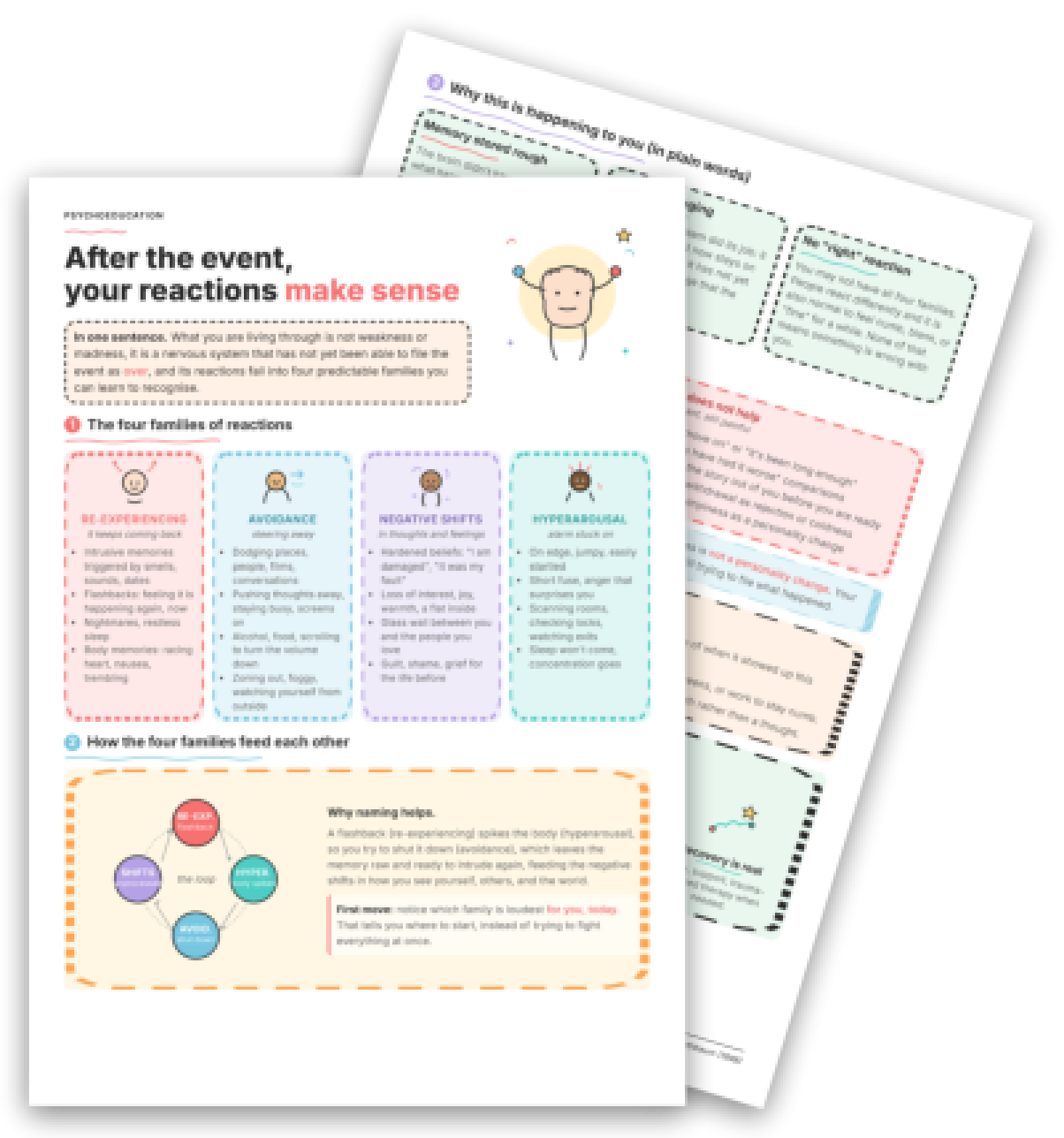
The fiche organises post-traumatic reactions into four clearly bounded families: re-experiencing (intrusive memories, flashbacks, somatic echoes), avoidance (situational, cognitive, and chemical), negative shifts (hardened beliefs, flat affect, relational disconnection), and hyperarousal (hypervigilance, irritability, sleep disruption). Each family lists four to five concrete, daily-life examples, deliberately avoiding diagnostic register.
A second panel renders how the four families feed each other as a visual loop. The fiche puts it plainly: "A flashback spikes the body, so you try to shut it down, which leaves the memory raw and ready to intrude again, feeding the negative shifts in how you see yourself, others, and the world." That sequence, shown as a diagram, does in ten seconds what five minutes of verbal explanation often cannot.
A third section offers a normalisation rationale in plain language, "Memory stored rough", "Alarm still ringing", "No right reaction", pitched to be read aloud or handed over mid-session. A fourth panel presents what helps vs. what does not help, designed to be shared with the patient's support network; it addresses the misreads family members typically make (reading withdrawal as rejection, jumpiness as a personality change). The fiche closes with a set of "To discuss in session" prompts flagging the moments worth bringing back to you: when one family runs louder than the others, when avoidance is widening, or when a belief like "I'm damaged" feels like fixed truth rather than a thought.
> Key point: this fiche is a visual support that facilitates explanation in session, not a self-administered questionnaire. You use it as a reference while you speak; the patient leaves with it as a concrete anchor between appointments, not a worksheet to complete alone.
750+ clinical tools
A library built with and for clinicians, ready to use in session and extend between appointments.
Access all the toolsWhen and how to introduce this fiche
The fiche fits naturally in the second or third session, once the initial clinical picture is clear and the alliance is solid enough to hold a psychoeducation moment. It is particularly well-suited for patients who pathologise their own reactions, and for those whose support network is struggling to interpret their withdrawal or irritability.
A low-threshold introduction: "I'd like to show you a map of the kinds of reactions that come up after something like what you've been through. It might help us identify which of these you're recognising in yourself right now." That framing positions the fiche as a shared instrument, not a diagnostic label.
During the debrief, ask which family feels loudest today. That single question, lifted directly from the fiche, orients the session without asking the patient to generate structure from scratch. From there, you can open work on behavioural avoidance patterns, cross-reference with autonomic dysregulation when hyperarousal dominates, or move toward a full PTSD symptom review for a more formal clinical picture. The adaptive vs. maladaptive coping resource pairs well when the patient is leaning on alcohol, screens, or overwork to manage the loop; the cognitive distortions framework extends the negative-shifts work naturally. Where somatic hypervigilance is prominent, a sensory grounding exercise or short body scan audio can be assigned alongside the fiche.
For patients moving toward formal trauma-focused work, the fiche can precede exposure hierarchy construction. The CBT maintaining processes model is a natural companion for case formulation conversations, and the fear psychoeducation program extends the normalisation work across several sessions. One limit worth naming: with patients in acute dissociative states, or in the very first days post-event, the four-family structure may be too complex to hold. Offer it once stabilisation is underway.
The fiche does not replace trauma-focused case formulation or the alliance that makes exposure work viable. It makes the early explanation phase sharper and leaves the patient with a concrete map to return to between sessions.
Use it with your patients
Share this tool in the mobile app and follow the work between sessions.
Sources
- American Psychiatric Association (APA) (2013). Posttraumatic Stress Disorder and DSM-5.
- van der Kolk, B. A. (2014). The Body Keeps the Score: Brain, Mind, and Body in the Healing of Trauma. Viking.
- Foa, E. B., Hembree, E. A., Rothbaum, B. O. (2007). Prolonged Exposure Therapy for PTSD: Emotional Processing of Traumatic Experiences - Therapist Guide. Oxford University Press.
- International Society for Traumatic Stress Studies (ISTSS) (2019). Posttraumatic Stress Disorder Prevention and Treatment Guidelines: Methodology and Recommendations.
- International Society for Traumatic Stress Studies (ISTSS). Trauma Basics: Common Reactions to Trauma.
Your session continues in your patients' pocket
Use with a patientYour resources, available everywhere
The handouts, exercises, programs and audios above: you choose which ones to make available to your patients, in the mobile app dedicated to them.
And far more than a library
The app goes well beyond resources, to support your patients every day:
Related categories
Explore other clinical resources by category.

Trauma
Clinical hub on trauma and PTSD: assessment, differential diagnosis, treatment phases, and printable resources for practitioners. 155 chars.

Understand
Clinical hub for the therapeutic aim 'Understand': worksheets and tools to build patient insight across CBT, ACT, schema therapy and more.

Build awareness
Clinical worksheets and tools to build awareness in therapy: cognitive distortions, schemas, emotions, ACT and CBT resources for practitioners.

CBT
CBT worksheets, cognitive restructuring exercises & behavioral tools for clinicians. Evidence-based resources for every phase of cognitive behavioral therapy.

Anxiety
Clinical hub for anxiety disorders: CBT and ACT worksheets, psychoeducation sheets, and exercises for assessment and treatment across the anxiety spectrum.

Mood
Evidence-based worksheets and clinical tools for mood disorders: CBT, ACT, and positive psychology resources for psychologists and therapists.