
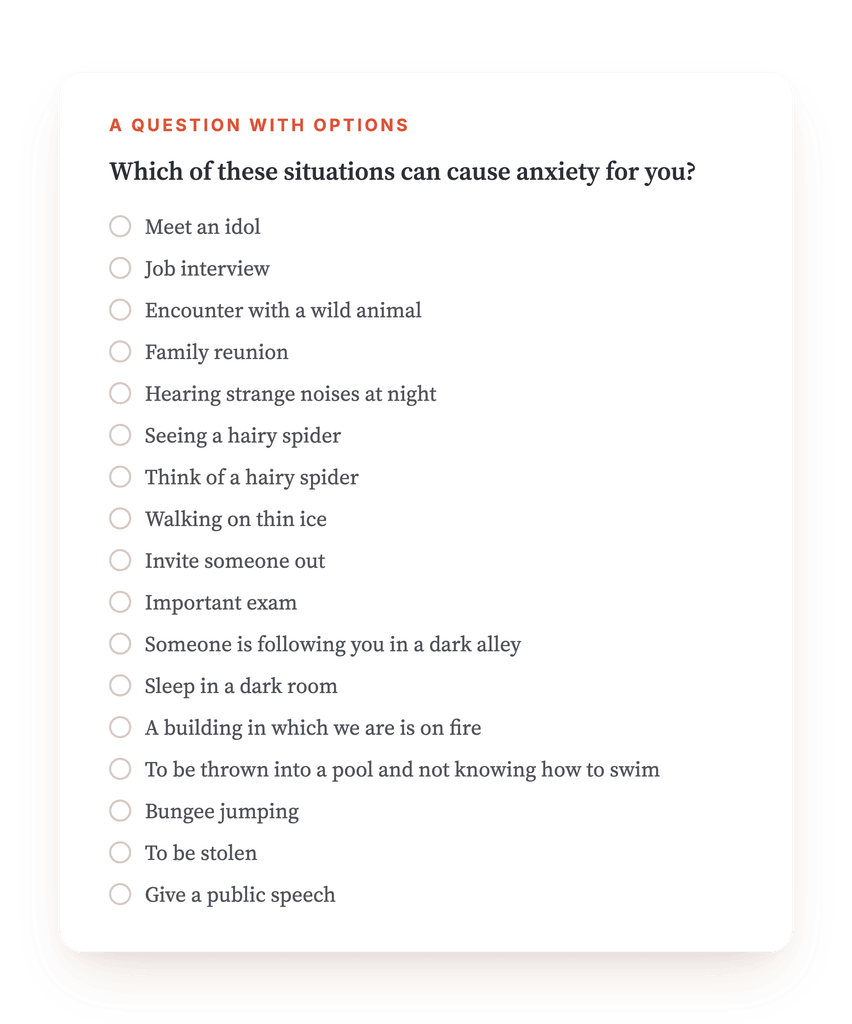
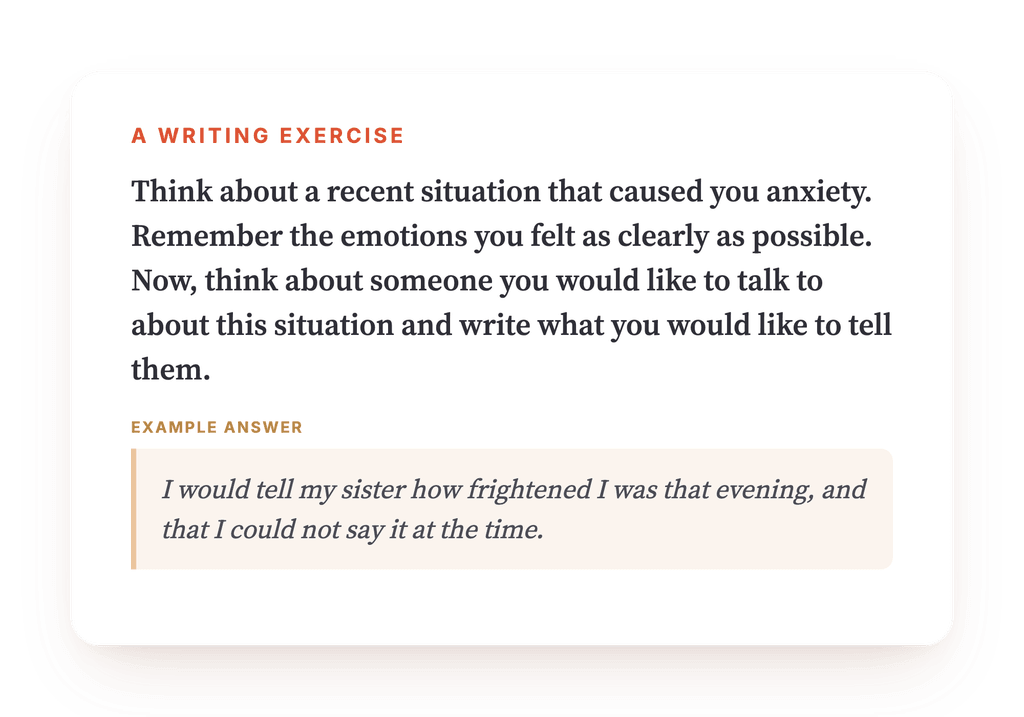
Clinical picture. A mother brings her 10-year-old son, T., following recurrent stomachaches before school; the paediatrician found no organic cause. The clinician introduces the psychoeducation program and asks the mother to work through Lesson 1 between appointments, focusing on the distinction between fear and anxiety and on somatic symptom recognition. At the next appointment she reports that the multiple-choice question listing anxiety-provoking situations helped her see that T. had been describing anticipatory worry, not defiance. This reframing shifted her approach at home from limit-setting toward validation, and T. began naming his physical sensations more readily in session.
Anxiety in Children and Adolescents: A Parent Psychoeducation Program
A structured five-lesson program helping parents understand, recognize, and respond to anxiety across developmental stages.
Clinical vignettes
Psychoeducation Clarifies a Parent's Framing
Adolescent Identifies Her Own Anxiety Profile
Clinical picture. L., 15 years old, presents with generalised worry and difficulty sleeping before assessments; she initially minimises symptoms, saying she is "just a bit stressed." The clinician assigns Lesson 1 as independent work, asking L. to complete the adjective-selection exercise and the reflective prompt about somatic experiences she has noticed. She returns having written two paragraphs describing heart palpitations and a dry mouth during oral presentations, which she had not previously connected to anxiety. The written exercise gave her a concrete vocabulary for subsequent sessions and reduced the time spent on basic psychoeducation within the clinical hour.
Use this resource with your patients
Handout, exercises and materials ready to use, right inside SessionFuel.
The clinical challenge: what words alone cannot carry
Explaining childhood anxiety to a worried parent is one of the more demanding psychoeducation tasks a clinician faces. The concept is genuinely slippery: fear, worry, anticipation, and panic are routinely conflated, and what reads as defiance or moodiness in an adolescent can be anxiety-driven behaviour that a parent simply does not recognize. Developmental stage compounds the difficulty further. The somatic expression of anxiety in a toddler who cannot yet label emotions looks nothing like the withdrawal or school refusal that marks anxiety in a fifteen-year-old. Conveying all of this verbally, within the ordinary time constraints of a consultation, is hard.
Parents also arrive with their own emotional reactions: guilt, confusion, a tendency to minimize, or the opposite impulse to catastrophize. These reactions can distort how much psychoeducation actually lands in the room. A structured, step-by-step resource they can work through on their own between appointments gives the information room to settle, and gives you something concrete to work from at the next consultation.
Clinical library
750+ clinical tools
A library built with and for clinicians, ready to use in session and extend between appointments.
Access all the toolsSeveral resource types
Psychoeducation handouts
Understand at a glance
Interactive exercises
To do and fill in
Interactive programs
A structured path
Audios
Meditation and relaxation
Psychometric tests
Automatic scoring
What the program contains
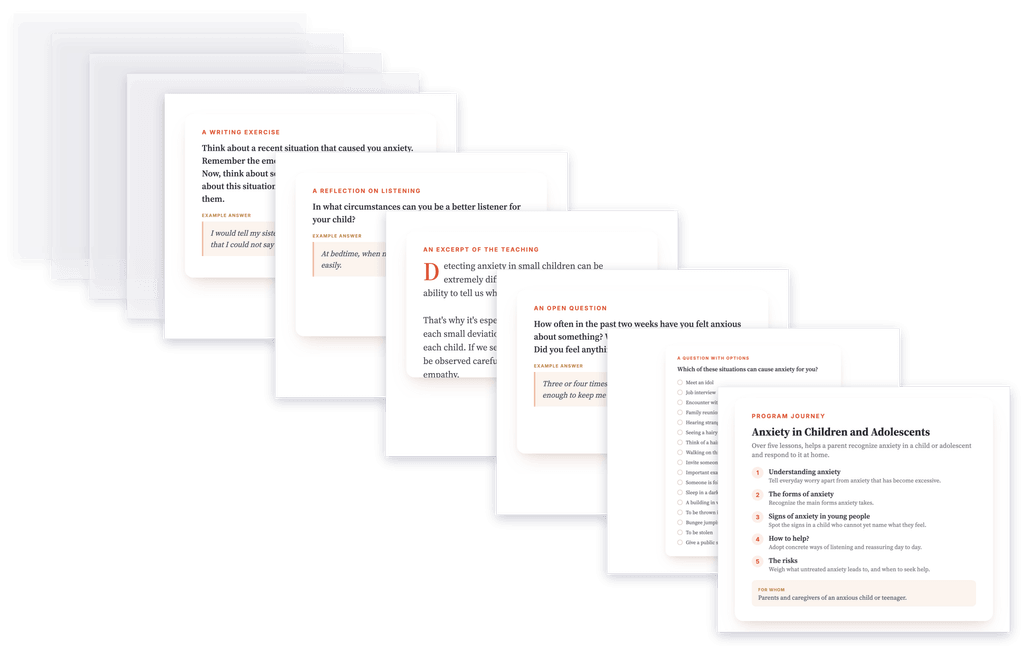
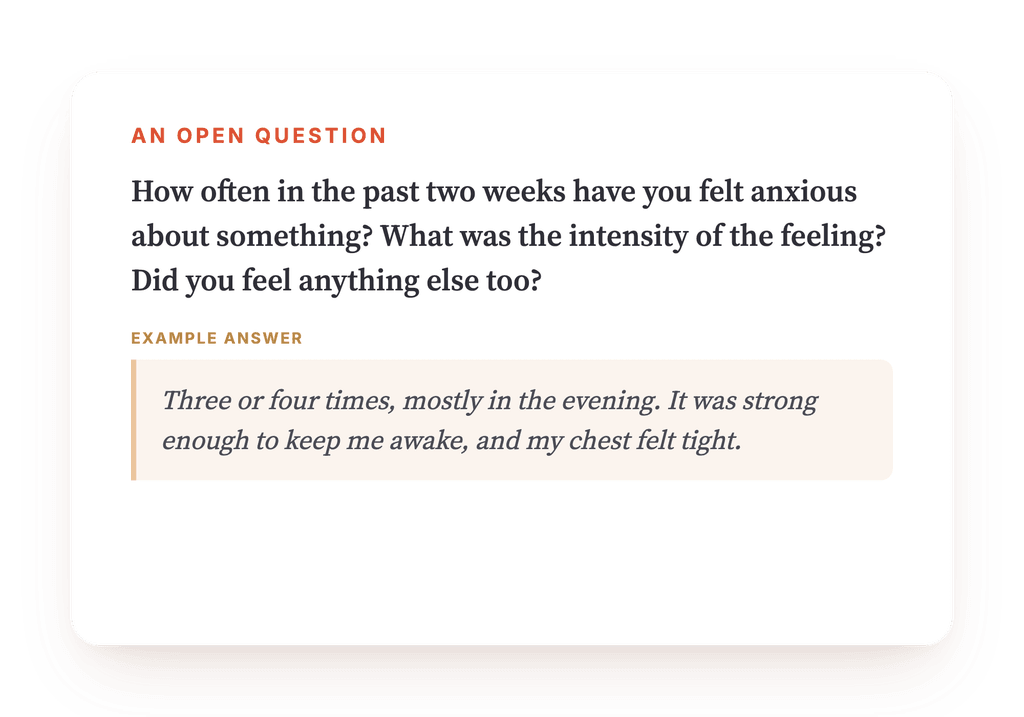
This five-lesson program builds a coherent arc from first principles to practical action. The preview images embedded here (a program overview map and a couple of sample cards) show only a small fraction of the complete curriculum; the full program contains many more lessons, steps, guided writing prompts, and multiple-choice questions than what is visible in these excerpts.
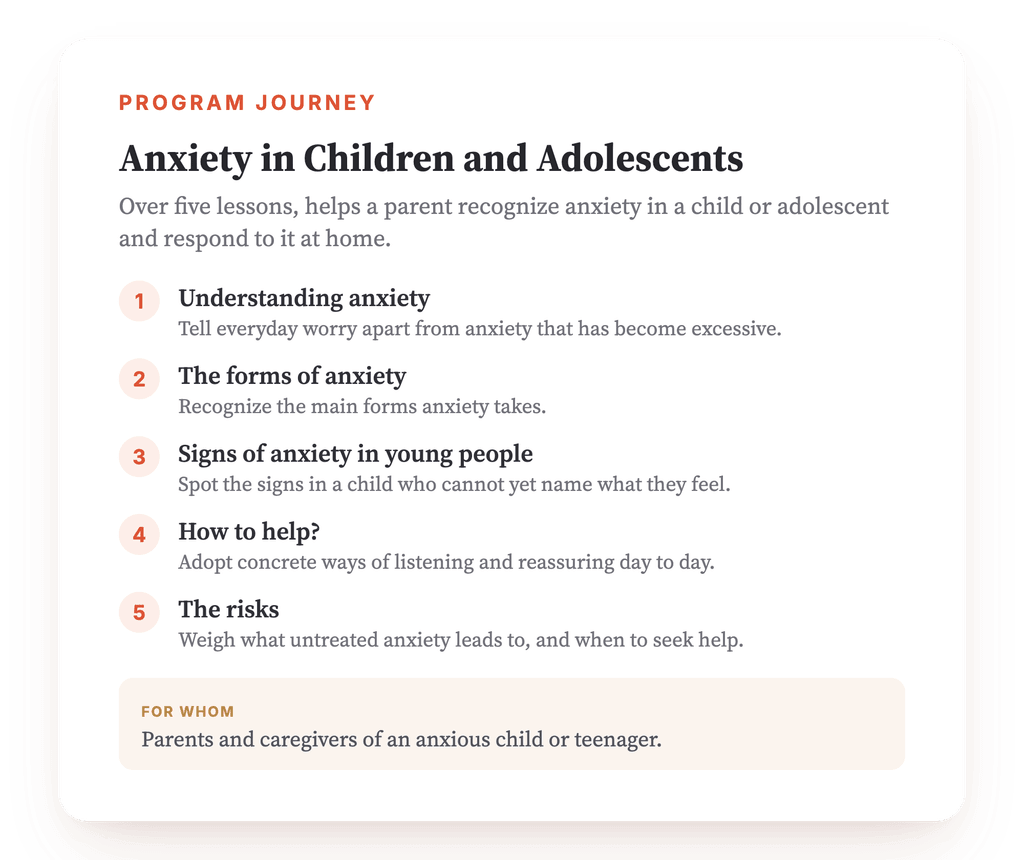
The opening lesson draws a clean distinction between fear and anxiety, introduces somatic symptoms through self-referential questions, and maps the spectrum from ordinary nervousness to clinical levels of distress. It also addresses how anxiety presents differently in children than in adults, establishing a developmentally grounded vocabulary from the start. Resources such as What Is Anxiety? and Your Stone Age Brain work well alongside this first lesson when parents ask why anxiety exists at all.
Lesson 2 surveys the main anxiety presentations, from specific phobias and social anxiety to generalized worry, and introduces the clinically important distinction between anxiety as an ordinary emotion and anxiety as a disorder. For parents whose child may be moving toward a diagnosis, pairing this lesson with Generalized Anxiety Disorder or Social Anxiety Disorder gives an additional layer of clarity.
Lesson 3 is the program's most practically oriented module for parents. It examines how anxiety looks at each developmental stage: preverbal children whose distress must be inferred from behaviour, school-age children navigating academic and social demands, and teenagers whose anxiety may appear as irritability, risk-taking, or social withdrawal. The Fight or Flight for Children fiche and Printable Emotion Faces can extend the conversation this lesson begins.
Lesson 4 shifts from understanding to action, covering building trust with an anxious child, genuine presence, managing parental anger in charged moments, and recognizing when professional help is warranted. Lesson 5 closes the program by examining the risks of untreated anxiety: escalation, the anxiety-depression loop, self-harm signals, and a self-compassion prompt for parents carrying their child's distress. The 50 Coping Strategies for Children and Adolescents worksheet is a natural companion resource to introduce alongside this final lesson.
Key takeaway: The program's alternation between explanatory text, reflective writing prompts, and multiple-choice questions makes psychoeducation an active process. What the parent writes between lessons becomes clinical material you can work from at the next appointment.
This program is available to your patients through the mobile patient application of SessionFuel, the companion app reserved for the patients of clinicians who use SessionFuel. You assign the program as between-session homework, and your patient works through each lesson directly on their phone, at their own pace.
Use it with your patients
Share this tool in the mobile app and follow the work between sessions.
Integrating the program as between-session homework
This program is designed for autonomous completion between two consultations, not for reading inside the session. It suits parents of children or adolescents presenting with anxiety, parents who are themselves anxious and therefore struggle to tolerate ambiguity in their child, and families where the presenting behaviour (school refusal, somatic complaints, oppositional episodes) has not yet been understood as anxiety-related.
When introducing it, a brief framing goes a long way: "Before we meet again, work through the first two lessons and notice what feels familiar." That instruction creates a low-threshold entry point and gives you specific material to return to. The written prompts your patient completes (on the moments they find it hardest to listen, on their own experience of vulnerability, on their teenager's fears) become a rich clinical document. Reviewing those responses opens conversations that would take much longer to reach through dialogue alone.
For parents of adolescents specifically, Lesson 3 on teenage anxiety presentations can reframe behaviour previously experienced as wilful defiance, shifting the relational stance before the next meeting. Combining the program with Facing Fears in Children, Token Reward System, Children's Fundamental Needs by Age, or CBT for Kids: Thoughts, Feelings and Actions gives you a broader toolkit to offer as therapeutic work progresses.
When comorbid low mood is part of the picture, the Child and Adolescent Depression: A Psychoeducation Program for Parents provides a direct continuation, since the anxiety-depression loop addressed in Lesson 5 often needs its own structured exploration. For parents whose child's anxiety is entangled with a difficult history, How Trauma Can Affect Children and Young People and What Is Worry? offer complementary psychoeducation angles worth assigning in sequence.
Patient mobile app
Your session continues in your patients' pocket
Use with a patientYour resources, available everywhere
The handouts, exercises, programs and audios above: you choose which ones to make available to your patients, in the mobile app dedicated to them.
Psychoeducation handoutsInteractive exercisesInteractive programsAudiosPsychometric tests
And far more than a library
The app goes well beyond resources, to support your patients every day:
Standardized tests
Therapy journal
Gamification
Wellbeing challenges
Introspection prompts
Therapist homework
Related categories
Explore other clinical resources by category.

Anxiety
Clinical hub for anxiety disorders: CBT and ACT worksheets, psychoeducation sheets, and exercises for assessment and treatment across the anxiety spectrum.

Relationships
Clinical worksheets and tools on relational functioning: attachment, schemas, assertiveness, and communication skills for therapists. Printable PDF resources.

Understand
Clinical hub for the therapeutic aim 'Understand': worksheets and tools to build patient insight across CBT, ACT, schema therapy and more.
CBT
CBT worksheets, cognitive restructuring exercises & behavioral tools for clinicians. Evidence-based resources for every phase of cognitive behavioral therapy.

Trauma
Clinical hub on trauma and PTSD: assessment, differential diagnosis, treatment phases, and printable resources for practitioners. 155 chars.

Mood
Evidence-based worksheets and clinical tools for mood disorders: CBT, ACT, and positive psychology resources for psychologists and therapists.