
Clinical picture. A., a 34-year-old presenting with recurrent panic attacks, described feeling "broken" because she could not simply talk herself out of her symptoms during episodes. The clinician introduced the Human Brain Diagram worksheet, walking through the brainstem's role in driving automatic arousal and the partial disengagement of the frontal lobe under acute threat. A. paused at the section on panic and said, unprompted, "So my brain is actually doing its job, just in the wrong situation." This reframe reduced her self-critical stance noticeably over the following two sessions and allowed the pair to shift focus toward earlier-stage regulation strategies rather than cognitively challenging thoughts mid-panic.
The Human Brain Diagram: PDF Worksheet, Tools and Exercises
A printable regional brain map with functional descriptions, top-down vs bottom-up skills, and session discussion prompts to anchor neurobiological psychoeducation in clinical work.
Clinical vignettes
Brain Map Reframes Panic Attacks
Anger and the Frontal Brake
Clinical picture. T., a 47-year-old referred following a workplace incident involving a verbal outburst, arrived to session skeptical that psychological input would address what he called a "character flaw." The clinician used the diagram's section on anger and the frontal lobe to explain why the regulatory brake is the slowest structure to engage during high arousal. T. recognized the description immediately, noting that his outbursts always felt reflexive rather than chosen. While the worksheet did not resolve the clinical picture, it opened a productive conversation about early physiological cues and gave T. a non-shaming framework within which to engage further with anger management work.
Explaining the neurobiology of dysregulation verbally rarely lands. Patients nod, then leave without a coherent framework for why "just calm down" fails them in the moment. This PDF worksheet gives the clinician a concrete visual anchor, a labelled side-view brain map with functional descriptions, clinical linkages, and session discussion prompts, that makes the explanation stick.
Use this resource with your patients
Handout, exercises and materials ready to use, right inside SessionFuel.
Why Neurobiological Psychoeducation Resists Verbal Delivery
When you tell a patient that their frontal lobe goes partly offline during acute panic, the idea is clinically accurate and therapeutically useful. Without a visual referent, it stays abstract. Patients commonly conflate brain with mind, assume dysregulation means weakness, and interpret the instruction to "use a coping skill" as a cognitive demand they cannot meet precisely when arousal is highest.
The top-down/bottom-up distinction is particularly hard to convey orally. In a CBT frame, patients are often introduced to cognitive restructuring and reframing before they understand why those tools fail when the brainstem has already shifted heart rate and breathing into high gear. Without a map showing which region runs what, the sequence body-first, then thought-work has no structural justification in the patient's mind. You end up repeating yourself across multiple sessions. A single visual support resolves this in far less time.
The same gap appears in trauma work. Patients presenting with PTSD symptoms or common trauma reactions often feel shame around flashback experiences they cannot narrate coherently. Naming the temporal lobe, parietal body-sense processing, and the deeper threat-detection systems (amygdala, hippocampus) as a coordinated, involuntary circuit reframes this experience immediately. Biology replaces moral failure as an explanatory frame.
What the Fiche Contains: A Visual Map for In-Session Use
The fiche PDF is structured across four panels, each building on the previous.
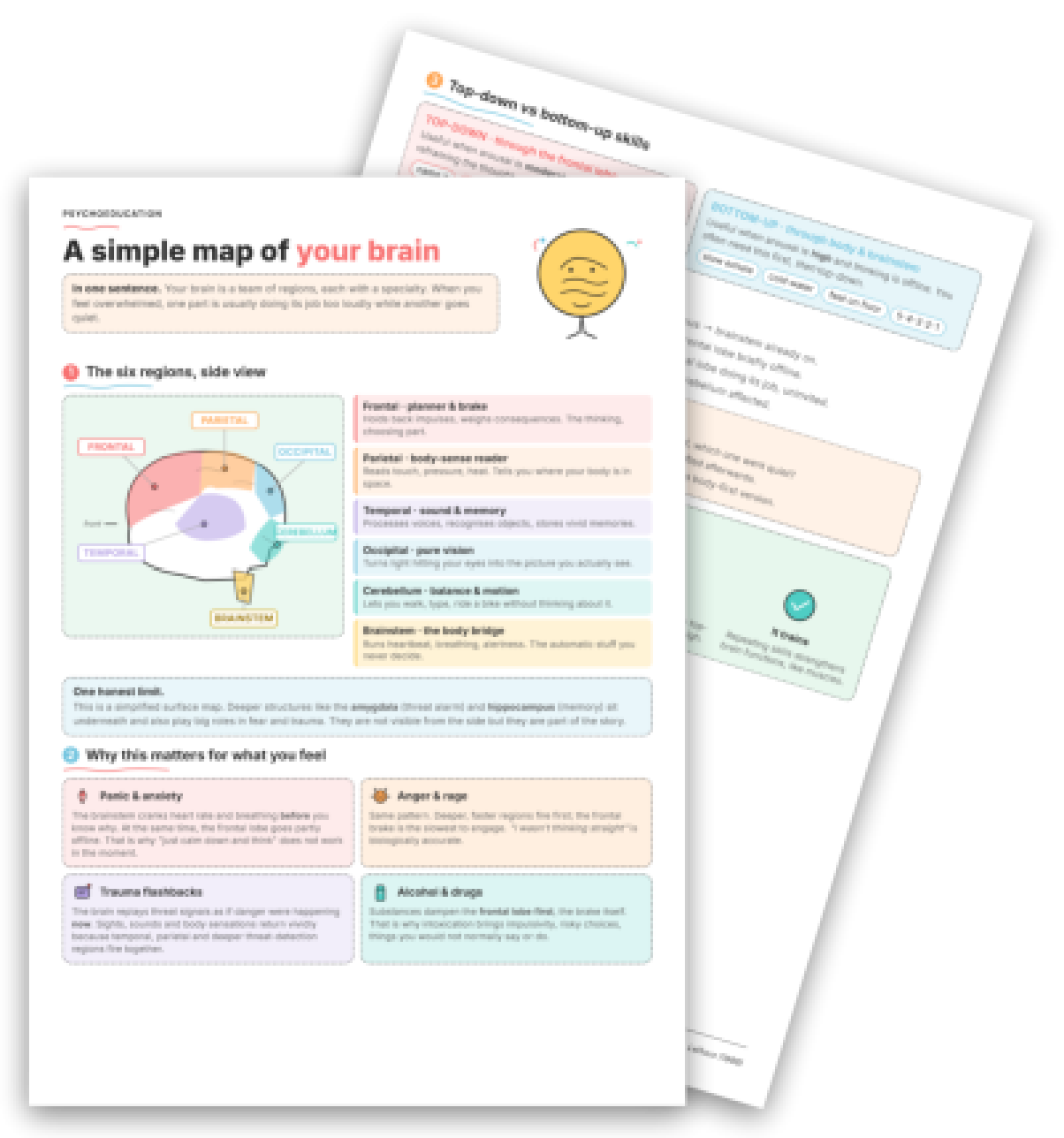
Panel 1 presents a side-view brain diagram with six labelled regions: Frontal, Parietal, Occipital, Temporal, Cerebellum, and Brainstem. Each region carries a brief functional descriptor, for instance, "Frontal · planner & brake: holds back impulses, weighs consequences" and "Brainstem · the body bridge: runs heartbeat, breathing, alertness." An honest-limits note flags that deeper structures (amygdala, hippocampus) are not visible from the side but remain clinically central to fear and trauma. This prevents the diagram from overpromising anatomical completeness.
Panel 2 links the map directly to presenting complaints: panic and anxiety, anger and rage, trauma flashbacks, and the effects of alcohol and drugs on frontal inhibition. The mechanism is stated plainly: "The brainstem cranks heart rate and breathing before you know why. At the same time, the frontal lobe goes partly offline." This gives patients a biological rationale for the sequencing you are already using clinically.
Panel 3 is the top-down vs bottom-up skills grid, the most immediately actionable section. It distinguishes skills routed through the frontal lobe (naming emotions, reframing, planning a response) from body-first interventions (slow exhale, cold water, feet on floor, 5-4-3-2-1). The grid specifies when each category applies: top-down when arousal is moderate, bottom-up when thinking is offline. This directly supports tools like grounding techniques, sensory grounding exercises for cognitive overwhelm, and DBT TIPP skills, giving patients a structural reason to reach for those resources first.
Panel 4 lists four recognisable moments (racing heart before conscious awareness, going blank in an argument, a smell triggering memory, losing coordination under stress) and three "To discuss in session" prompts designed for in-session debrief, not independent completion.
> To remember: The fiche is a visual support that facilitates psychoeducation in session, not a self-administered questionnaire. The diagram, the skills grid, and the session prompts are all tools the clinician uses with the patient, leaving them with a concrete referent they can return to between appointments.
Clinical library
750+ clinical tools
A library built with and for clinicians, ready to use in session and extend between appointments.
Access all the toolsSeveral resource types
Psychoeducation handouts
Understand at a glance
Interactive exercises
To do and fill in
Interactive programs
A structured path
Audios
Meditation and relaxation
Psychometric tests
Automatic scoring
When and How to Introduce the Fiche
This resource fits naturally in early psychoeducation phases, particularly after an initial exploration of anxiety or fear, and before introducing graded exposure or formal emotion regulation work. It is also well suited mid-treatment when a patient is struggling to generalise skills across contexts.
Introduce it without diagnostic labelling: "I'd like to show you a map that explains what happens in the brain when things get overwhelming, it helps us decide which kind of skill to reach for." Point to the brainstem and frontal regions while describing the patient's own reported experience. Then move directly to the top-down/bottom-up grid and anchor it to the skills you have already introduced, such as breathing-based regulation or body-awareness work.
For the debrief, use the three session prompts as they stand: ask the patient which region was "loud" in a recent dysregulated moment, and which went "quiet." This vocabulary, once shared, becomes a precise shorthand across subsequent sessions.
One practical limit: with patients who hold strong biomedical models of mental illness, the regional framing may temporarily reinforce fatalism ("my brain does this, so I can't change it"). Counter this proactively with the "It trains" reminder printed at the bottom of the fiche: repeating skills strengthens brain functions, much like muscle conditioning. The fiche raises the point; you complete the frame.
The fiche does not replace clinical conceptualisation or the formulation of a full case formulation. It makes one foundational explanation clearer and leaves the patient with a durable, portable reference, which is precisely what a PDF worksheet is for.
Use it with your patients
Share this tool in the mobile app and follow the work between sessions.
Sources
- LeDoux, J. E. (1996). The Emotional Brain: The Mysterious Underpinnings of Emotional Life. Simon & Schuster.
- Panksepp, J. (1998). Affective Neuroscience: The Foundations of Human and Animal Emotions. Oxford University Press.
- Porges, S. W. (2011). The Polyvagal Theory: Neurophysiological Foundations of Emotions, Attachment, Communication, and Self-regulation. W. W. Norton & Company.
- van der Kolk, B. A. (2014). The Body Keeps the Score: Brain, Mind, and Body in the Healing of Trauma. Viking.
- Guendelman, S., Medeiros, S., Rampes, H. (2017). Mindfulness and Emotion Regulation: Insights from Neurobiological, Psychological, and Clinical Studies. Frontiers in Psychology.
Patient mobile app
Your session continues in your patients' pocket
Use with a patientYour resources, available everywhere
The handouts, exercises, programs and audios above: you choose which ones to make available to your patients, in the mobile app dedicated to them.
Psychoeducation handoutsInteractive exercisesInteractive programsAudiosPsychometric tests
And far more than a library
The app goes well beyond resources, to support your patients every day:
Standardized tests
Therapy journal
Gamification
Wellbeing challenges
Introspection prompts
Therapist homework
Related categories
Explore other clinical resources by category.

Trauma
Clinical hub on trauma and PTSD: assessment, differential diagnosis, treatment phases, and printable resources for practitioners. 155 chars.

Emotions
Clinical resources on emotion regulation: worksheets, coping tools, CBT, REBT, and ACT exercises for therapists working across diagnoses and age groups.

Behaviours
Clinical hub for behaviors in therapy: worksheets and tools for coping, eating disorders, CBT formulation, and maladaptive behavioral patterns.

Cognition
Printable cognitive therapy worksheets and clinical tools for therapists: CBT, ACT, schema work, defusion, distortions, and belief restructuring.

Understand
Clinical hub for the therapeutic aim 'Understand': worksheets and tools to build patient insight across CBT, ACT, schema therapy and more.

CBT
CBT worksheets, cognitive restructuring exercises & behavioral tools for clinicians. Evidence-based resources for every phase of cognitive behavioral therapy.