
Clinical picture. A 34-year-old man referred for anger management described weekly outbursts at work that were straining his professional relationships; he consistently reported feeling "fine" until he was already shouting. During a session focused on psychoeducation, the clinician introduced Plutchik's Wheel and drew attention to the outer intensity ring, pointing out that annoyance and irritability are detectable long before anger reaches rage. The patient was asked to track body cues across the coming week and match them to the wheel's outer ring rather than waiting for a felt sense of "explosion." At the next appointment he reported having noticed a low-grade annoyance two hours before a typical trigger situation and leaving the open-plan office for ten minutes. No outburst occurred; the clinician used the example as a starting point for building a personalised early-signal plan.
Plutchik's Wheel of Emotions: PDF Worksheet, Tools and Exercises
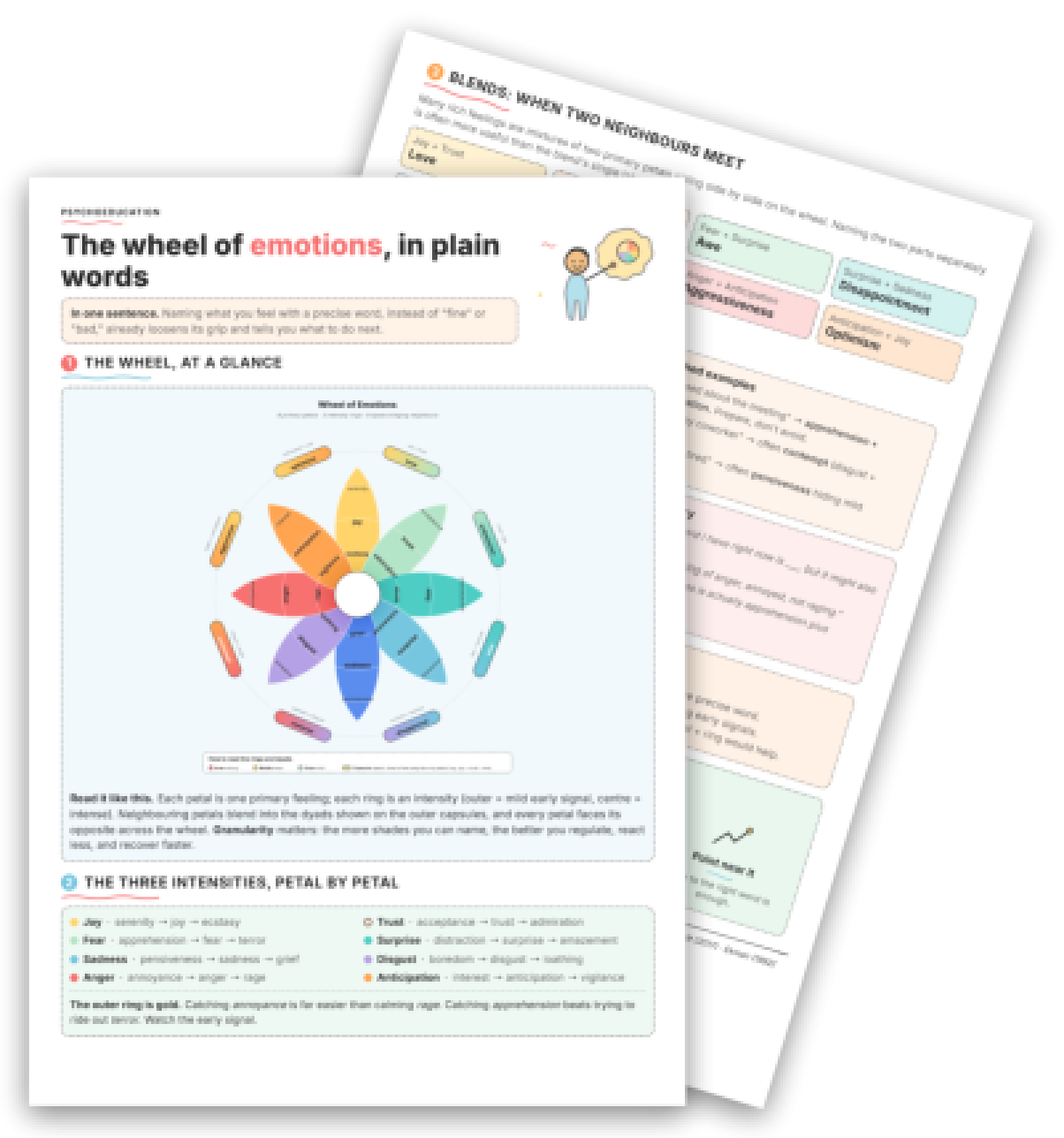
A visual psychoeducation fiche mapping 8 primary emotions, 3 intensity rings, and 8 dyads, to build emotional granularity with patients directly in session.
Clinical vignettes
Naming Annoyance Before It Becomes Rage
Differentiating Remorse From Sadness in Grief Work
Clinical picture. A 58-year-old woman presented eight months after the death of her spouse with persistent low mood she described only as "feeling terrible all the time," which had made it difficult to identify targets for intervention. The clinician introduced the Wheel of Emotions as a shared vocabulary tool, and the patient was invited to place her daily states on the diagram rather than use global descriptors. She quickly identified that a recurring night-time state sat closer to the remorse capsule (sadness combined with disgust directed at herself) than to straightforward sadness, linked to a conversation she regretted not having before her husband died. This distinction allowed the clinician to shift part of the work toward the self-critical component specifically, using a more targeted approach than grief psychoeducation alone would have provided.
Patients almost universally collapse emotional experience into two or three words: "stressed," "bad," "fine." Verbal prompting in session rarely expands that vocabulary fast enough to be clinically useful. This fiche PDF on Plutchik's Wheel of Emotions gives you a concrete visual support to do that work alongside the patient, without delivering a lecture.
Use this resource with your patients
Handout, exercises and materials ready to use, right inside SessionFuel.
Why Emotional Granularity Resists Verbal Explanation
The clinical obstacle is not that patients lack emotional experience. It is that they lack the vocabulary to differentiate it, and that deficit has real functional consequences. Research in affective labeling shows that naming an emotion with precision reduces its regulatory load; the more granular the label, the lower the sustained physiological arousal. Barrett's theory of constructed emotion makes the same argument from a different angle: the brain needs a precise concept to regulate what it is constructing. When a patient describes everything as "stressed," you lose access to the distinction between apprehension (fear-toned anticipation, pointing toward preparation) and annoyance (mild anger, pointing toward a boundary or injustice), two states that call for completely different clinical moves.
Trying to convey the intensity spectrum and blending logic of emotions verbally, in the middle of a session, rarely lands. The patient nods, but the map does not transfer. A spatially organised emotion reference tool anchors the concept in a form the patient can keep and return to between appointments.
What the Fiche Contains: Four Panels, One Shared Map
The fiche is structured in four numbered sections. Panel 1 presents the full wheel: eight primary petals (joy, trust, fear, surprise, sadness, disgust, anger, anticipation), three concentric intensity rings (outer mild, middle base, inner strong), and eight labelled dyads bridging adjacent petals. The circular layout makes immediately visible what words obscure: that emotions exist on a continuous spectrum, and that neighbouring states blend into richer, named experiences.
Panel 2 walks through each petal across its three intensities. The progression annoyance, anger, rage and apprehension, fear, terror is printed explicitly, with the clinical note that "catching annoyance is far easier than calming rage." This single line reframes outer-ring detection as a learnable skill and maps naturally onto any work you are doing with identifying emotional triggers or anger stop signs.
Panel 3 maps the eight dyads. Joy + trust = love. Disgust + anger = contempt. Sadness + disgust = remorse. This section is especially useful when you are already working with the anger iceberg: the wheel makes visible that much of what patients label "rage" contains a secondary petal, often sadness or fear, sitting one position over. Naming both components gives the patient a more accurate and more workable target.
Panel 4 offers a three-step move the patient can apply in real time: identify which petal is closest, identify which ring, then check whether a neighbouring emotion is blending in. The worked examples are clinically precise. "Fine, just tired" is reframed as "pensiveness hiding mild sadness"; "stressed about the meeting" becomes "apprehension plus anticipation." Three distinctions are spelled out explicitly: anger versus hurt, anxiety versus excitement, sadness versus shame. These are exactly the confusions that generate the most therapeutic drift across sessions.
The panel closes with a short list of "To discuss in session" prompts, ready to use as a shared agenda.
> Key takeaway: This fiche is a visual support that facilitates in-session explanation. You hold it, you point to it, you locate the patient's experience on the wheel together. It is not a self-administered questionnaire; it is a psychoeducation scaffold that leaves the patient with a reusable, concrete reference between appointments.
750+ clinical tools
A library built with and for clinicians, ready to use in session and extend between appointments.
Access all the toolsWhen and How to Propose It
The fiche fits naturally from the second or third session onward, once the initial anamnesis is complete and you have a working sense of the patient's affective vocabulary. It is particularly indicated with patients who:
- Default to somatic descriptors ("I feel heavy," "I'm tense") rather than emotional labels
- Show emotional inhibition or an alexithymia-adjacent presentation
- Use globally negative self-labels ("I'm depressed," "I hate them") that would benefit from unpacking into petal and ring
A straightforward introduction: "I want to show you something that might give us a shared vocabulary for what you've been describing." Start with the outer ring. Ask the patient to locate their current or recent experience on the wheel before you offer any label yourself. What you observe in that moment, hesitation, surprise at a word, immediate recognition, is clinically informative in its own right.
The fiche integrates without friction into DBT work on emotion regulation skills, into ACT work on the function of emotions and defusion from emotional labels, and into any formulation where behavior, emotion, and underlying need need to be mapped explicitly. It also pairs cleanly with adaptive versus maladaptive coping once the patient can name what they are actually coping with.
For younger patients, combine it with emotion thermometers for children or coping strategies for kids and teens. For presentations where anger is the chief complaint, layer it with anger management tools to make the outer-ring detection skill explicit and practised.
The fiche does not replace formulation or the therapeutic relationship. It accelerates the moment when both you and the patient are pointing at the same thing, which is often when the real work begins.
Use it with your patients
Share this tool in the mobile app and follow the work between sessions.
Sources
- Plutchik, R. (1980). Emotion: A Psychoevolutionary Synthesis. Harper and Row.
- Plutchik, R. (1991). The Emotions (Revised Edition). University Press of America.
- Plutchik, R. (2001). The Nature of Emotions. American Scientist, 89(4), 344-350.
Your session continues in your patients' pocket
Use with a patientYour resources, available everywhere
The handouts, exercises, programs and audios above: you choose which ones to make available to your patients, in the mobile app dedicated to them.
And far more than a library
The app goes well beyond resources, to support your patients every day:
Related categories
Explore other clinical resources by category.

Identity
Clinical resources for self-identity work in therapy: CBT, ACT, schema tools for clinicians addressing self-concept, core beliefs, and identity disruption.

Emotions
Clinical resources on emotion regulation: worksheets, coping tools, CBT, REBT, and ACT exercises for therapists working across diagnoses and age groups.

Build awareness
Clinical worksheets and tools to build awareness in therapy: cognitive distortions, schemas, emotions, ACT and CBT resources for practitioners.
CBT
CBT worksheets, cognitive restructuring exercises & behavioral tools for clinicians. Evidence-based resources for every phase of cognitive behavioral therapy.

Emotion-focused
Emotion-focused therapy clinical resources: worksheets, exercises & programs for EFT practitioners working with individuals and couples.

Anxiety
Clinical hub for anxiety disorders: CBT and ACT worksheets, psychoeducation sheets, and exercises for assessment and treatment across the anxiety spectrum.