
Clinical picture. R., a man in his late thirties, presents with longstanding worry and sleep disruption; he describes his inner state almost exclusively as 'stressed' or 'not great,' regardless of context. The clinician introduces the hierarchical map as a between-session worksheet, asking R. to circle the closest word each evening rather than write prose. By the third week R. consistently lands on dread before work calls and resentment after family interactions, two distinct clusters he had been conflating. With that separation in place, the clinician and R. could address each thread with a different focus, and R. reported that naming alone reduced his urge to ruminate on undifferentiated tension.
Emotions: A Hierarchical Map: PDF Worksheet, Tools and Exercises
A structured visual fiche helping clinicians teach emotion granularity in session, moving patients from vague labels to precise, actionable emotional language.
Clinical vignettes
Granular Labelling in Generalized Anxiety
Locating Shame Beneath Reported Anger
Clinical picture. T., a woman in her mid-forties referred after a workplace conflict, opens the session insisting she feels only anger toward a colleague who was promoted ahead of her. The clinician shares the hierarchical map and walks through the sadness family aloud, pausing at the neglect cluster. T. goes quiet when she reads the word humiliation, then circles it without prompting. The clinician notes that humiliation and anger often sit in the same moment, and that the anger had been the more tolerable surface layer. Naming the underlying humiliation shifted the session from grievance rehearsal to an exploration of what the promotion had meant to T.'s sense of professional worth.
Patients reach for the same four or five words: "stressed," "fine," "upset," "angry," "bad." Pressing them verbally to be more precise often stalls the session or produces polite agreement without any real shift in self-awareness. This fiche PDF on the hierarchical map of emotions gives you a concrete visual structure to do that work in session, grounding what is otherwise an abstract psychoeducation point in something the patient can see, circle, and take home.
Use this resource with your patients
Handout, exercises and materials ready to use, right inside SessionFuel.
Why Emotion Granularity Resists Oral Explanation
The construct is well-supported. Feldman Barrett's work on emotion granularity shows that finer-grained emotional concepts predict lower symptom reactivity, better regulatory flexibility, and reduced reliance on maladaptive coping. Kashdan's research reinforces this in clinical populations. The theory lands easily with colleagues. With patients, the gap between hearing the principle and actually accessing a richer vocabulary is wide.
When you explain orally that "anger has layers" or that "anxiety and fear are clinically distinct," the patient will often nod, then revert to the same global label the following week. The concept needs a scaffold: a structure that makes the hierarchy visible, that the patient can scan in real time during the session. Without it, you are asking someone to expand their emotional vocabulary on demand, in the middle of the emotional activation that brought them to you. That is precisely when generative word-finding is hardest.
The Emotion Wheel (114 Emotions) and the Basic Emotions fiche address adjacent territory, but the hierarchical map here is specifically built around the drill-down logic: family first, then cluster, then the exact word that produces a somatic "yes."
What the Fiche Contains: A Visual Scaffold for the Session
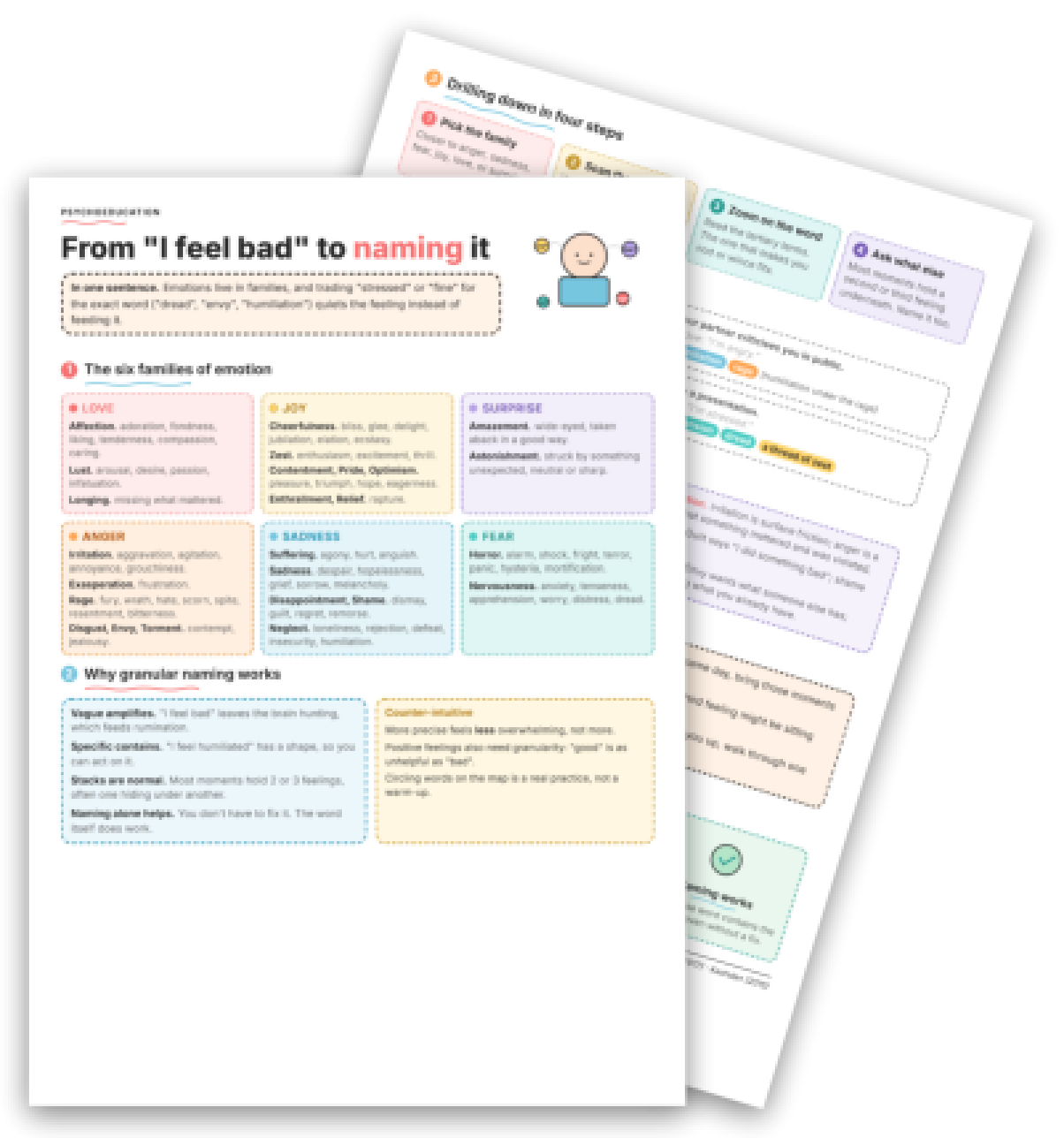
The fiche organises six primary emotion families (love, joy, surprise, anger, sadness, fear) and expands each into secondary clusters and tertiary terms. Under sadness, for instance, the map moves from suffering and grief down to humiliation, defeat, insecurity, and neglect as distinct emotional experiences. Under fear, it separates horror (alarm, terror, panic) from nervousness (apprehension, dread, distress), which is a clinically meaningful distinction when working with generalised anxiety versus acute fear responses.
> Key clinical point: This fiche is a visual psychoeducation support you use in session, not a self-administered questionnaire. The patient reads the map alongside you, scans for resonance, and lands on a word together with you, which is the active ingredient.
Section 2 of the fiche articulates the mechanism concisely: "Vague amplifies. 'I feel bad' leaves the brain hunting, which feeds rumination. Specific contains. 'I feel humiliated' has a shape, so you can act on it." That framing transfers directly into your in-session language without requiring you to reconstruct the argument from scratch.
Section 5, "Close cousins, different work," is particularly useful for differentiating affectively similar states that pull toward different interventions: shame versus guilt, envy versus jealousy, loneliness versus chosen solitude, anxiety versus fear. Each pair has a one-line clinical distinction. This panel alone saves several minutes of verbal explanation and opens a much cleaner formulation conversation. It pairs naturally with The Anger Iceberg for patients where secondary anger masks more vulnerable states, and with the Behavior, Emotion, Underlying Need fiche when formulating what the precise emotion is signalling functionally.
Section 4 provides four worked examples ("a friend cancels last minute," "your partner criticises you in public") showing the move from a vague label to a two-or-three-word emotional stack. You can walk through these with the patient or use them as models for a live drilling exercise.
Section 6, "To discuss in session," closes the fiche with three explicit prompts for between-session observation, giving the patient a concrete task: notice when they reach for "fine" or "stressed" twice in one day and bring those moments back.
Clinical library
750+ clinical tools
A library built with and for clinicians, ready to use in session and extend between appointments.
Access all the toolsSeveral resource types
Psychoeducation handouts
Understand at a glance
Interactive exercises
To do and fill in
Interactive programs
A structured path
Audios
Meditation and relaxation
Psychometric tests
Automatic scoring
When and How to Introduce the Fiche
This fiche fits naturally from the second or third session onward, once the initial anamnèse is complete and you have a working picture of the patient's dominant emotional presenting pattern. It is especially indicated with patients who show alexithymia features, those who intellectualise in session without affective contact, and those whose cognitive distortions are entangled with globally labelled emotional states that resist differentiation verbally.
You can introduce it simply: "I want to show you a map that a lot of people find useful. It's not a test. We're just going to look at it together and see if any of these words land closer to what you described." Then move into the drill-down sequence from Section 3: pick the family, scan the cluster, zoom to the exact word, then ask what else might be underneath.
The fiche integrates readily into DBT-informed emotion regulation work, CBT case formulation, and the cognitive triangle, since naming the emotion precisely is a prerequisite for accurate thought monitoring. It also pairs well with the Emotions in Depression program and the Emotion Regulation psychoeducation program as an accessible entry point before deeper regulatory work begins.
A practical note on contraindications: with patients in acute dissociative states or with limited capacity for introspection due to a current depressive episode, defer the granularity work until some stabilisation is achieved. For patients who are ready, the fiche does not replace the clinical conversation; it structures it, shortens it, and leaves something concrete in the patient's hands after the session ends.
Use it with your patients
Share this tool in the mobile app and follow the work between sessions.
Sources
- Parrott, W. G. (2001). Emotions in Social Psychology: Essential Readings. Psychology Press.
- Plutchik, R. (1980). Emotion: A Psychoevolutionary Synthesis. Harper and Row.
- Wilson-Mendenhall, C. D., Dunne, J. D. (2021). Cultivating Emotional Granularity. Frontiers in Psychology.
Patient mobile app
Your session continues in your patients' pocket
Use with a patientYour resources, available everywhere
The handouts, exercises, programs and audios above: you choose which ones to make available to your patients, in the mobile app dedicated to them.
Psychoeducation handoutsInteractive exercisesInteractive programsAudiosPsychometric tests
And far more than a library
The app goes well beyond resources, to support your patients every day:
Standardized tests
Therapy journal
Gamification
Wellbeing challenges
Introspection prompts
Therapist homework
Related categories
Explore other clinical resources by category.

Emotions
Clinical resources on emotion regulation: worksheets, coping tools, CBT, REBT, and ACT exercises for therapists working across diagnoses and age groups.

Understand
Clinical hub for the therapeutic aim 'Understand': worksheets and tools to build patient insight across CBT, ACT, schema therapy and more.

Build awareness
Clinical worksheets and tools to build awareness in therapy: cognitive distortions, schemas, emotions, ACT and CBT resources for practitioners.

CBT
CBT worksheets, cognitive restructuring exercises & behavioral tools for clinicians. Evidence-based resources for every phase of cognitive behavioral therapy.

Emotion-focused
Emotion-focused therapy clinical resources: worksheets, exercises & programs for EFT practitioners working with individuals and couples.

Anxiety
Clinical hub for anxiety disorders: CBT and ACT worksheets, psychoeducation sheets, and exercises for assessment and treatment across the anxiety spectrum.