
Clinical picture. A., a man in his early 40s, presents with work-related burnout and reports feeling "stressed all the time" without being able to say more. During a cognitive-behavioural session, the clinician introduces the 114-emotion wheel and asks him to locate last Tuesday's team meeting on it. A. moves from the outer ring inward, settling first on overwhelmed, then on dismissed and inferior. With those two words in view, the conversation shifts from a diffuse complaint about workload to a specific relational dynamic with his line manager. The session ends with a concrete behavioural experiment rather than a generic stress-management plan.
Emotion Wheel (114 Emotions): PDF Worksheet, Tools and Exercises
A visual PDF worksheet mapping 114 emotions across three rings, with tools and exercises to help patients move from vague feelings to precise emotional labels in session.
Clinical vignettes
Naming Beyond 'Stressed' in CBT
Emotional Granularity in Grief Work
Clinical picture. M., a woman in her late 50s, is eight months into bereavement following the death of her spouse and describes being "just sad, all the time." The clinician places the emotion wheel on the table and invites her to scan it while recounting a specific moment from the previous week, sitting alone at dinner. M. identifies abandoned, guilty, and, after a pause, resentful, the last of which surprises her. Naming resentment alongside grief opens a discussion about ambivalence that she had not previously been able to articulate. The clinician notes this as a useful entry point for subsequent work on complicated grief.
Patients regularly arrive describing feeling "bad," "stressed," or "off", and stay stuck there. The label is accurate enough to locate suffering, but too vague to target therapeutically. This emotion wheel PDF worksheet gives you a concrete visual tool to move that description forward, in session, without lengthy verbal scaffolding.
Use this resource with your patients
Handout, exercises and materials ready to use, right inside SessionFuel.
Why Emotional Granularity Is Hard to Build Through Conversation Alone
Emotional granularity, the capacity to distinguish finely between affective states, is not a given. As Feldman Barrett's work makes clear, people who label emotions with precision regulate them more efficiently and ruminate less. The clinical problem is that most patients have never been given a vocabulary for this. When you ask "What are you feeling right now?", the answer "angry" or "sad" is often the ceiling of what they can access unaided.
Explaining this verbally runs into a predictable wall: the patient can follow the concept intellectually while remaining unable to apply it to their own experience. The same patient who understands that jealousy and envy are different things will still reach for "I'm jealous" when what they mean is envy, or vice versa. The distinction collapses under the cognitive load of a charged moment.
This is particularly visible when working on anger that masks secondary emotions, on shame-adjacent states, or on the diffuse low mood that characterizes depression's emotional landscape. Without a shared lexicon, the therapeutic conversation keeps circling back to the same undifferentiated words. The fiche gives both you and your patient a map to navigate that terrain together.
What the Fiche Contains: A Three-Ring Visual Map
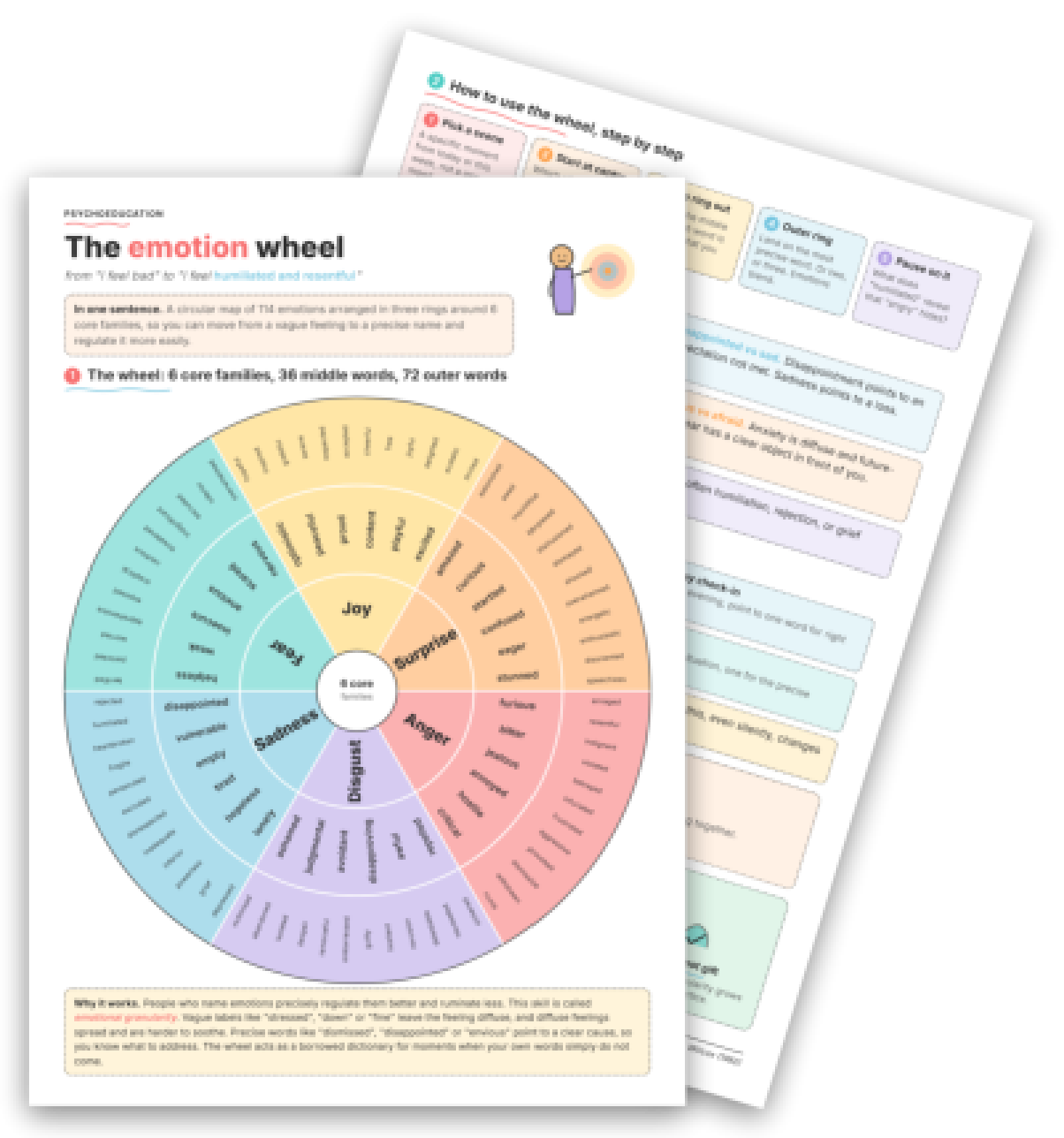
The emotion wheel organises 114 emotions across three concentric rings anchored in 6 core families: Joy, Surprise, Anger, Disgust, Sadness, and Fear. From the centre outward, the granularity increases: 6 core words become 36 intermediate words (such as hostile, hopeless, insecure, eager), which expand into 72 outer words (including infuriated, resentful, heartbroken, panicked, awed, speechless).
The visual structure does something oral explanation cannot: it shows the patient, at a glance, that humiliated and rejected are both refinements of fear, not just intensified versions of anger. That spatial logic is immediately graspable in a way that a spoken list never is.
The fiche also includes a step-by-step guide for using the wheel: start with a specific scene, locate the core family, move one ring outward, then land on the most precise word. The instruction "What does 'humiliated' reveal that 'angry' hides?" is printed on the sheet itself, which means the patient can re-engage that question independently between sessions.
A dedicated panel on words that look alike but feel different addresses four high-frequency clinical confusions: humiliated vs ashamed (the first involves another person lowering you; the second is about who you feel you are), disappointed vs sad, jealous vs envious, and anxious vs afraid. Each distinction points toward a specific therapeutic direction, and having them printed in front of the patient makes the conversation faster and more precise. This pairs naturally with shame-focused work or exercises targeting the behavior-emotion-need triad.
> Key point: This fiche is a visual support for psychoeducation to be used with the patient in session. It is not a self-report questionnaire to complete alone; it is a shared reference that builds a common vocabulary and leaves the patient with a concrete tool to take home.
A final section on daily practice (twice-a-day check-ins, journaling pairs, saying the word aloud) and a set of session discussion prompts round out the resource, giving you structured entry points for the next appointment.
Clinical library
750+ clinical tools
A library built with and for clinicians, ready to use in session and extend between appointments.
Access all the toolsSeveral resource types
Psychoeducation handouts
Understand at a glance
Interactive exercises
To do and fill in
Interactive programs
A structured path
Audios
Meditation and relaxation
Psychometric tests
Automatic scoring
When and How to Introduce the Fiche
The wheel fits naturally from the second or third session onward, once you have a working alliance and an initial formulation. For patients presenting with emotion regulation difficulties, anger management work, or persistent low mood, it can be introduced earlier as a grounding tool.
A low-pressure framing: "I want to show you something that a lot of people find useful. It's a map of emotions, we'll use it together right now to name what you were feeling in that moment you described." This avoids pathologising and positions the wheel as a collaborative exercise rather than a diagnostic task.
In session, work the wheel together around a concrete scene the patient has already described. Point to the core ring, let them choose, then move outward. The moment a patient lands on a precise outer word and says "yes, that one" is clinically significant: notice the somatic shift, the slight relief of being named accurately. That is the emotional granularity effect in real time.
The fiche's built-in session prompts, "When you keep landing on the same outer-ring word week after week, bring it in", also make it useful as a between-session monitoring anchor, complementing structured self-monitoring exercises or CBT-based emotional tracking.
A reasonable limit: for patients in acute dissociative states or with significant alexithymia, the 114-item wheel can initially feel overwhelming. The fiche itself acknowledges this with the note "When the 114 words feel paralysing, ask for a simpler version to start from." In those cases, beginning with the basic emotions guide before introducing the full wheel is a sensible staging strategy.
The fiche does not replace the formulation or the therapeutic frame; it makes the vocabulary work faster and leaves the patient with a reference they can actually use between sessions.
Use it with your patients
Share this tool in the mobile app and follow the work between sessions.
Sources
- Plutchik, R. (1980). Emotion: A Psychoevolutionary Synthesis. Harper and Row.
- Plutchik, R. (2001). The Nature of Emotions. American Scientist.
Patient mobile app
Your session continues in your patients' pocket
Use with a patientYour resources, available everywhere
The handouts, exercises, programs and audios above: you choose which ones to make available to your patients, in the mobile app dedicated to them.
Psychoeducation handoutsInteractive exercisesInteractive programsAudiosPsychometric tests
And far more than a library
The app goes well beyond resources, to support your patients every day:
Standardized tests
Therapy journal
Gamification
Wellbeing challenges
Introspection prompts
Therapist homework
Related categories
Explore other clinical resources by category.

Identity
Clinical resources for self-identity work in therapy: CBT, ACT, schema tools for clinicians addressing self-concept, core beliefs, and identity disruption.

Emotions
Clinical resources on emotion regulation: worksheets, coping tools, CBT, REBT, and ACT exercises for therapists working across diagnoses and age groups.

Build awareness
Clinical worksheets and tools to build awareness in therapy: cognitive distortions, schemas, emotions, ACT and CBT resources for practitioners.

CBT
CBT worksheets, cognitive restructuring exercises & behavioral tools for clinicians. Evidence-based resources for every phase of cognitive behavioral therapy.

Emotion-focused
Emotion-focused therapy clinical resources: worksheets, exercises & programs for EFT practitioners working with individuals and couples.

Integrative
Integrative therapy clinical resources: worksheets, psychoeducation programs, and exercises for eclectic, multimodal practice across orientations.