
Clinical picture. A., a man in his early forties, was referred following a workplace incident in which he had sent an aggressive email to a colleague after receiving minor critical feedback. He described the reaction himself as disproportionate but could not account for it beyond saying he had been "pushed too far." The clinician introduced the anger iceberg in session, walking through the waterline diagram and asking A. to replay the moment and pause ten seconds before the anger landed. After a silence, A. identified a brief flash of humiliation, the sense that his competence had been publicly questioned, which he had not registered at the time. Naming that layer did not resolve the pattern immediately, but it gave A. a concrete point of entry for the following weeks of work.
The Anger Iceberg: PDF Worksheet, Tools and Exercises for Clinical Practice
A visual PDF worksheet and practical tools to help clinicians explain the secondary-emotion structure of anger and map the softer feelings underneath in session.
Clinical vignettes
Outsized Anger, Hidden Shame
Recurring Conflict, Unspoken Fear
Clinical picture. R., a woman in her late thirties, described a repetitive argument with her partner that always escalated in the same way and ended with both parties withdrawn. She reported feeling inexplicably low after each episode, which she found confusing given that she believed she had been in the right. The clinician used the iceberg worksheet as a shared reference, drawing attention to the amplifiers section after R. mentioned chronic sleep difficulties, and then to the softer emotions below the waterline. Working through step two of the four-step exercise, R. identified fear of abandonment as the feeling that had appeared first, before anger had closed over it. She described the chest-tightening test as unexpectedly accurate and agreed to track the sequence at home before the next session.
Patients who arrive presenting anger as their primary problem almost never realise it functions, most of the time, as a secondary emotion. Explaining this verbally in session tends to land as a correction rather than a revelation. This PDF worksheet gives you a shared visual object to make the mechanism concrete, accessible, and non-threatening from the first time you raise it.
Use this resource with your patients
Handout, exercises and materials ready to use, right inside SessionFuel.
Why anger resists verbal explanation in session
The clinical difficulty here is not conceptual. The secondary-emotion mechanism, anger arriving a half-second after something more vulnerable (shame, fear, hurt, helplessness) and serving as protective armour, is well-grounded in Greenberg's emotion-focused framework and consistent with what Gottman's couples research shows about contempt and defensiveness in conflict. The difficulty is phenomenological: patients in the grip of anger do not experience it as secondary. They experience it as a signal, complete and sufficient.
Several things compound this in session. Patients with limited emotional granularity get stuck cycling between "fine," "annoyed," and "furious." Naming shame or helplessness as the real driver feels exposing to those whose identity is organised around strength or control. And without a shared vocabulary, the exploration stalls at "I was just angry" with no place left to go. A purely oral explanation of the layered structure risks sounding like a reframe the patient did not ask for. The Anger Iceberg fiche sidesteps this by creating a concrete, external reference point the patient can scan themselves, without being told what they feel.
750+ clinical tools
A library built with and for clinicians, ready to use in session and extend between appointments.
Access all the toolsWhat the fiche contains, and what the visual format makes possible
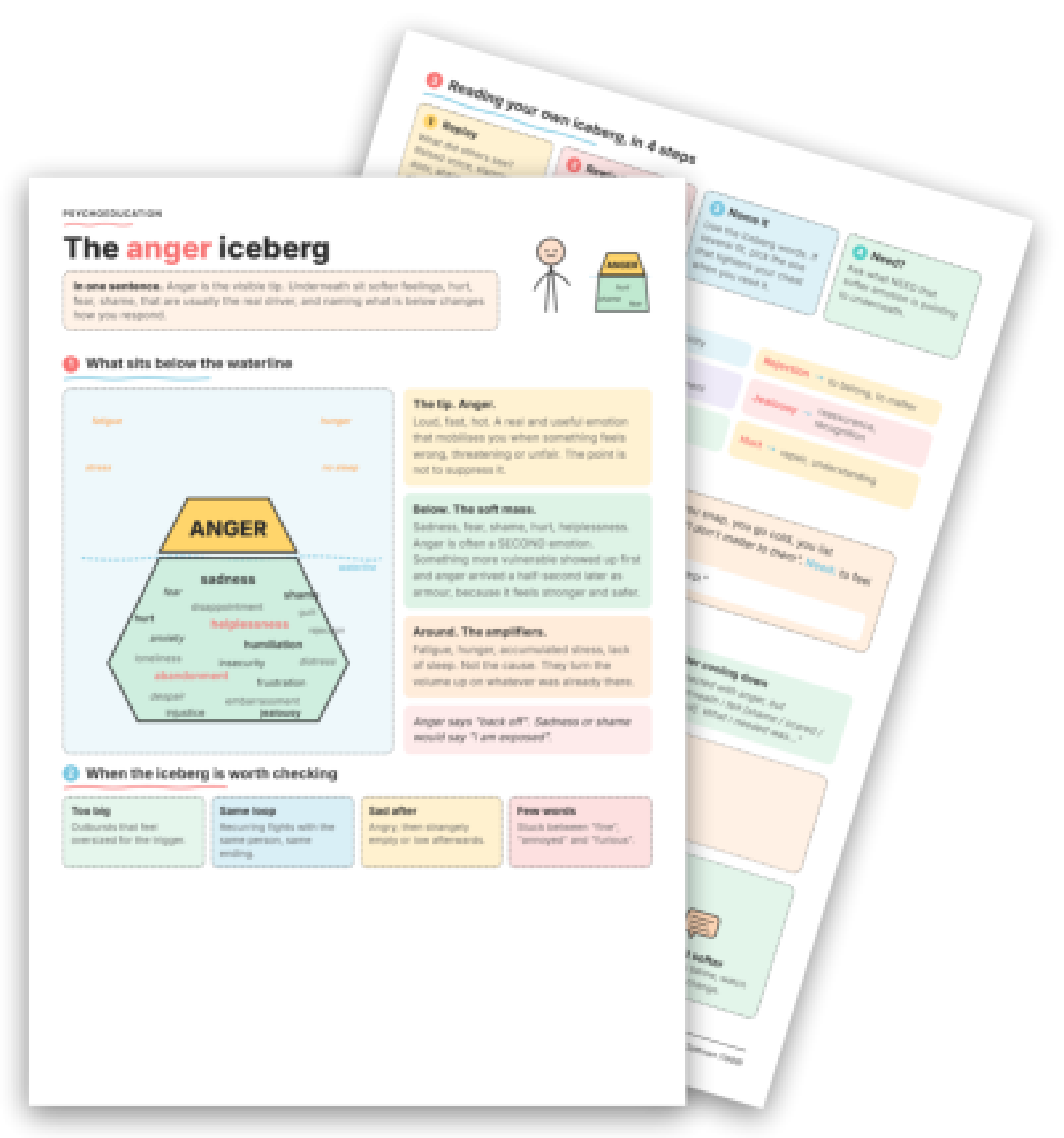
The fiche is structured across six numbered panels, each building on the last. Panel 1 presents the core iceberg diagram: anger sits above a clearly marked waterline, and below it the fiche maps 18 underlying emotions explicitly named, including sadness, shame, fear, helplessness, rejection, humiliation, loneliness, injustice, despair, and abandonment. Three amplifier factors (fatigue, hunger, sleep deprivation, accumulated stress) sit around the structure with an explicit label: "Not the cause. They turn the volume up on whatever was already there." This distinction between trigger, amplifier, and underlying driver is one that patients often conflate; the visual layout separates them spatially.
Panel 2 offers four clinical indicators suggesting the iceberg is worth exploring: outbursts disproportionate to the trigger, repetitive conflict loops with the same person, a low or empty mood following anger, and a patient who can only reach for three or four emotional words. You can use this panel to normalise the assessment without pathologising the patient.
Panel 3 introduces a 4-step self-reading protocol: Replay (what others observed), Rewind (the split-second feeling just before anger), Name it (scanning the iceberg list), and Need (what the softer emotion is pointing to underneath). This sequence is close to what you would construct verbally in an emotion-focused session, but the fiche makes it portable and repeatable between appointments. Panel 4 maps each underlying emotion to its associated unmet need: shame to feeling worthy and respected, rejection to belonging, helplessness to agency, loneliness to connection.
Panel 6 provides ready-to-use phrases in three registers, including "My anger is loud. What is the quieter feeling underneath?" as an inner reframe, and three explicit prompts labelled "To discuss in session," which feed directly into your debriefing agenda the following week.
> Key point: The Anger Iceberg fiche is not a self-assessment the patient completes independently. It is a visual support that facilitates the psychoeducation explanation in session, then functions as a between-session reference the patient can return to when an outburst happens before the next appointment.
Use it with your patients
Share this tool in the mobile app and follow the work between sessions.
When and how to introduce the fiche
The fiche fits naturally from the second or third session onward, once the presenting problem is established and the alliance is sufficient for a gentle reframe. It is particularly indicated with patients who describe anger warning signs they cannot explain, couples where the same conflict loop recurs (useful alongside couple conflict psychoeducation), or patients in whom you suspect shame or abandonment schema activation beneath the surface presentation.
A low-resistance introduction: "I'd like to show you a model that might fit what you're describing. It's a diagram, not a questionnaire, so there's nothing to fill in. I'll walk you through it." This framing removes the evaluative weight and positions you as a guide rather than an interrogator.
Walk through Panel 1 together, invite the patient to name which below-waterline words resonate, then move to Panel 3 to apply the 4-step protocol to a recent episode. The "To discuss in session" prompts in Panel 6 then become your bridge to the following session. Debrief by asking which word from the iceberg list tightened their chest most, and follow that thread.
The fiche pairs well with between-session work on anger self-reflection, frustration tolerance, or perceived injustice depending on which underlying emotion surfaces. For patients where anger maps onto aggressive communication patterns, the iceberg provides a psychoeducational foundation before you move into assertiveness work. Where emotion regulation is the broader frame, this fiche anchors the affect-identification phase. You may also find it useful as a starter tool within a more structured anger psychoeducation program for patients who need a sequenced curriculum. A contraindication to note: in acute crisis presentations, or with patients in an active angry state at the start of the session, the conceptual framing of Panel 1 may not land. Prioritise somatic regulation first.
The fiche does not replace the therapeutic framework. It makes the explanation faster, clearer, and leaves the patient with a concrete reference at a moment when abstract insight rarely holds.
Your session continues in your patients' pocket
Use with a patientYour resources, available everywhere
The handouts, exercises, programs and audios above: you choose which ones to make available to your patients, in the mobile app dedicated to them.
And far more than a library
The app goes well beyond resources, to support your patients every day:
Related categories
Explore other clinical resources by category.

Identity
Clinical resources for self-identity work in therapy: CBT, ACT, schema tools for clinicians addressing self-concept, core beliefs, and identity disruption.

Emotions
Clinical resources on emotion regulation: worksheets, coping tools, CBT, REBT, and ACT exercises for therapists working across diagnoses and age groups.

Understand
Clinical hub for the therapeutic aim 'Understand': worksheets and tools to build patient insight across CBT, ACT, schema therapy and more.

Build awareness
Clinical worksheets and tools to build awareness in therapy: cognitive distortions, schemas, emotions, ACT and CBT resources for practitioners.

CBT
CBT worksheets, cognitive restructuring exercises & behavioral tools for clinicians. Evidence-based resources for every phase of cognitive behavioral therapy.

Emotion-focused
Emotion-focused therapy clinical resources: worksheets, exercises & programs for EFT practitioners working with individuals and couples.