
Clinical picture. M., a man in his early forties, was referred following repeated workplace conflicts; he described his anger as something that "just exploded" without warning and left him ashamed afterward. In the first session, the clinician introduced the psychoeducation program on anger and assigned Lesson 1, asking M. to work through the text on physical sensations and the prompted reflection on his main triggers before the next appointment. M. returned having identified that a sharp feeling of disrespect reliably preceded his outbursts, and that shame and hurt were present alongside the anger rather than after it. This distinction opened a more productive conversation about the function the anger was serving, without framing it as a character flaw.
Anger Psychoeducation: A 6-Lesson Clinical Program
Help patients understand anger's function, map counterproductive patterns, and build healthier expression skills through structured autonomous work.
Clinical vignettes
Reframing Anger as a Signal
Ambivalence About Expressing Anger
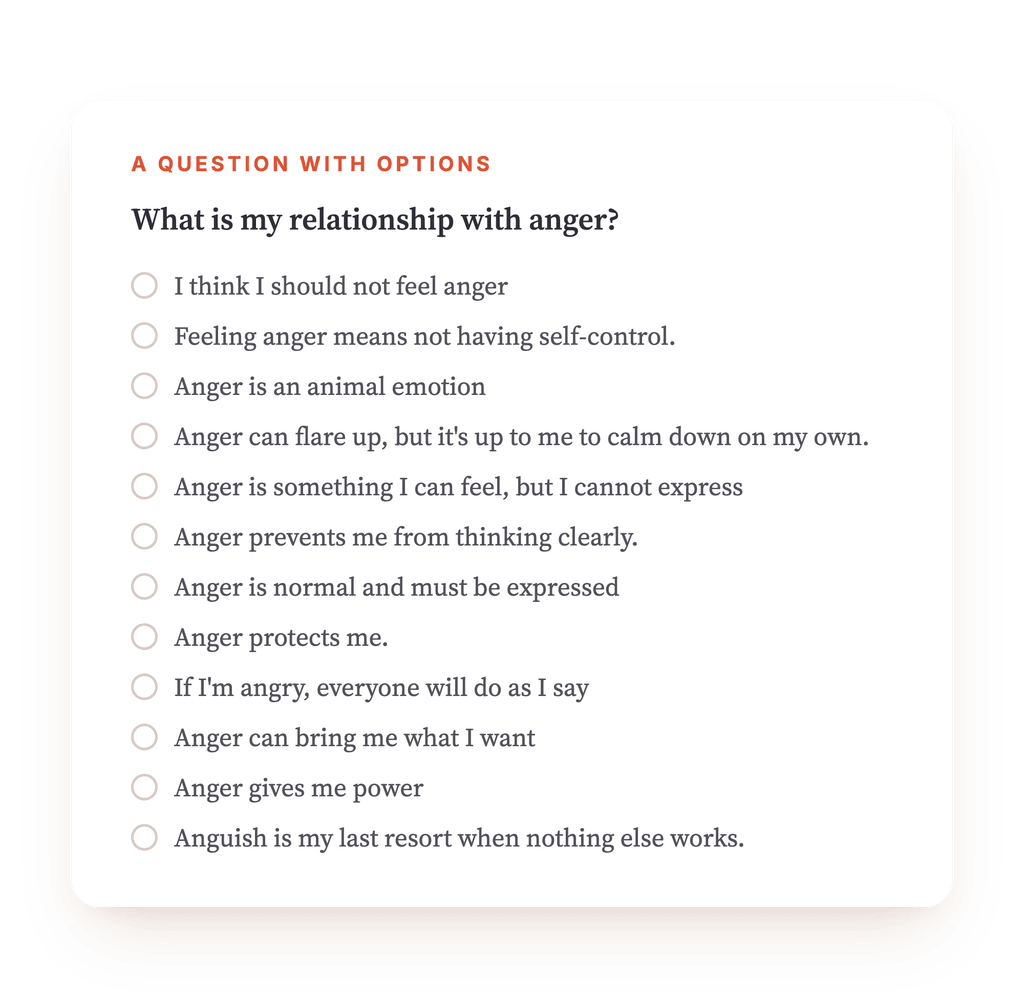
Clinical picture. A., a woman in her late thirties with a history of anxious inhibition, reported never allowing herself to feel angry and described the emotion as "something animals do." The clinician introduced the program and asked her to complete the multiple-choice reflection in Lesson 1 on her current relationship with anger before the following session. A. selected responses indicating she believed anger should be suppressed entirely and that feeling it meant losing self-control. Reviewing her choices together allowed the clinician to address these beliefs directly, using the lesson material on anger as a neutral and adaptive signal rather than a moral failing, which A. found less threatening than a purely verbal explanation would have been.
Use this resource with your patients
Handout, exercises and materials ready to use, right inside SessionFuel.
The clinical challenge: why anger resists a purely verbal approach
Anger is one of the most clinically loaded emotions you will encounter. Patients arrive with entrenched beliefs about it: that it signals weakness or loss of control, that expressing it is dangerous, that suppressing it is the mature choice. These beliefs are rarely conscious, and they rarely shift through psychoeducation delivered in a single conversation.
What makes anger particularly hard to address verbally alone is its layered structure. As the Anger Iceberg worksheet illustrates, visible anger almost always sits above a hidden layer of hurt, shame, or fear. Add to that the weight of family scripts and social conditioning, and you have an emotion that patients have spent years relating to through inherited patterns rather than genuine awareness. The Anger Warning Signs checklist and the Anger Cycle handout are useful session supports, but what they cannot do is accompany a patient through a sustained, progressive process of self-inquiry. That is where a structured step-by-step program earns its place.
What the program contains: a structured curriculum across six lessons
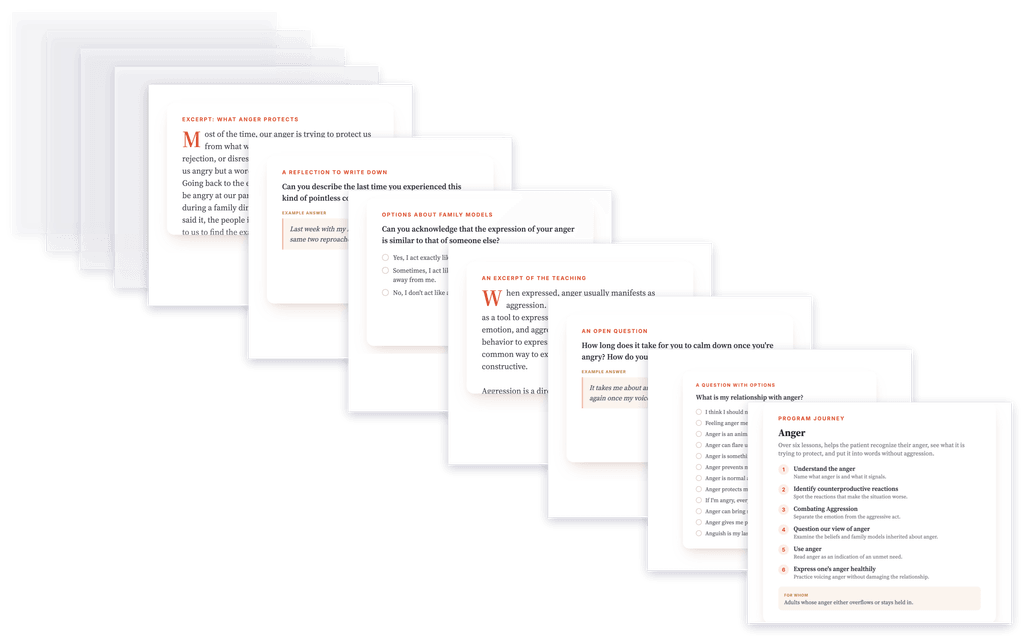
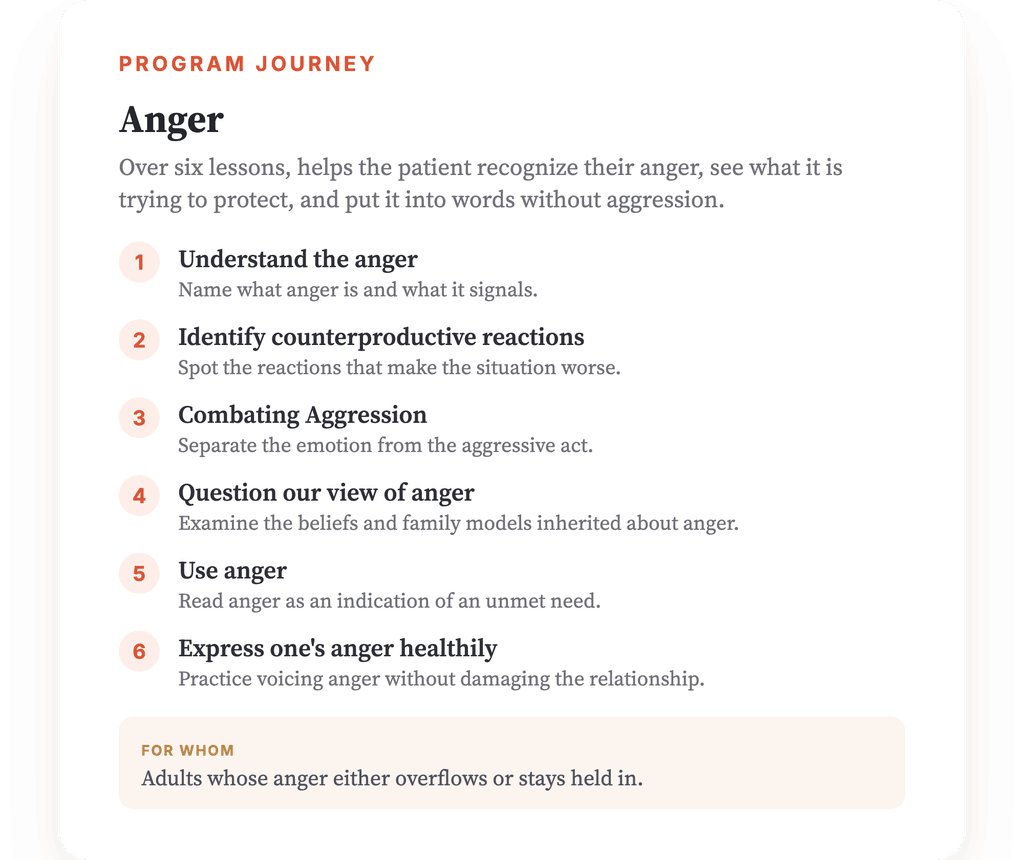
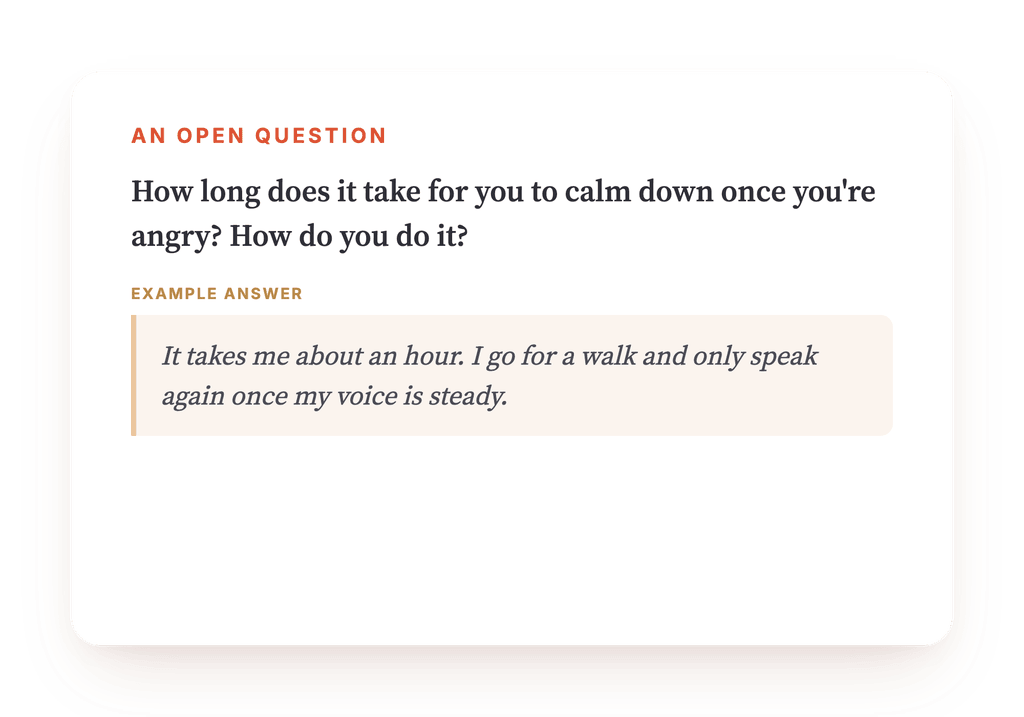
This six-lesson curriculum moves patients through a coherent arc, from foundational understanding to practical skill. Each lesson combines psychoeducation text, guided open-ended prompts, and multiple-choice reflection questions, so patients do not passively read but actively engage.
Lesson 1, Understanding anger introduces the protective and adaptive function of anger, its physical signals, and the co-occurring emotions that often precede or accompany it. Patients identify their own triggers and their deepest beliefs about whether anger is acceptable at all. This maps well onto what the Anger Iceberg resource and the Behavior, Emotion, Underlying Need worksheet address visually in a single session.
Lesson 2, Identifying counterproductive reactions distinguishes between explosive expression, suppression, and displaced anger. Patients examine which unhealthy patterns they rely on most, and what they are actually trying to achieve through each one. The Coping Skills for Anger worksheet and Adaptive vs Maladaptive Coping resource make natural companions here.
Lesson 3, Combating aggression differentiates active aggression from passive-aggressive behaviour, asking patients to map exactly when they use each mode and with whom. This step pairs naturally with your work using the Aggressive Communication worksheet and the Passive-Aggressive Communication fiche.
Lesson 4, Questioning our inherited view of anger explores family modelling and social norms, helping patients recognise that their default expression style is largely learned. The Emotion Regulation Psychoeducation Program provides a wider emotional context, while the Emotional Inhibition Schema worksheet deepens the work for patients whose main pattern is suppression.
Lesson 5, Using anger constructively identifies the most common conversational errors: blame games, catastrophising, jumping to conclusions, trying to change others. The Arbitrary Inference worksheet and the Perceived Injustice guided exercise extend this step well.
Lesson 6, Expressing anger in a healthy way closes the arc with concrete skills: identifying the precise source, discharging physiological activation before speaking, asking questions instead of assuming, using assertive and empathic communication. The Nonviolent Communication fiche, the Assertive Communication worksheet, and the Feel, Reflect, Act Differently fiche all reinforce this final step.
Key insight: Anger rarely responds to a single explanation. What changes clinical outcomes is sustained, structured self-reflection between appointments, where patients return each week having already done the cognitive and emotional work the lesson prompted.
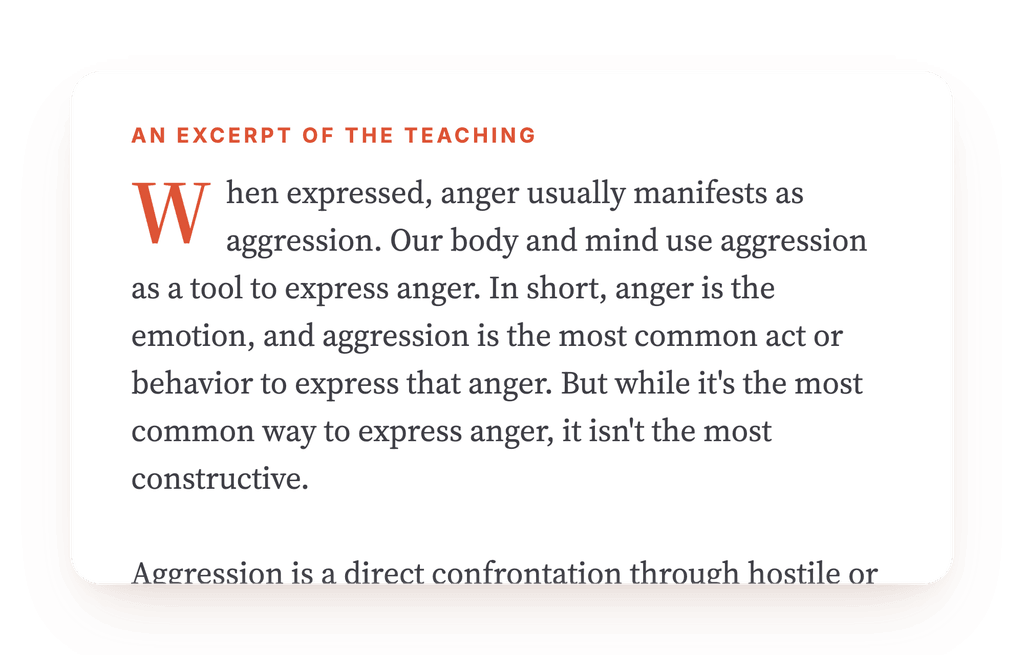
The overview map and sample cards embedded below give you an aperçu of the program's structure and a few example steps. These previews show only a small fraction of the program: the complete curriculum contains many more lessons, guided prompts, psychoeducation units, and multiple-choice reflection questions than what is visible here.
This program is available to your patients through the patient mobile application of SessionFuel, the dedicated patient-side interface that complements your SessionFuel practice. You assign the program directly from your clinician account, and your patient then works through each lesson on their own, on their phone, between your appointments.
750+ clinical tools
A library built with and for clinicians, ready to use in session and extend between appointments.
Access all the toolsHow to integrate it into your practice as between-session homework
This program is designed as autonomous homework: the patient works through one lesson at a time on their own, between two consultations, and brings what they produced back to the next appointment.
Which patients benefit most: patients dealing with relational conflict, emotional dysregulation, or a pattern of either explosive or suppressed anger; those who tend toward passive aggression; patients working on assertiveness; anyone whose anger has become a source of shame or confusion. It also works well alongside couples work, where the individual partner can complete it in parallel with couples sessions. For younger patients, pair it with the Anger Thermometer worksheet and the Anger Stop Signs fiche as tangible visual supports.
How to introduce it: frame it as a structured self-inquiry tool, not a behaviour-change mandate. You might say: "Between now and our next appointment, I am going to give you the first lesson of a program on anger. There is no right or wrong answer, it is simply an invitation to look honestly at how anger works for you." Patients who feel judged about their anger are more likely to engage when the framing is curious rather than corrective.
What to do with what the patient brings back: the open-ended prompts are the richest clinical material. A patient who writes "my biggest trigger is being ignored" opens a conversation about attachment needs. Someone who identifies passive aggression as their primary mode invites work on the Expressing Vulnerability in Relationships worksheet and on assertive rights. The multiple-choice responses function as a quick map you can review together at the start of the session to orient where to go deeper. The Guided Anger Self-Reflection exercise and the Anti-Anger Balm guided meditation audio are ready companions for the lessons on discharge and regulation.
Use it with your patients
Share this tool in the mobile app and follow the work between sessions.
Articulating the program with your broader clinical work
The six lessons cover overlapping territory with several CBT and schema-informed tools. If you are already using the Anger Management Skills worksheet in your practice, this program provides the longitudinal scaffolding that a single handout cannot. For patients whose anger is rooted in a justice schema or perceived injustice, connect lesson 5 explicitly to the Perceived Injustice guided exercise and the Fair Fighting Rules worksheet. For patients who carry anger into conflict with a partner, the Conflict in Romantic Relationships program provides a natural next step once this curriculum is complete.
Your session continues in your patients' pocket
Use with a patientYour resources, available everywhere
The handouts, exercises, programs and audios above: you choose which ones to make available to your patients, in the mobile app dedicated to them.
And far more than a library
The app goes well beyond resources, to support your patients every day:
Related categories
Explore other clinical resources by category.

Emotions
Clinical resources on emotion regulation: worksheets, coping tools, CBT, REBT, and ACT exercises for therapists working across diagnoses and age groups.

Cognition
Printable cognitive therapy worksheets and clinical tools for therapists: CBT, ACT, schema work, defusion, distortions, and belief restructuring.

Understand
Clinical hub for the therapeutic aim 'Understand': worksheets and tools to build patient insight across CBT, ACT, schema therapy and more.

CBT
CBT worksheets, cognitive restructuring exercises & behavioral tools for clinicians. Evidence-based resources for every phase of cognitive behavioral therapy.

Integrative
Integrative therapy clinical resources: worksheets, psychoeducation programs, and exercises for eclectic, multimodal practice across orientations.
Anxiety
Clinical hub for anxiety disorders: CBT and ACT worksheets, psychoeducation sheets, and exercises for assessment and treatment across the anxiety spectrum.