
Clinical picture. M., a 41-year-old man referred for chronic work-related stress, describes his relationship with his partner as stable but emotionally flat. He reports a long-standing pattern of managing difficulties alone, shaped by an early family environment where emotional expression was discouraged. In session, the clinician introduces the informational sheet on vulnerability and invites M. to identify one recent situation where he had withheld a need from his partner. M. acknowledges that he had said nothing about feeling overwhelmed at work for several weeks, fearing he would be seen as incapable. As a brief between-session task, he agreed to name this to his partner in one sentence; he returned the following week reporting that his partner had responded with support rather than the anticipated disappointment, which M. described as genuinely unexpected.
Expressing Vulnerability in Relationships: PDF Worksheet, Tools and Exercises
A visual PDF worksheet, practical tools, and ready-to-use exercises to help patients put vulnerability into words, overcome relational avoidance, and build genuine emotional intimacy.
Clinical vignettes
Naming a Need, Not Suppressing It
Loneliness Within Friendship
Clinical picture. S., a 34-year-old woman seen for recurrent low mood, reports several close friendships yet describes a persistent sense of emotional isolation. She identifies a strong belief, reinforced after a confidence was once used against her in adolescence, that disclosing difficulties puts her at risk of judgment or rejection. The clinician uses the worksheet's section on past wounds and blocking beliefs to help S. distinguish between that earlier context and her current relationships. S. selects one trusted friend and prepares, with the clinician, a brief and specific disclosure about a current difficulty at work. At the following appointment she reported that the exchange had opened a reciprocal conversation, and that the anticipated withdrawal from her friend had not occurred.
Explaining emotional vulnerability verbally in session often lands with a nod and little else. Patients hear "it takes courage to open up," agree in principle, and return the following week having said nothing to anyone. This fiche PDF gives the concept a visible, concrete structure they can actually hold onto.
Use this resource with your patients
Handout, exercises and materials ready to use, right inside SessionFuel.
Why Vulnerability Is Hard to Explain Out Loud
The core difficulty is not conceptual ignorance. Most patients know, on some level, that sharing feelings is "good." The resistance runs deeper: deeply held myths ("being vulnerable means being weak"), early-learned prohibitions ("don't bother people," "keep it together"), and past experiences where a confidence was mocked or weaponized. When you name these mechanisms orally, the patient hears a list. When they see them laid out on a page, the recognition hits differently.
There is also a language gap. Patients frequently want to open up with a partner, a friend, or a colleague, but freeze when it comes to finding actual words. This is where assertive communication tools and vulnerability-focused psychoeducation diverge: assertiveness addresses rights and boundaries, while this fiche addresses the more intimate, emotionally exposing act of saying "I am scared" or "I need to feel that I matter." The two are complementary, not redundant. For patients presenting with emotional inhibition or abandonment-related fears, the relational cost of never opening up is a key maintenance mechanism worth making visible together.
What the Fiche Contains: A Visual Support for the Explanation
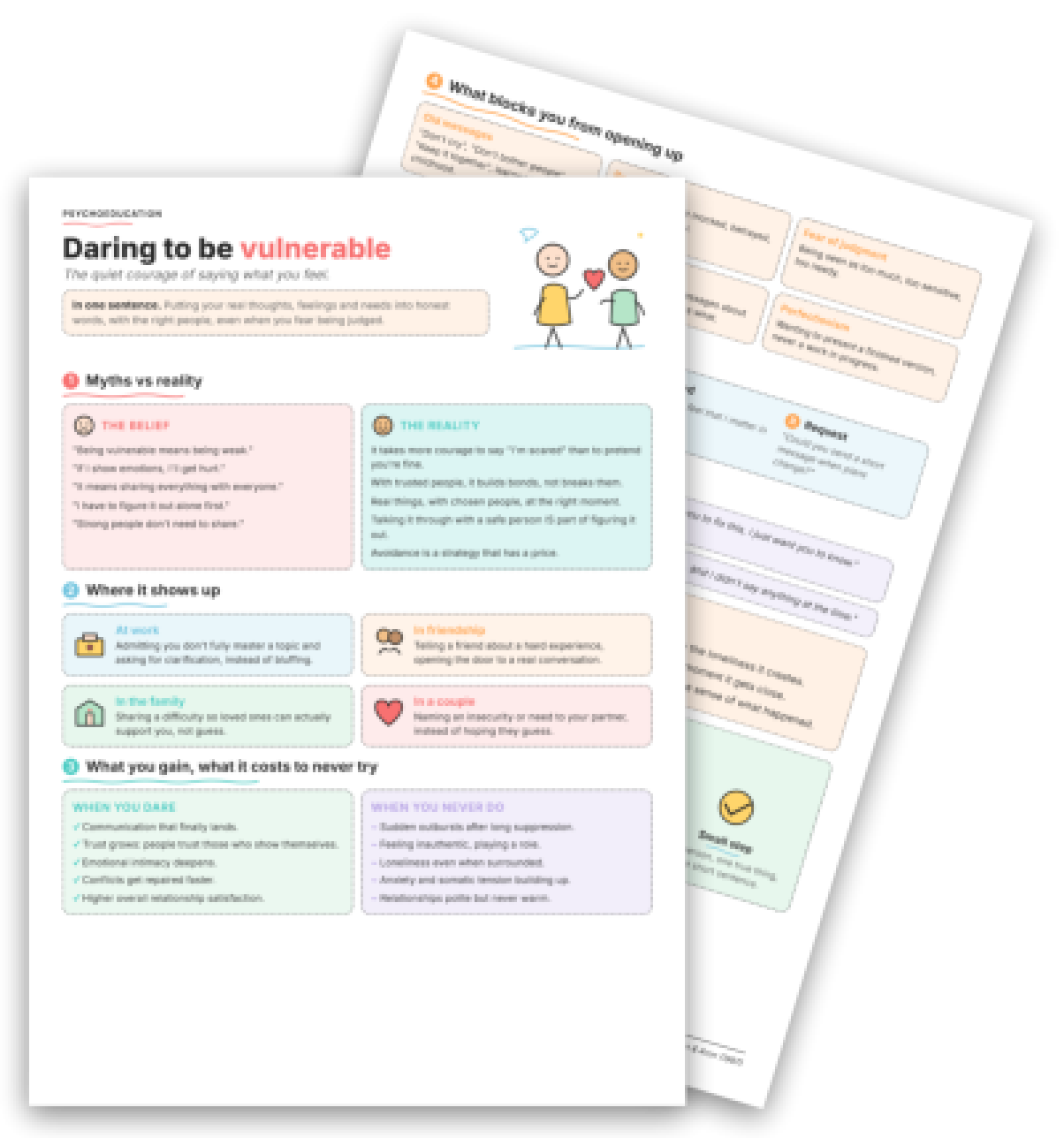
The fiche opens with a myths vs. reality panel that directly confronts the five most common beliefs blocking vulnerability: "Being vulnerable means being weak," "If I show emotions, I'll get hurt," "It means sharing everything with everyone," and two others. Each belief is matched with a one-line reality check. Presented visually, the contrast is immediate; the patient does not have to hold both sides in working memory while listening to you.
The second panel maps where vulnerability shows up across four relational domains (work, friendship, family, couple), with a concrete example in each. This is clinically useful because patients often recognize the pattern in one domain but not another, and the visual layout prompts spontaneous generalization.
A cost-benefit column comparison follows, listing what is gained when patients dare to open up (trust builds, conflicts repair faster, emotional intimacy deepens) against what accumulates when they never try (sudden outbursts after suppression, loneliness even when surrounded, "relationships polite but never warm"). This is the kind of argument that lands when patients can read it, not just hear it.
The fiche then identifies six specific blockers: old childhood messages, past wounds, fear of judgment, shame, cultural and gendered rules, and perfectionism. This taxonomy gives you shared vocabulary for formulation work, particularly useful when articulating how early maladaptive schemas or core beliefs feed the inhibition.
The final working section offers an OFNR structure (Observation, Feeling, Need, Request), grounded in Rosenberg's CNV framework, plus four ready-to-borrow phrases the patient can use verbatim if needed: "There's something I'd like to share, and it's a bit hard for me to say" or "I don't need you to fix this, I just want you to know." For patients with social anxiety or low assertiveness confidence, having pre-formed language reduces the moment-of-action cognitive load considerably.
> Key clinical point: this fiche is a visual psychoeducation support for use within the session, not a self-administered questionnaire. You walk through it with the patient, it names what has been unnamed, and it leaves them with a concrete reference to take home.
750+ clinical tools
A library built with and for clinicians, ready to use in session and extend between appointments.
Access all the toolsWhen and How to Introduce It
The fiche is best introduced after the initial alliance has formed and once avoidance or emotional suppression has been identified as a maintaining factor: typically from the second or third session onward. It fits naturally in presentations involving communication difficulties in couples, relational loneliness (see Loneliness), attachment insecurity, or affect regulation work in the context of schema therapy.
A neutral framing to introduce it: "I have a one-page support I often go through with patients who describe feeling stuck when they want to say something real to someone. Would you like to look at it together?" This avoids any implication that the patient is failing at relationships; it positions the fiche as a shared working tool.
When debriefing, use the "To discuss in session" prompts printed on the fiche itself: whether the patient has been bluffing or pretending with someone specific, whether they have frozen mid-approach, or whether a recent attempt to open up did not go as hoped. These prompts create a natural bridge from psychoeducation to interpersonal conflict processing or shame work.
One limit worth keeping in mind: for patients with significant trauma history involving boundary violations or repeated relational betrayal, the myth-busting tone of the fiche may feel discordant without prior containment work. In those cases, building secure attachment and active listening skills are better entry points, with this fiche introduced at a later stage when safety is more established.
Use it with your patients
Share this tool in the mobile app and follow the work between sessions.
Sources
- Brown, B. (2012). Daring Greatly: How the Courage to Be Vulnerable Transforms the Way We Live, Love, Parent, and Lead. Gotham Books.
- Rosenberg, M. B. (2015). Nonviolent Communication: A Language of Life (3rd ed.). PuddleDancer Press.
- Reis, H. T., & Shaver, P. (1988). Intimacy as an interpersonal process. In S. Duck (Ed.), Handbook of Personal Relationships (pp. 367-389). Wiley.
Your session continues in your patients' pocket
Use with a patientYour resources, available everywhere
The handouts, exercises, programs and audios above: you choose which ones to make available to your patients, in the mobile app dedicated to them.
And far more than a library
The app goes well beyond resources, to support your patients every day:
Related categories
Explore other clinical resources by category.

Identity
Clinical resources for self-identity work in therapy: CBT, ACT, schema tools for clinicians addressing self-concept, core beliefs, and identity disruption.

Emotions
Clinical resources on emotion regulation: worksheets, coping tools, CBT, REBT, and ACT exercises for therapists working across diagnoses and age groups.
Relationships
Clinical worksheets and tools on relational functioning: attachment, schemas, assertiveness, and communication skills for therapists. Printable PDF resources.

Understand
Clinical hub for the therapeutic aim 'Understand': worksheets and tools to build patient insight across CBT, ACT, schema therapy and more.

Build awareness
Clinical worksheets and tools to build awareness in therapy: cognitive distortions, schemas, emotions, ACT and CBT resources for practitioners.

Build skills
Skill-building resources for clinicians: printable worksheets and exercises for coping, assertiveness, and communication skills training in therapy.