
Clinical picture. A, a woman in her early thirties, presented with recurrent relational distress and described a persistent fear that her partner was withdrawing whenever he needed solitary time. During a session, the clinician introduced the psychoeducational sheet on attachment styles and invited her to read the anxious profile aloud. She recognized the pattern immediately, noting that the same dynamic had ended two previous relationships. Over the following fortnight she practiced the "act opposite" exercise: when the urge to send repeated checking messages arose, she waited twenty minutes, engaged in a brief absorbing task, and recorded whether the spike of anxiety resolved on its own. At the next session she reported that, on three separate occasions, the distress had subsided before she had acted on it, which she found genuinely surprising and modestly shifted her confidence in her ability to self-regulate.
Secure Attachment: PDF Worksheet, Tools and Exercises for Clinical Practice
A printable PDF worksheet with tools and exercises to explain attachment styles, challenge core beliefs about love, and support earned secure attachment in clinical practice.
Clinical vignettes
Anxious Pattern Recognized, Urge Resisted
Avoidant Withdrawal Named in Session
Clinical picture. M, a man in his mid-forties, sought therapy after his partner stated she felt consistently shut out during disagreements. He described his habitual response to conflict as going quiet and managing the situation alone, and he had never framed this as a problem until his partner named it directly. The clinician used the informational sheet to place this pattern within an attachment framework, helping M see the behavior as a learned self-protective habit rather than evidence of emotional competence. They rehearsed a minimal disclosure, specifically saying "I am overwhelmed right now, but I am still here," as a low-threshold alternative to disengaging. M trialed this once before the following session and reported that his partner's response was noticeably less escalated, which provided enough evidence for him to consider practicing it further.
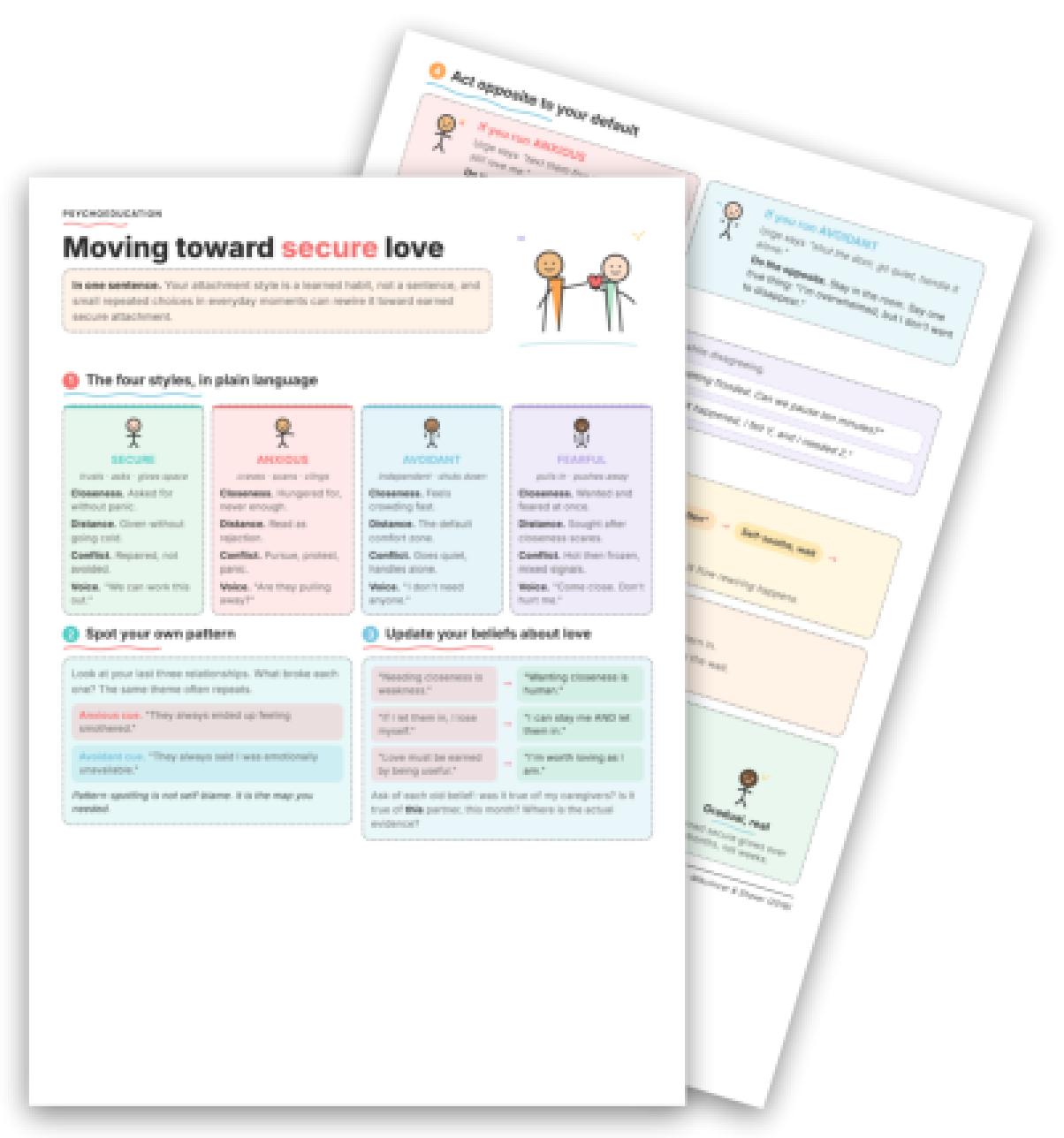
Explaining attachment theory verbally in session tends to produce polite nodding. Patients hear "anxious" or "avoidant" as diagnostic labels rather than as recognisable descriptions of their own relational behaviour. This fiche PDF resolves that gap: a single printable visual that maps all four styles side by side, ties each one to concrete internal voices and conflict patterns, and gives both clinician and patient a shared language to work from the moment it lands on the desk.
Use this resource with your patients
Handout, exercises and materials ready to use, right inside SessionFuel.
Why Attachment Styles Are Difficult to Convey Without a Visual Support
The difficulty isn't conceptual complexity. Any clinician can summarise Bowlby in two minutes. The difficulty is that patients process attachment information through the very distortions their style already produces. An anxiously attached patient hears "you fear abandonment" and experiences it as confirmation of unworthiness. An avoidant patient hears "you shut people out" and braces against the implied demand for closeness. Oral explanation collapses into argument, deflection, or a surface-level agreement that evaporates between sessions.
A second obstacle: patients who present with abandonment fears or emotional dependency patterns often have no vocabulary for what their relational default actually looks like from the outside. They describe symptoms, conflict, distance, jealousy, without recognising the schema-level pattern underneath. The same complaint repeating across three successive relationships rarely registers as a pattern without something external to point to.
The visual layout of this fiche does what words alone cannot: it externalises the pattern, places it alongside three alternatives, and lets the patient locate themselves rather than receive a verdict.
What the Fiche Contains: A Sequenced Visual Tool for In-Session Use
The support moves through six sections, each short enough to read together in session, each building on the last.
Section 1 presents the four styles, secure, anxious, avoidant, and fearful, as parallel behavioural profiles. Each column lists observable actions, a relational default (closeness, distance, conflict), and a characteristic internal voice. "Are they pulling away?" for anxious; "I don't need anyone." for avoidant. Seeing all four at once breaks the binary of "normal vs. problematic" and makes the fearful (pull-in / push-away) pattern visible for patients who have never seen it named.
Section 2 invites pattern-spotting across the patient's last three relationships, framed explicitly as "the map you needed", not self-blame. This wording is worth noting: it repositions self-awareness as instrumental rather than accusatory, which is clinically useful for patients with core beliefs about being fundamentally flawed.
Section 3 targets the belief layer: "Needing closeness is weakness" rewritten as "Wanting closeness is human." Each belief is followed by the challenge question, "Was it true of my caregivers? Is it true of this partner, this month?", which maps directly onto the kind of cognitive restructuring work described in tools like 12 Beliefs That Damage Relationships.
Sections 4 and 5 provide opposite-action directives tailored to anxious and avoidant defaults, and five ready-to-use conflict phrases ("I'm getting flooded. Can we pause ten minutes?"). Section 6 walks through a worked example, four hours of unanswered messages, showing the full cycle from trigger to catastrophic interpretation to self-regulation to disconfirmation.
A closing "To discuss in session" block gives the clinician three specific debriefing prompts, making the fiche explicitly a dialogue-starter rather than a self-administered questionnaire.
> Key point: this fiche is a visual support that facilitates the in-session explanation of attachment theory; it is not homework the patient fills in alone. Its value is the conversation it opens, not the reading itself.
750+ clinical tools
A library built with and for clinicians, ready to use in session and extend between appointments.
Access all the toolsWhen and How to Introduce the Fiche
The optimal moment is typically after initial assessment, once a relational pattern has surfaced in the anamnesis, a repeated breakup theme, a complaint of emotional unavailability from multiple partners, or a patient who describes both craving and fearing closeness. It sits naturally alongside Attachment Styles in Romantic Relationships for relational mapping or Building Secure Attachment for skill-building work.
A low-threshold introduction: "I'd like to show you something that might give us a cleaner way to talk about what you're describing." Avoid naming the patient's style before they see the sheet; let them read Section 1 and locate themselves. Their initial identification, and any resistance to it, is itself clinical material.
For anxiously attached patients, Section 4's opposite-action directive ("Wait. Self-soothe 20 min.") can be debriefed as a between-session micro-experiment, complemented by a fear of partner leaving exercise for the belief layer. For avoidant presentations, Section 3's belief reframe pairs well with trust-building psychoeducation. For couples work, the conflict phrases in Section 5 bridge naturally into couples communication programmes or couple conflict psychoeducation.
One caution: the fiche is not calibrated for patients in acute trauma processing or those presenting with PTSD where early relational wounding is still dissociated. In those cases, the pattern-spotting frame may feel premature before sufficient stabilisation. In all other outpatient relational presentations, it earns its place in the first three sessions.
The fiche does not replace the therapeutic frame; it makes the explanation concrete, saves explanation time, and leaves the patient with a reference point they can return to between sessions.
Use it with your patients
Share this tool in the mobile app and follow the work between sessions.
Sources
- Bowlby, J. (1982). Attachment and Loss, Vol. 1: Attachment. Basic Books.
- Ainsworth, M. D. S., Blehar, M. C., Waters, E., Wall, S. (1978). Patterns of Attachment: A Psychological Study of the Strange Situation. Lawrence Erlbaum Associates.
- Levine, A., Heller, R. S. F. (2010). Attached: The New Science of Adult Attachment and How It Can Help You Find and Keep Love. TarcherPerigee.
- Johnson, S. (2008). Hold Me Tight: Seven Conversations for a Lifetime of Love. Little, Brown Spark.
Your session continues in your patients' pocket
Use with a patientYour resources, available everywhere
The handouts, exercises, programs and audios above: you choose which ones to make available to your patients, in the mobile app dedicated to them.
And far more than a library
The app goes well beyond resources, to support your patients every day:
Related categories
Explore other clinical resources by category.

Identity
Clinical resources for self-identity work in therapy: CBT, ACT, schema tools for clinicians addressing self-concept, core beliefs, and identity disruption.

Relationships
Clinical worksheets and tools on relational functioning: attachment, schemas, assertiveness, and communication skills for therapists. Printable PDF resources.

Understand
Clinical hub for the therapeutic aim 'Understand': worksheets and tools to build patient insight across CBT, ACT, schema therapy and more.

Build awareness
Clinical worksheets and tools to build awareness in therapy: cognitive distortions, schemas, emotions, ACT and CBT resources for practitioners.

Build skills
Skill-building resources for clinicians: printable worksheets and exercises for coping, assertiveness, and communication skills training in therapy.
Repair & soothe
Clinical resources for the repair and soothe therapeutic aim: worksheets, exercises and tools to build self-compassion, reduce shame and restore emotional safety.