
Clinical picture. A and B, a couple in their early forties, presented after two years of progressive emotional distance; both described feeling unseen without being able to name what had shifted. In session, the clinician introduced the five relationship maintenance behaviors as a shared reference frame, pausing on Openness to highlight the distinction between minor, early disclosure and the accumulated silences that had become their pattern. A recognized that small frustrations had repeatedly gone unnamed until they calcified into resentment, while B acknowledged withdrawing rather than signaling needs. As a between-session task, each partner was asked to bring one low-stakes, currently unspoken concern to the other before the next appointment. At follow-up, both reported the exercise felt awkward but accessible, and one exchange had prompted a longer, productive conversation about weekend time together.
Relationship Maintenance Behaviors: PDF Worksheet, Tools and Exercises
A printable PDF fiche and clinical tools to help patients understand the five behaviors that actively sustain a healthy relationship, grounded in Gottman and Stafford's research.
Clinical vignettes
Openness Deficit in a Distancing Couple
Assurances After Repeated Conflict Escalation
Clinical picture. C, a 36-year-old individual seen in conjoint therapy with their partner D, described a recurring pattern in which arguments ended with one partner leaving the flat and contact going dark for several hours. The clinician used the Assurances section of the maintenance behaviors fiche to name the specific cost of exit-without-repair on felt safety, without framing D's departures as malicious. The couple was invited to identify one concrete reconnection signal, agreed upon in advance, that could be used once both had deescalated. They chose a brief text message reading only "I'm back" as a low-demand re-entry cue. Over the following three weeks, C reported that receiving the message twice had meaningfully reduced the anticipatory dread that had been building around conflict, though underlying disagreements remained a focus of ongoing work.
Couples in distress rarely lack commitment; they lack a shared language for what sustaining a relationship actually requires. Explaining relationship maintenance verbally tends to produce vague agreement without conceptual traction. This fiche PDF gives you a concrete visual scaffold to make the idea specific, behavioral, and immediately usable in session.
Use this resource with your patients
Handout, exercises and materials ready to use, right inside SessionFuel.
Why Relationship Maintenance Is Difficult to Convey at the Oral Level
Most patients arrive with an implicit theory that love either "works" or it doesn't. When you introduce the idea that relationships require active, repeated behaviors to stay healthy, the concept registers intellectually but rarely reorganizes anything. Patients hear it as encouragement, not as a clinical map.
The deeper difficulty is specificity. Without a named taxonomy, "investing in the relationship" remains too abstract to generate behavioral targets. The patient nods, agrees, and leaves without knowing which of their specific patterns is eroding the bond or which single behavior to modify first. This is precisely the gap a visual support closes: by laying the five behaviors side by side on paper, the fiche converts a general principle into a scannable, discussable structure.
The concept is also easily conflated with crisis repair. A key clinical reframe, one the fiche makes explicit, is that maintenance behaviors are preventive, not remedial. "Healthy couples are not just found, they are maintained." Getting that sentence in front of a patient, rather than just saying it aloud, changes its status from clinician opinion to shared reference point.
What the Fiche Contains: A Visual Map of Five Behaviors
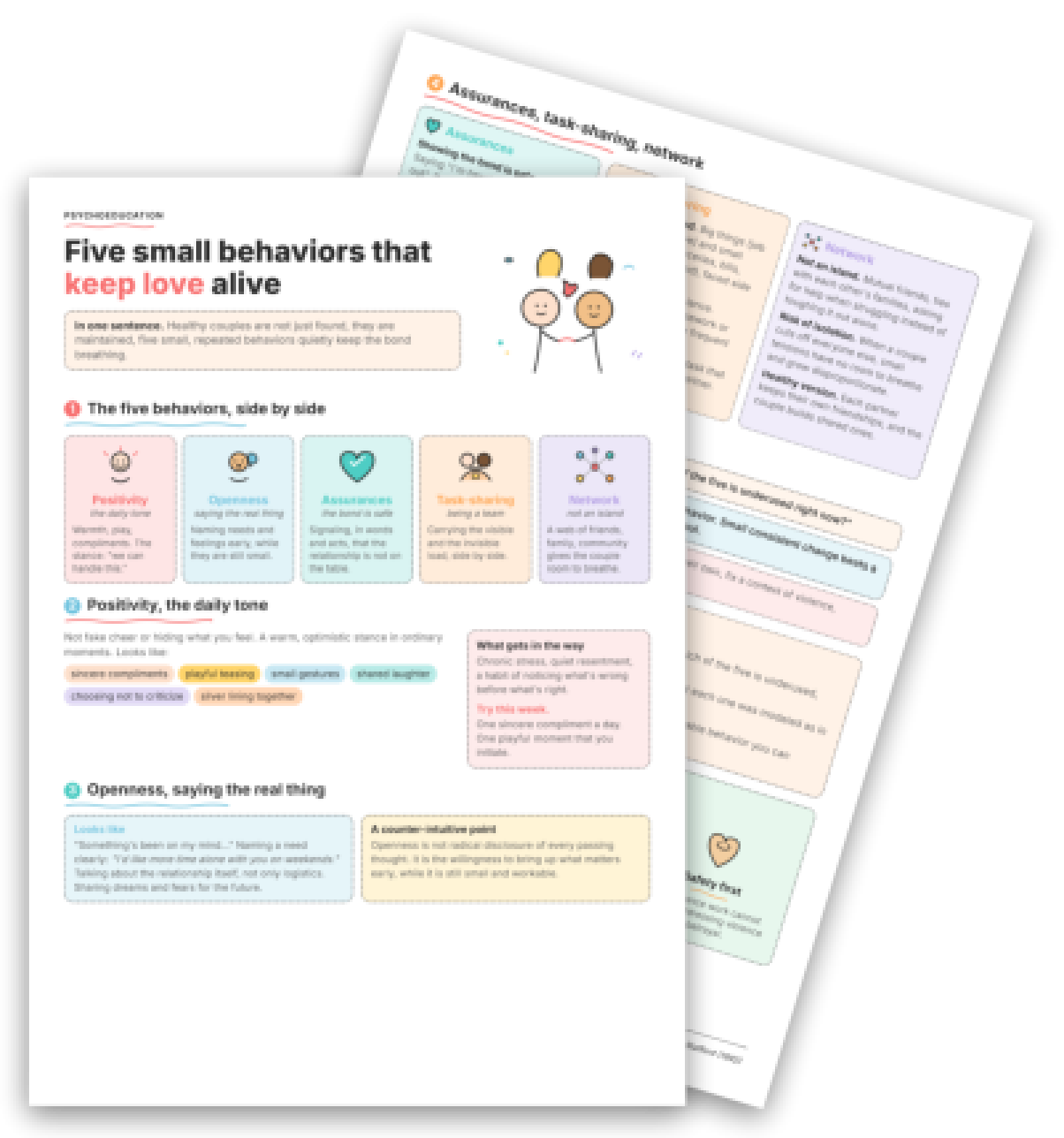
The fiche is organized across five labeled panels, presented side by side in the opening section so patients can see the full picture at once: Positivity (warmth, play, compliments in ordinary moments), Openness (naming needs early, while they are still small), Assurances (signaling in words and acts that the bond is safe), Task-sharing (visible and invisible load carried side by side), and Network (mutual friendships and family ties that give the couple room to breathe).
Each behavior then receives its own expanded panel. Positivity is distinguished from forced optimism, with concrete examples (sincere compliments, shared laughter, choosing not to criticize) and a note on what typically gets in the way: "chronic stress, quiet resentment, a habit of noticing what's wrong before what's right." Openness includes a counter-intuitive clarification that most patients need: it is not radical disclosure of every passing thought, but the willingness to surface what matters before it becomes unworkable. Assurances addresses what to actively avoid (threats, walking out in anger, weaponizing the relationship's existence in a fight), making it useful for patients working on fair fighting and conflict de-escalation or on the dynamics mapped in the EFT infinity loop.
The Task-sharing panel names silent imbalance as a frequent erosion point, with a direct prompt for the week. The Network panel addresses the risk of couple isolation: "when a couple cuts off everyone else, small tensions have no room to breathe." A closing section offers ready-made reframes ("Which of the five is underused right now?") and a clear clinical boundary: these behaviors describe healthy functioning; they cannot substitute for addressing violence, betrayal, or active addiction.
> Key takeaway: The fiche is a visual psychoeducation support that facilitates explanation in session. It is not a questionnaire the patient fills in alone; it is a shared reference the clinician uses to name patterns, set concrete targets, and leave the patient with a printed map to consult between appointments.
750+ clinical tools
A library built with and for clinicians, ready to use in session and extend between appointments.
Access all the toolsWhen and How to Introduce the Fiche
The fiche fits naturally in early-to-mid couples work, once the initial case formulation is established and the therapeutic alliance is solid enough to hold a normalizing frame. It also works well in individual therapy with patients reflecting on their relationship patterns, particularly those engaged in the kind of relational psychoeducation offered in the Healthy Relationships program or the Long-Term Relationships program.
You can introduce it with a simple framing: "I'd like to show you a framework that researchers have found useful for describing what active couples actually do, not in crises, but in ordinary weeks. I'd like us to look at the five behaviors together and see which ones feel familiar and which feel more distant." This opens a collaborative review rather than an evaluative exercise.
In session, the visual layout lets you and the patient scan across the five domains together, point to a specific panel, and ask targeted questions: which behavior comes most naturally? Which was absent in the family of origin? This kind of structured inquiry pairs well with exploring vulnerability in relationships, nonviolent communication for couples, or a follow-up with the Weekly Couple Check-In exercise.
The "pick one behavior this week" prompt built into the fiche is a low-barrier behavioral commitment; debrief it the following session before moving to a second domain. For patients with the abandonment schema or significant attachment insecurity, the Assurances panel often warrants more time and connects directly to building secure attachment work.
One clinical limit: the fiche does not address conflict resolution directly. Pair it with the Four Horsemen and their antidotes or Relationship Conflict Resolution when communication breakdown is the presenting issue. The fiche is most useful as a maintenance map once the couple (or individual) has a working baseline of safety.
Use it with your patients
Share this tool in the mobile app and follow the work between sessions.
Sources
- Canary, D. J., & Dainton, M. (2003). Maintaining Relationships Through Communication: Relational, Contextual, and Cultural Variations. Lawrence Erlbaum Associates.
Your session continues in your patients' pocket
Use with a patientYour resources, available everywhere
The handouts, exercises, programs and audios above: you choose which ones to make available to your patients, in the mobile app dedicated to them.
And far more than a library
The app goes well beyond resources, to support your patients every day:
Related categories
Explore other clinical resources by category.

Relationships
Clinical worksheets and tools on relational functioning: attachment, schemas, assertiveness, and communication skills for therapists. Printable PDF resources.

Understand
Clinical hub for the therapeutic aim 'Understand': worksheets and tools to build patient insight across CBT, ACT, schema therapy and more.

Build awareness
Clinical worksheets and tools to build awareness in therapy: cognitive distortions, schemas, emotions, ACT and CBT resources for practitioners.

Build skills
Skill-building resources for clinicians: printable worksheets and exercises for coping, assertiveness, and communication skills training in therapy.

Integrative
Integrative therapy clinical resources: worksheets, psychoeducation programs, and exercises for eclectic, multimodal practice across orientations.
IPT
Clinical resources for interpersonal psychotherapy (IPT): worksheets, psychoeducation, and exercises to support IPT practice across depression, grief, role transitions, and more.