
Interpersonal Psychotherapy (IPT): Clinical Resources for Practitioners
Interpersonal psychotherapy (IPT), also referred to as interpersonal therapy or relational psychotherapy, is a structured, time-limited, evidence-based approach that targets the reciprocal relationship between psychiatric symptoms and the quality of a patient's interpersonal functioning. This page is designed for clinicians who integrate IPT principles into individual or group practice across a range of clinical presentations and settings. The resources grouped here, including worksheets, psychoeducation sheets, structured exercises, and guided audio, are designed to support the core phases and focal problem areas of IPT-oriented treatment.

Origins and Core Theoretical Model
Interpersonal psychotherapy was developed by Gerald Klerman and Myrna Weissman in the 1970s, drawing on the interpersonal psychiatry of Adolf Meyer and Harry Stack Sullivan, and on John Bowlby's attachment theory. The central premise is that psychiatric symptoms, most extensively studied in major depressive disorder, do not arise in a relational vacuum: they emerge within, and are maintained by, disrupted interpersonal contexts. The model does not claim that interpersonal difficulties cause psychopathology in a strict aetiological sense, but rather that resolving them is a lever for symptom reduction.
<cite>IPT sees interpersonal difficulties as both antecedents and consequences of clinical depression, with the two continuously reinforcing each other.</cite> This bidirectional framing is clinically consequential: it licenses the therapist to intervene at the relational level even when the presenting complaint is primarily affective or somatic. The approach is explicitly biopsychosocial, assigning the patient a temporary "sick role" that reduces shame and self-blame while mobilising active engagement with treatment.
Structure and Format
<cite>IPT is a time-limited, problem-area-focused, and evidence-based therapy designed to treat different psychiatric conditions.</cite> The standard individual protocol runs 12 to 16 weekly sessions, organised into three phases: an initial assessment and interpersonal inventory phase, a middle working phase focused on one or two selected problem areas, and a termination phase that consolidates gains and anticipates future relational challenges. Brief adaptations exist for contexts requiring a reduced session count, and group formats follow their own structured agenda.
The Four IPT Problem Areas: Clinical Identification and Focus
Grief and Complicated Bereavement
Grief in IPT refers specifically to bereavement following the death of a significant other, including cases where mourning has been delayed, distorted, or complicated by traumatic circumstances. <cite>IPT focuses on grief and loss as a problem area to help clients address and process their grief symptoms, leading them to reach a phase of finding meaning.</cite> Clinically, the therapist facilitates a chronological reconstruction of the relationship, elicits avoided affect, and supports the patient in reinvesting in other relationships.
When grief co-occurs with trauma symptoms, the clinical picture is more complex. <cite>Traumatic grief, characterised by concurrent symptoms of trauma and grief, can complicate treatment; for post-traumatic presentations, IPT can be a treatment option by addressing perceived isolation and emotional dysregulation through mobilising adequate social support.</cite> This is a relevant consideration when triaging patients who present after sudden, violent, or stigmatised losses.
Interpersonal Role Disputes
Role disputes arise when a patient and at least one significant other hold differing, unspoken, or incompatible expectations about their relationship. The therapist helps the patient identify the stage of the dispute (negotiation, impasse, or dissolution), clarify their own expectations, and develop more effective communication strategies. This problem area frequently surfaces in couple conflict, workplace difficulties, and family estrangement.
Careful assessment is required to distinguish a role dispute from a broader personality-driven relational pattern, which would point toward a longer-term or more schema-focused intervention. In IPT, the focus remains on the current, circumscribed conflict rather than on characterological reconstruction.
Role Transitions
Role transitions encompass any significant life change requiring the patient to relinquish a familiar role and adapt to a new one: parenthood, job loss, retirement, migration, diagnosis of a chronic illness, or recovery from addiction. <cite>The conceptualisation of depression in IPT is a promising framework because it focuses on coping with stressful life events, managing change, and accessing social support.</cite>
The therapeutic task is twofold: facilitating mourning for the lost role, and identifying the realistic assets and opportunities embedded in the new one. <cite>Patients facing major life changes may be confronted with role transitions concerning loss of activity, strength, autonomy, and perceived immortality,</cite> a formulation that extends naturally from oncology populations to any patient negotiating a significant identity shift.
Interpersonal Deficits and Social Isolation
Interpersonal deficits is the fourth problem area, reserved for patients whose difficulties are not anchored to a specific recent event but reflect longstanding patterns of social isolation, poverty of close relationships, or chronic difficulty forming and maintaining attachments. It is typically the most complex area to work with within a brief IPT frame, as it approaches territory more familiar to long-term relational therapies.
<cite>The focal points of IPT include interpersonal conflicts, role changes, lack of interpersonal skills (such as social isolation), grief, and loss; the aims include facilitating the grief process, supporting healthy completion of loss, enabling the patient to express experiences to others, and strengthening the capacity to establish new relationships.</cite>
Clinical Indications, Populations, and Adaptations
Core Evidence Base
IPT carries its strongest evidence base in unipolar depression, where multiple meta-analyses confirm efficacy comparable to cognitive-behavioural therapy for acute-phase treatment. <cite>Prior research has demonstrated that IPT can be effective for individuals with bipolar disorder, depression, and eating disorders.</cite> Guidelines from several national health systems (including NICE in the UK and comparable bodies in North America and Australia) list IPT as a first-line psychological intervention for moderate to severe depression.
<cite>IPT has demonstrated comparable short-term efficacy to CBT, with studies indicating superior long-term maintenance of treatment effects</cite> in certain populations, notably for binge-eating disorder and bulimia nervosa. For clinicians working in eating disorder services, this is a clinically significant differential when the patient's presentation centres on interpersonal function rather than cognitive distortions about food and weight.
Perinatal and Adolescent Applications
IPT has been extensively adapted for perinatal depression, where role transitions, shifts in couple dynamics, and grief over the pre-parenthood self form a natural clinical focus. <cite>IPT for postpartum depression mirrors this theoretical foundation and primarily focuses on role disputes, role transitions, and grief and loss.</cite>
In adolescent populations, <cite>sharing, problem-solving, giving and receiving support, managing emotions, and negotiating emerged as mechanisms through which adolescents improved their depression</cite> in group IPT formats. The group modality is particularly relevant for adolescents, for whom peer validation and social learning carry specific developmental weight.
Adaptations Across Settings
<cite>Over 150 clinical trials of IPT have been carried out,</cite> with adaptations validated in oncology (where the sick role and disease-related role transitions are central), HIV-seropositive patients, post-stroke rehabilitation, elderly populations, and low-resource settings globally. Each adaptation retains the four problem areas as an organising framework while adjusting session length, group composition, and psychoeducation content to the clinical context.
Repérage in Consultation: Recognising the IPT-Suitable Presentation
Clinical Signals Pointing to an Interpersonal Focus
Not every depressed or anxious patient is a natural fit for IPT. The approach is particularly well indicated when the patient spontaneously foregrounds relational content: a recent bereavement, a deteriorating marriage, a professional downgrading, or a sense of profound isolation. The interpersonal inventory, conducted in the first phase, maps the patient's significant relationships systematically and typically reveals the dominant problem area within the first two or three sessions.
A useful clinical signal is the patient who arrives describing a clear temporal link between a life event and the onset or worsening of symptoms. This "event anchor" is a positive predictor of IPT engagement. Conversely, the patient whose distress appears unconnected to relational events, or who presents with severe personality pathology, rigid cognitive schemas, or active psychosis, is less likely to benefit without significant adaptation or adjunctive intervention.
Differential with CBT and Psychodynamic Approaches
A frequent clinical question concerns the differential indication between IPT, cognitive-behavioural therapy (CBT), and psychodynamic approaches. The practical distinction is one of focus and time horizon: IPT targets current interpersonal functioning within a fixed, short frame; CBT targets maladaptive cognitions and behaviours; psychodynamic therapy traces current relational patterns to earlier developmental experiences. IPT is agnostic about deep developmental origins, which both simplifies the initial formulation and limits the depth of characterological work achievable.
For patients where the interpersonal difficulties are clearly rooted in early trauma or attachment disorganisation, a sequenced approach may be preferable: stabilise with IPT-compatible psychoeducation and social support work, then transition to a trauma-focused or longer-term relational modality.
Using IPT-Oriented Resources in Session
Role of Structured Materials in IPT Practice
IPT is sometimes described as a "pure talk" therapy, but structured written materials have a legitimate place throughout the treatment. In the initial phase, psychoeducation sheets about the nature of depression, the IPT model, and the sick role reduce patient resistance and facilitate early alliance. In the middle phase, worksheets targeting interpersonal communication, emotion identification, and role expectation clarification extend in-session work between appointments.
In the termination phase, consolidation exercises help the patient articulate what they have learned about their relational patterns and rehearse strategies for managing future interpersonal disruptions. These materials are not substitutes for the therapeutic relationship, which carries particular weight in IPT, but they extend its reach and reinforce learning between sessions.
> A patient referred for a third episode of depression described her recurrent pattern succinctly: "Every time something changes, I disappear." Mapping the sequence from role transition to social withdrawal to rumination to depressive relapse, using a structured worksheet, allowed her to name the pattern and anticipate it before it was fully entrenched. The psychoeducation around the sick role reduced her guilt about reducing her workload during the episode.
Matching Resources to Problem Area and Phase
The most effective use of IPT-oriented materials involves matching the resource to the active problem area and the current treatment phase. A grief-focused exercise is poorly timed in the initial phase, before the therapeutic relationship supports affect mobilisation. Communication analysis worksheets are most productive in the middle phase of a role-dispute focus, once the patient has identified the unspoken expectations maintaining the conflict.
The following sequence reflects best practice for integrating printed resources into an IPT care plan:
- Initial phase (sessions 1 to 3): Deliver psychoeducation about the IPT model, the biopsychosocial understanding of depression, and the rationale for an interpersonal focus. Introduce the interpersonal inventory exercise.
- Problem-area identification (session 3 to 4): Use structured mapping tools to confirm the focal problem area(s) with the patient.
- Middle phase (sessions 4 to 12): Deploy problem-area-specific worksheets, communication exercises, or emotion-tracking tools according to the dominant focus (grief, dispute, transition, or deficits).
- Termination phase (sessions 13 to 16): Use consolidation exercises, relapse anticipation frameworks, and summary reflection sheets to close the work.
Integration into the Care Plan and Coordination with Other Interventions
IPT and Pharmacotherapy
IPT was originally developed and validated in combination with antidepressant medication, and this combined approach remains supported by evidence for moderate to severe depression. The sick-role framing is compatible with medical management: it normalises pharmacotherapy as a tool for symptom relief while IPT addresses the interpersonal context. Clinicians conducting IPT alongside prescribing colleagues benefit from explicit communication about the division of work and the shared formulation.
For patients who decline or discontinue medication, IPT alone retains significant efficacy. The decision to use IPT as monotherapy is best made on a case-by-case basis, weighing symptom severity, previous treatment history, and patient preference.
Group IPT Considerations
<cite>Group IPT has been shown to effectively address interpersonal deficits, providing social support and improving interpersonal skills, which contributes to sustained treatment outcomes.</cite> The group format carries specific advantages for patients whose primary problem area is interpersonal deficits or social isolation: the group itself becomes a laboratory for relational learning. <cite>Group IPT is carried out with group members who share a common distress, and it is more structured than individual IPT,</cite> with a defined agenda and endpoint that require careful facilitation.
Points of Vigilance and Clinical Limits
When IPT Requires Adaptation or Complementary Approaches
Several clinical presentations warrant caution when considering IPT as a primary modality. Active suicidal ideation with a specific plan requires safety planning and possibly crisis intervention before a focal interpersonal approach can be sustained. Bipolar I disorder with active manic episodes, psychotic depression, and severe personality disorders each require either specific adaptations (such as Interpersonal and Social Rhythm Therapy for bipolar presentations) or an explicitly sequenced care plan.
Patients with significant somatic symptom disorders, chronic pain, or medical comorbidity can benefit from IPT, particularly around role transition, but the pacing and session structure may require adjustment. Similarly, patients from cultural backgrounds where expressing interpersonal distress in a dyadic therapeutic setting is unfamiliar may need additional psychoeducation or a group format.
Competency, Supervision, and Fidelity
IPT is a manualised treatment with a defined competency framework. Clinicians new to the modality are encouraged to seek formal training and ongoing supervision rather than applying IPT principles ad hoc. Fidelity to the structured phases and the problem-area focus is associated with better outcomes; drift toward an unstructured supportive approach reduces the specific efficacy of the intervention. The printed resources grouped on this page are most effective in the hands of a clinician who understands the model's structure and can anchor each exercise to the relevant phase and focus of the ongoing treatment.
Tools in this category

Handout
Gaslighting Warning Signs: PDF Worksheet, Tools and Exercises
A visual psychoeducation sheet clinicians can use in session to name the eight signs of gaslighting, rebuild perceptual trust, and open space for concrete safety planning.
Trauma & PTSDSelf & identity
Handout
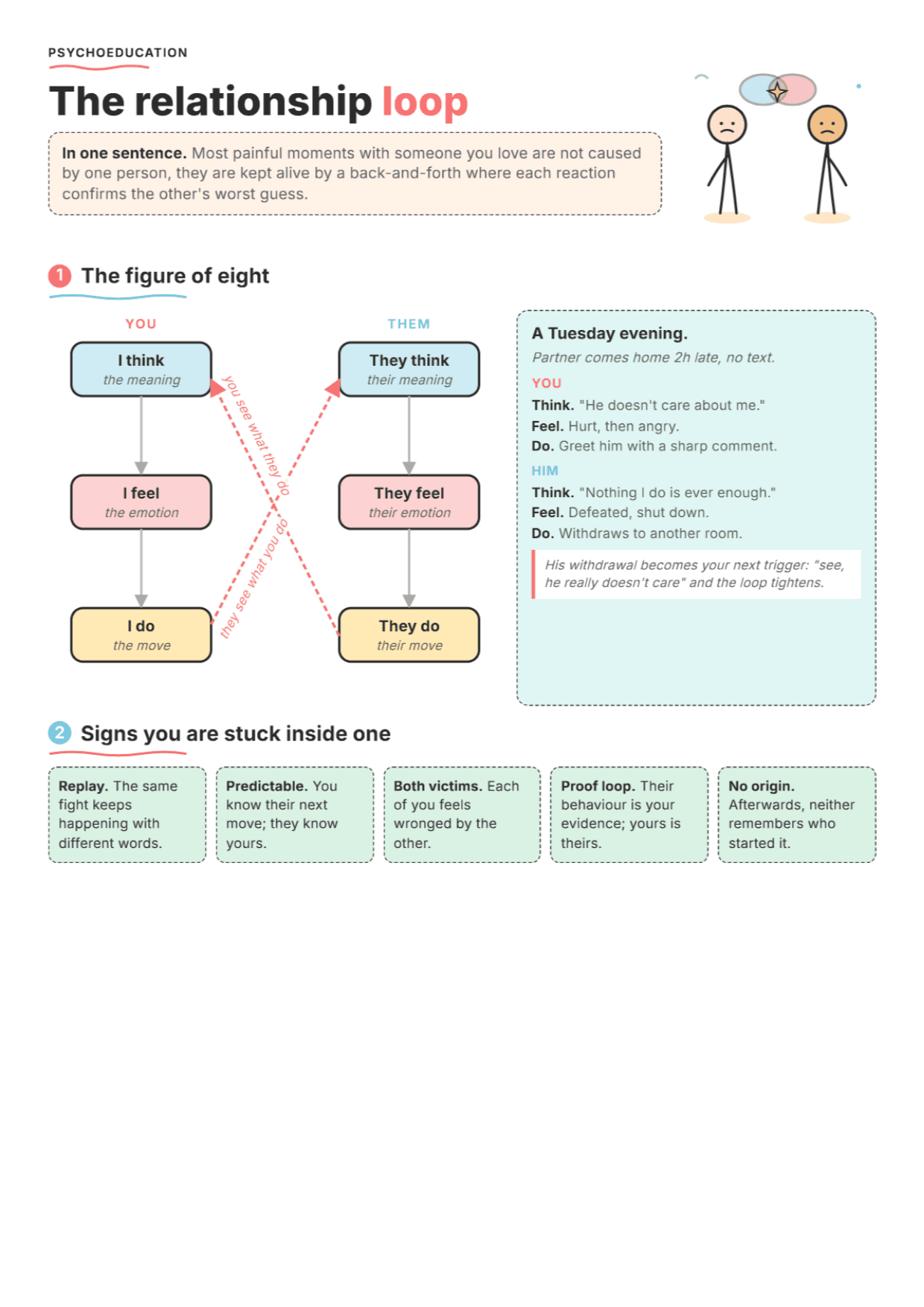
Reciprocal CBT Formulation: PDF Worksheet, Tools and Exercises
A visual PDF worksheet for explaining mutual maintenance cycles in relationships, a clinical tool that makes the reciprocal loop concrete in session.
RelationshipsThoughts & cognition
Handout
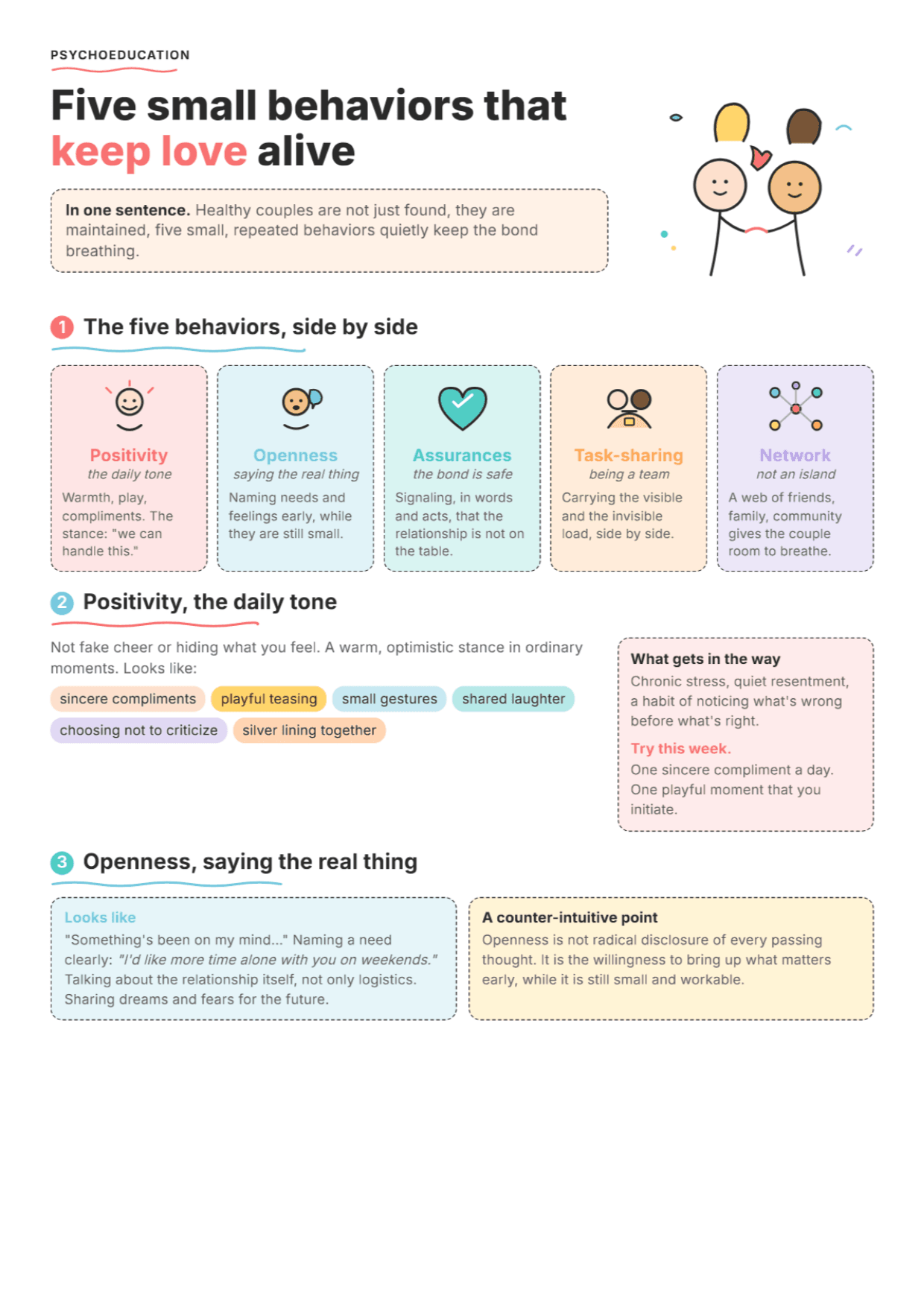
Relationship Maintenance Behaviors: PDF Worksheet, Tools and Exercises
A printable PDF fiche and clinical tools to help patients understand the five behaviors that actively sustain a healthy relationship, grounded in Gottman and Stafford's research.
Relationships

Handout
SMART Goals: PDF Worksheet, Tools and Exercises for Clinical Practice
A printable PDF worksheet, clinical tools, and concrete exercises to help patients turn vague intentions into structured, achievable SMART goals in therapy.
Life transitionsMood & depression