
Clinical picture. T., a man in his early forties, presented with mild depression and low self-efficacy, reporting that he had "tried to get more active" repeatedly without success. In session, the clinician introduced the SMART Goals infosheet and walked through each letter with T., who initially proposed "exercise more" as his goal. Working through the Specific and Measurable columns together, T. revised this to walking 20 minutes after his lunch break on Monday, Wednesday, and Friday for three weeks, rating his confidence in achieving it at eight out of ten. At the following session he reported having completed five of the six planned walks, and attributed the success partly to having written the goal on a sticky note on his computer screen.
SMART Goals: PDF Worksheet, Tools and Exercises for Clinical Practice
A printable PDF worksheet, clinical tools, and concrete exercises to help patients turn vague intentions into structured, achievable SMART goals in therapy.
Clinical vignettes
Vague Intention Becomes Workable Plan
Relevance Check Redirects a Patient's Goal
Clinical picture. A., a woman in her mid-thirties with generalised anxiety, arrived to session with a self-generated goal to "meditate daily" after reading about mindfulness online. The clinician used the SMART Goals infosheet to prompt a Relevance check, asking what that goal was actually connected to for A. personally. A. acknowledged the goal felt more like a "should" than a genuine priority, and through the worksheet identified that reading with her young daughter each evening was both meaningful and behaviorally concrete. She left with a time-bound, specific plan and noted at review that anchoring it to an existing bedtime routine had removed the effortful decision-making that usually preceded avoidance.
When you ask a patient what they want to work on between sessions, the answer is almost always a direction, not a destination: "exercise more," "stress less," "be a better parent." This SMART goals PDF worksheet gives you a visual scaffold to close that gap in session, without spending ten minutes explaining a framework that evaporates the moment the patient walks out.
Use this resource with your patients
Handout, exercises and materials ready to use, right inside SessionFuel.
Why SMART goals are harder to teach verbally than they look
The acronym is deceptively simple. Clinically, what trips patients up is not the letters themselves but the specificity gap between what they intend and what they actually commit to. A patient who says "I want to read more" genuinely believes that is a plan. Explaining, verbally, why it is not tends to feel like criticism, or worse, like an academic exercise disconnected from their actual distress.
A second sticking point is the relevance filter. Patients readily generate goals that belong to the "should" category rather than to anything they actually value, and those goals die within days. Without a visual prompt that distinguishes "what I should do" from "what genuinely matters to me," this distinction often gets lost in the conversational flow.
The same pattern applies to procrastination work and motivational ambivalence: patients state intentions with conviction and then encounter no concrete behavioural bridge. The fiche addresses exactly this execution gap.
750+ clinical tools
A library built with and for clinicians, ready to use in session and extend between appointments.
Access all the toolsWhat the fiche contains: a visual support for explaining SMART in session
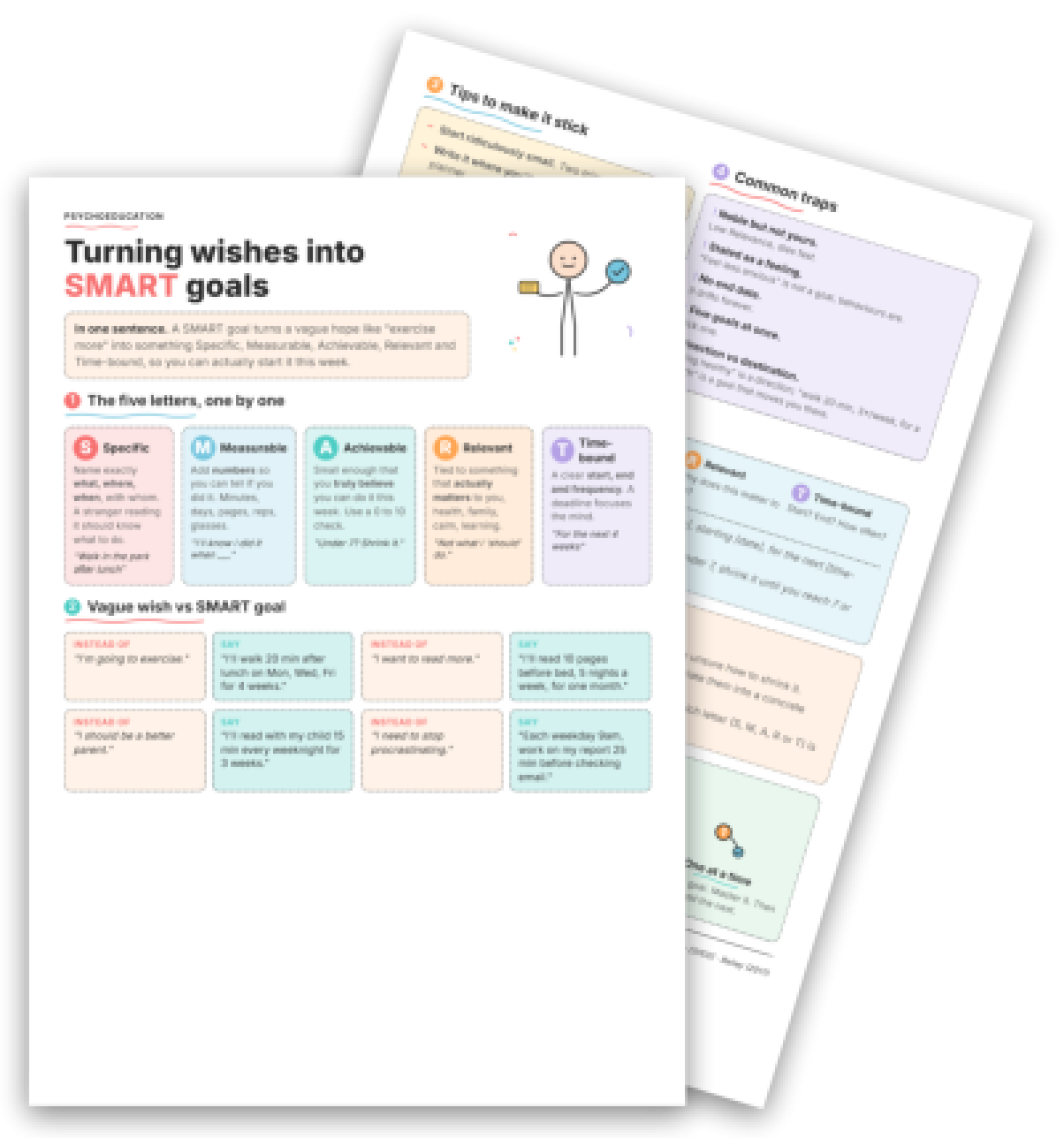
The fiche is structured across five numbered panels, each serving a distinct pedagogical function during psychoeducation.
- Panel 1 walks through each letter individually, with a concrete sensory anchor: "A stranger reading it should know what to do" (Specific); "I'll know I did it when ___" (Measurable); a 0-to-10 confidence check with the rule "Under 7? Shrink it" (Achievable); "Not what I 'should' do" (Relevant); and a clear start-end-frequency structure for Time-bound.
- Panel 2 provides four side-by-side reformulations, moving from vague wishes ("I'm going to exercise") to concrete SMART versions ("I'll walk 20 min after lunch on Mon, Wed, Fri for 4 weeks"). Patients can see, at a glance, what the transformation actually looks like.
- Panel 3 lists practical implementation tips, including habit anchoring: "After my morning coffee, I will ___." This directly supports building new habits and connects to behavioral activation work.
- Panel 4 names the most common traps: noble but irrelevant goals, goals stated as feelings rather than behaviours, no end date, and attempting five goals simultaneously.
- Panel 5 is a structured drafting template with one sentence per SMART letter, closing with a full-sentence goal template and the 0-to-10 confidence check as a go/no-go criterion.
The fiche also includes a "To discuss in session" section flagging three specific situations worth revisiting with you: a confidence rating stuck below 7, persistent feeling-based goal phrasing, and two consecutive missed goals.
> Key takeaway: the fiche is a visual support that facilitates the explanation of SMART goals in session; it is not a homework form the patient completes alone. The side-by-side reformulation panel and the confidence scale do the heavy lifting of an explanation that would otherwise take most of the session.
Use it with your patients
Share this tool in the mobile app and follow the work between sessions.
When and how to introduce this fiche
The ideal moment is after an initial formulation is in place, once you have identified a target behaviour that would meaningfully support the treatment plan, whether that is values-based committed action, recovery from depression through activity scheduling, or the preparation phase of a goal-setting and behaviour change exercise.
For patients presenting with procrastination, low motivation, or those struggling to move from insight to action, introduce it as early as session two or three. For patients engaged in longer-term goal planning or life goals work across multiple domains, it functions as a precision tool for translating each domain objective into a workable weekly commitment.
A useful introduction: "I'd like to show you a framework we can use together to turn what you just described into something concrete enough to actually start this week." Open the fiche to Panel 2 first. The reformulation examples tend to generate immediate recognition. Then work through Panel 5 together, using the confidence check to calibrate until the patient reaches 7 or above. Leave the fiche with them.
Debrief at the next session with the weekly behavioural review: if the goal was missed, use the fiche's own diagnostic logic: which letter was weak? That question lands differently when the patient has the visual in hand.
One limit worth noting: patients in acute crisis or with severe executive functioning difficulties may find even the drafting template cognitively demanding. In those cases, work through the template entirely in session and set the bar very low on the A dimension before handing the sheet over.
The fiche does not replace clinical formulation. It makes the step from formulation to first behaviour visible, shared, and concrete.
Your session continues in your patients' pocket
Use with a patientYour resources, available everywhere
The handouts, exercises, programs and audios above: you choose which ones to make available to your patients, in the mobile app dedicated to them.
And far more than a library
The app goes well beyond resources, to support your patients every day:
Related categories
Explore other clinical resources by category.
Anxiety
Clinical hub for anxiety disorders: CBT and ACT worksheets, psychoeducation sheets, and exercises for assessment and treatment across the anxiety spectrum.

Mood
Evidence-based worksheets and clinical tools for mood disorders: CBT, ACT, and positive psychology resources for psychologists and therapists.

Identity
Clinical resources for self-identity work in therapy: CBT, ACT, schema tools for clinicians addressing self-concept, core beliefs, and identity disruption.

Transitions
Clinical hub for life transitions: tools, worksheets and exercises to support psychosocial adjustment, role change and identity work in practice.

Neurodevelopment
Clinical hub for neurodevelopmental disorders: psychoeducation, worksheets and intervention tools for ADHD, ASD, learning disorders and related conditions.

Understand
Clinical hub for the therapeutic aim 'Understand': worksheets and tools to build patient insight across CBT, ACT, schema therapy and more.