
Clinical picture. A., a woman in her late thirties, presented with an adjustment disorder following organisational restructuring at her workplace; she reported persistent rumination about whether to apply for a newly created managerial role or request a lateral transfer. Her anxiety was maintained partly by the undifferentiated quality of her worry: she could not separate her own resources from situational constraints. The clinician introduced the SWOT worksheet as a structured 20-minute exercise, asking her to name the decision concretely before filling each quadrant with short phrases rather than narrative. A. identified, in the Weaknesses box, a pattern of avoidance when facing hierarchical conflict, which she had not previously articulated; this single item shifted the session focus toward a specific skill gap rather than global self-doubt. At the following appointment she reported that the grid had not resolved the dilemma but had made the trade-off feel manageable enough to schedule a conversation with her line manager.
SWOT Analysis: PDF Worksheet, Tools and Exercises for Clinical Practice
A structured visual PDF worksheet helping clinicians externalise complex decisions with patients, separate internal from contextual factors, and turn looping deliberation into a concrete action plan.
Clinical vignettes
Career Decision in Adjustment Disorder
Ambivalence About Relationship Transition
Clinical picture. P., a man in his early forties with a history of generalised anxiety, had been cycling through the same deliberation for several months: whether to move in with his partner or maintain separate households. Standard Socratic questioning had produced limited traction, as each session tended to reproduce the same loop. The clinician offered the SWOT worksheet and noted explicitly that a pros-and-cons list had already been tried; the four-quadrant structure was framed as a way to separate what was internal and controllable from what was external and uncertain. Completing the Opportunities quadrant, P. noted his partner's flexible work schedule as a concrete contextual resource he had consistently discounted in previous discussions. The exercise did not produce an immediate decision, but P. described a reduction in the sense that the situation was entirely out of his hands, which aligned with a modest drop on his weekly anxiety self-monitoring scale.
Patients weighing major life decisions rarely suffer from a shortage of information. They suffer because everything is entangled in one looping internal monologue. This SWOT Analysis PDF worksheet gives you a concrete visual scaffold to interrupt that loop and sort the tangle together, in session, on a single page.
Use this resource with your patients
Handout, exercises and materials ready to use, right inside SessionFuel.
Why decision-making resists verbal explanation in session
When a patient is caught between two options, accepting a promotion, ending a relationship, moving cities, the clinical picture is typically rumination dressed as deliberation. They revisit the same arguments in cycles, collapse internal factors (skills, fears, habitual patterns) with external ones (timing, allies, structural risks), and arrive at the same impasse each time.
A verbal pros-and-cons walkthrough rarely breaks this. The patient adds items to their mental list, then loops it again. The underlying problem is structural: a flat pros/cons list conflates what is inside the patient with what is in the context. That conflation sustains the paralysis. No amount of Socratic questioning resolves it when the patient is still mixing the two registers freely.
The SWOT grid solves a structural problem, not just a content one. That is precisely why it needs to be visual, and why explaining it at the oral level alone is rarely enough.
What the fiche contains: a four-quadrant visual support
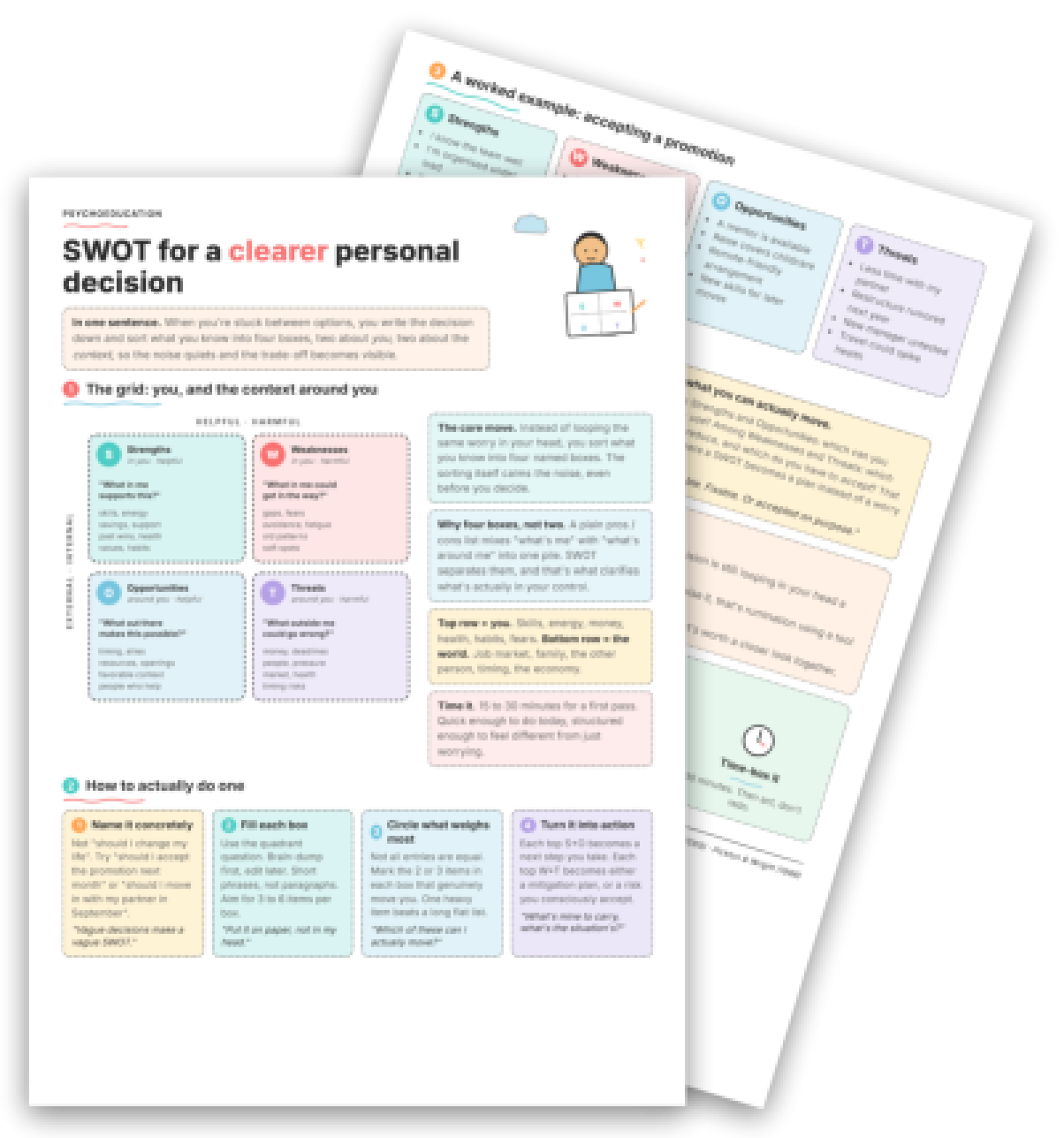
The fiche PDF organises the decision space across two axes: helpful versus harmful, and internal versus external. The result is four named cells: Strengths ("What in me supports this?"), Weaknesses ("What in me could get in the way?"), Opportunities ("What out there makes this possible?"), and Threats ("What outside me could go wrong?"). Each cell carries concrete prompts drawn from everyday clinical situations.
The step-by-step process that accompanies the grid walks through four moves:
- Name it concretely: the fiche insists on specificity ("Vague decisions make a vague SWOT"), itself a psychoeducation point worth pausing on with patients who reframe every decision as a philosophical question.
- Fill each box via brain-dump first, 3 to 6 short phrases per cell.
- Circle what weighs most: the fiche draws attention to the difference between heavy items and long flat lists, which maps neatly onto work on cognitive overload and overthinking.
- Turn it into action: S+O pairs become next steps; W+T pairs become mitigation plans or consciously accepted risks.
A worked example (accepting a promotion) is laid out in full, so you can model the exercise directly from the page rather than improvising one. This matters when the patient's own decision still feels too charged to fill in cold.
The fourth panel introduces the reverse SWOT: running all four boxes for not taking the action. This is the move that surfaces the cost of avoidance. It pairs naturally with ACT-based work on the choice point and with cost-benefit analysis tools, and it complements decisional balance exercises by adding the internal/external separation those tools do not make. The fiche frames it bluntly: "What's the cost of staying exactly where I am?"
> Key point: The fiche is a visual support that facilitates the explanation of SWOT in session. The patient does not fill it alone at home and return with a grid. You walk the quadrants together, externalise the cognitive tangle onto the page, and leave them a concrete reference to carry forward.
750+ clinical tools
A library built with and for clinicians, ready to use in session and extend between appointments.
Access all the toolsWhen and how to introduce it
The SWOT worksheet fits best once a decision has surfaced repeatedly across sessions without resolution. It is particularly well indicated when rumination has already been named as a pattern, when intolerance of uncertainty is keeping the patient from committing, or when procrastination is framed as waiting for the "right moment" that never arrives. For patients navigating professional crossroads, it pairs well with the professional life assessment exercise and with SMART goal-setting tools. When ambivalence is the presenting dynamic, combining it with motivational interviewing tools on ambivalence and change sharpens the clinical picture further. For patients who need to map what is actually controllable, the Control, Influence, Accept framework makes a clean companion.
A simple introduction: "Instead of going through pros and cons again, let's sort what you already know into four boxes, two about you, two about the situation around you. It usually makes the trade-off much easier to see."
When debriefing, note which quadrant fills fastest and which stays thin. A suspiciously empty Weaknesses box or an overloaded Threats box is clinical data. The fiche itself flags that if the patient redoes the SWOT three or four times without acting, that pattern is worth naming directly: rumination using a structured tool as fuel. The fiche does not replace your case formulation; it externalises one piece of it onto a page the patient can hold.
Use it with your patients
Share this tool in the mobile app and follow the work between sessions.
Sources
- Benzaghta, M. A., Elwalda, A., Mousa, M., Erkan, I., Rahman, M. (2021). SWOT analysis applications: An integrative literature review. Journal of Global Business Insights, 6(1), 55-73.
Your session continues in your patients' pocket
Use with a patientYour resources, available everywhere
The handouts, exercises, programs and audios above: you choose which ones to make available to your patients, in the mobile app dedicated to them.
And far more than a library
The app goes well beyond resources, to support your patients every day:
Related categories
Explore other clinical resources by category.

Emotions
Clinical resources on emotion regulation: worksheets, coping tools, CBT, REBT, and ACT exercises for therapists working across diagnoses and age groups.

Transitions
Clinical hub for life transitions: tools, worksheets and exercises to support psychosocial adjustment, role change and identity work in practice.

Cognition
Printable cognitive therapy worksheets and clinical tools for therapists: CBT, ACT, schema work, defusion, distortions, and belief restructuring.

Build awareness
Clinical worksheets and tools to build awareness in therapy: cognitive distortions, schemas, emotions, ACT and CBT resources for practitioners.

Build skills
Skill-building resources for clinicians: printable worksheets and exercises for coping, assertiveness, and communication skills training in therapy.

Engage & motivate
Clinical hub: printable worksheets and exercises to build therapeutic engagement and motivation across ACT, CBT, and integrative practice. For clinicians.