
Clinical picture. A, a man in his mid-forties, presented with low-grade dysphoria and a diffuse sense of stagnation after a promotion that had objectively improved his financial situation. During a session focused on behavioural activation, the clinician introduced the values clarification worksheet and asked him to select and rank his ten core values from the starter pool. A placed "Family" at number one and "Achievement" at number six, yet his daily schedule, when reviewed, was structured almost entirely around work output. Scoring each value on current presence, he rated Family at 2 out of 10 and Achievement at 8, producing a gap of seven points on the value he had himself ranked highest. That discrepancy became the organising focus of the following two sessions, replacing the more diffuse complaint of feeling unfulfilled.
Values Clarification: PDF Worksheet, Tools and Exercises
A structured PDF worksheet with visual panels to help clinicians guide patients through values ranking, gap analysis, and committed action in ACT-informed practice.
Clinical vignettes
Ranking Reveals an Unspoken Priority
Separating Inherited Values from Personal Ones
Clinical picture. M, a woman in her early thirties, was seen in the context of chronic indecision and recurrent conflict with her partner around lifestyle choices. The clinician offered the worksheet as a between-session task, inviting M to notice which of her chosen ten felt genuinely motivating versus obligatory. M returned having circled "Responsibility" and "Stability" in her top three, but noted during review that both had been heavily emphasised in her family of origin and that neither produced any felt sense of direction when she imagined acting on them. The clinician used this observation to introduce the distinction between an internalised value and a socially adopted rule, without pathologising either. M then identified "Creativity" and "Freedom," initially left off her list, as values she had discarded prematurely, which opened a more grounded conversation about her relationship dissatisfaction.
When you introduce values work verbally, patients often nod and then name a goal ("I want to travel more"), an outcome state ("I want to feel happy"), or something their family handed them. The distinction between a value, a goal, and a feeling collapses in conversation. This values clarification fiche PDF gives you a visual structure to hold that distinction in place, so the concept sticks beyond the session itself.
Use this resource with your patients
Handout, exercises and materials ready to use, right inside SessionFuel.
Why Values Clarification Resists Oral Explanation
The core clinical difficulty is conceptual, not motivational. Most patients have never been asked to distinguish between a direction and a destination. Within ACT, the values/goals/feelings triad is foundational, yet spoken explanation rarely survives the week. The patient who leaves having understood the difference between "being a present parent" (a value) and "dinner with the kids on Tuesday" (a goal) may return the following session using both terms interchangeably.
A second layer of difficulty is the "should" value: beliefs about what a good person is supposed to prioritize, absorbed from family or cultural context, which patients present as genuine personal commitments. Without a concrete tool to help them interrogate their list, this confusion remains invisible, and treatment targets drift accordingly. The Exploring Values fiche for ACT practice addresses the same territory; this worksheet goes further by adding a ranking and gap-scoring structure that surfaces what patients actually privilege, not what they report valuing.
750+ clinical tools
A library built with and for clinicians, ready to use in session and extend between appointments.
Access all the toolsInside the Fiche: A Visual Support for Every Stage of the Work
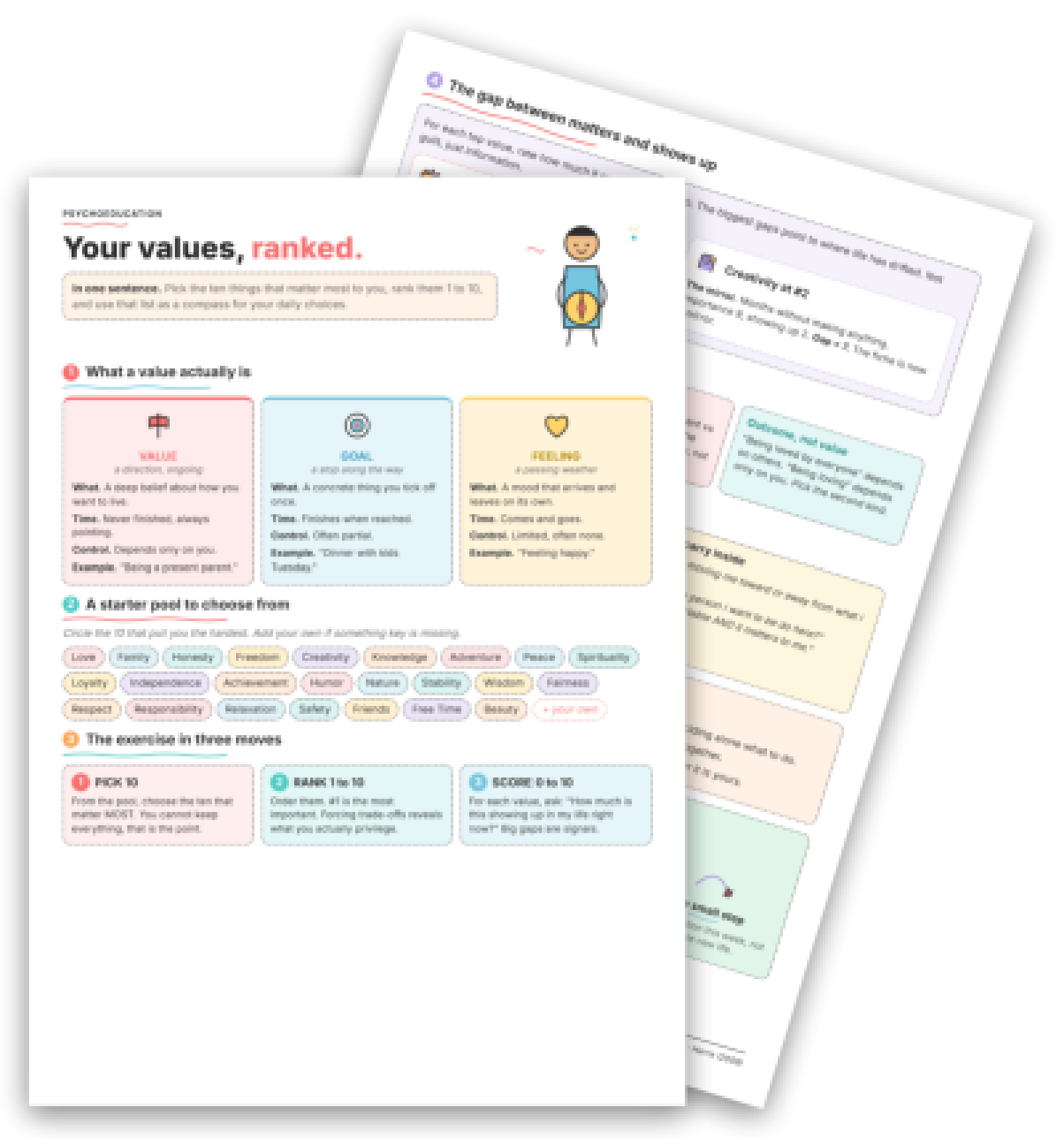
The fiche PDF is organized around six sequential panels, each targeting a distinct moment of the psychoeducation.
The first panel presents the value / goal / feeling distinction in a three-column layout. Each column carries the same four dimensions (what, time, control, example), so patients can compare at a glance rather than hold three verbal definitions in working memory. The lived example "Being a present parent" versus "Dinner with kids Tuesday" makes the distinction concrete without requiring interpretation.
The second panel provides a starter pool of 24 values (love, creativity, freedom, loyalty, stability, and so on), with space to add personal items. Patients circle the ten that "pull you the hardest", a deliberate phrasing that bypasses cognitive override.
The three-move exercise that follows is the operational heart of the fiche. Step 1: pick 10. Step 2: rank them 1 to 10. Step 3: score 0 to 10 for current enactment. As the fiche puts it, "forcing trade-offs reveals what you actually privilege". The ranking step, in particular, is what the Choice Point worksheet for ACT and the ACT Hexaflex rely on implicitly but rarely make this explicit as a scored exercise.
The gap analysis panel then does the clinical heavy lifting: a top value ranked first but scoring a 3 on current enactment produces a gap of 7. The fiche names this clearly: "The biggest gaps point to where life has drifted. Not guilt, just information." That single reframe, visible on the page, saves considerable session time in managing the shame response.
A panel on three traps (the "should" value, clashing values such as freedom vs. family, and outcome-dependent values) gives you a structured way to probe the list before committing to treatment targets. Finally, a "To discuss in session" section at the bottom carries three explicit prompts for you to debrief with the patient, including how to handle a top value scoring 3 or below and how to name a values tension rather than suppress one side of it.
> Key point: This fiche is a visual support that facilitates explanation in session. It is not a self-administered questionnaire. You walk through the panels with the patient, use the gap scores as a springboard for collaborative formulation, and leave the sheet with them as a compass for between-session reflection.
Use it with your patients
Share this tool in the mobile app and follow the work between sessions.
When and How to Propose the Fiche
Timing. This worksheet fits naturally in the early-to-mid phase of an ACT-informed treatment, once alliance is established and the patient has some tolerance for self-reflection. It is also highly useful in depression work, where behavioral activation stalls because the patient cannot identify activities that feel genuinely worth doing; the Valued Domains worksheet for ACT and the Personal Values Clarification exercise make good companions at that stage. For couples work, the Couple Misalignment and Values exercise extends the same framework to relational compatibility.
Profiles. Patients presenting with existential drift, chronic overwork, or a pattern of living for others' approval (see approval-seeking schemas) often have no accessible language for their own priorities. The fiche gives that language fast. For patients with marked perfectionism or unrelenting standards, the "should" value trap panel is where you will want to linger.
How to introduce it. A neutral framing works best: "Before we focus on what's causing problems, I'd like us to spend a few minutes mapping what actually matters to you. There's a sheet I use that makes this easier to see." You then work through the panels together, pausing at the ranking step and at any gap of 5 or more.
Debrief. The "To discuss in session" prompts at the base of the fiche guide the debrief for you. After the session, pair the fiche with the Values Cultivation exercise or the My Future Inventory exercise to close the gap between insight and committed action. For patients building longer-term direction, Setting Life Goals and the Psychological Flexibility worksheet extend the work naturally.
The fiche does not replace the collaborative case formulation; it makes the values conversation visible, structured, and reproducible across sessions.
Your session continues in your patients' pocket
Use with a patientYour resources, available everywhere
The handouts, exercises, programs and audios above: you choose which ones to make available to your patients, in the mobile app dedicated to them.
And far more than a library
The app goes well beyond resources, to support your patients every day:
Related categories
Explore other clinical resources by category.

Identity
Clinical resources for self-identity work in therapy: CBT, ACT, schema tools for clinicians addressing self-concept, core beliefs, and identity disruption.

Transitions
Clinical hub for life transitions: tools, worksheets and exercises to support psychosocial adjustment, role change and identity work in practice.

Build awareness
Clinical worksheets and tools to build awareness in therapy: cognitive distortions, schemas, emotions, ACT and CBT resources for practitioners.

Engage & motivate
Clinical hub: printable worksheets and exercises to build therapeutic engagement and motivation across ACT, CBT, and integrative practice. For clinicians.

ACT
Clinical hub for Acceptance and Commitment Therapy (ACT): worksheets, exercises, programs and audio resources for practitioners using the ACT model.

CBT
CBT worksheets, cognitive restructuring exercises & behavioral tools for clinicians. Evidence-based resources for every phase of cognitive behavioral therapy.