
Clinical picture. A, a 34-year-old presenting with low-grade anxiety and reported difficulty concentrating at work, described spending several hours each evening scrolling through social media without any clear intention. The clinician introduced the five-question homework exercise between sessions, asking A to complete it in writing before the next appointment. Reviewing A's responses, the pair identified a consistent trigger: phone use escalated reliably after work emails arrived in the late afternoon, functioning as an avoidance response to residual occupational stress. Question three prompted A to note, unprompted, that prolonged scrolling was directly at odds with a stated goal of reading more. By the following session, A had drafted one concrete self-commitment around phone-free evenings and reported moderate but sustained adherence over the intervening week.
Excessive Screen Time: A Guided Clinical Exercise
A structured five-question homework tool helping patients identify smartphone triggers, assess values alignment, and commit to concrete behavioral change.
Clinical vignettes
Mapping Triggers in Recurrent Avoidance
Values Alignment in Adolescent Presentation
Clinical picture. T, a 17-year-old referred for low motivation and disrupted sleep, reported checking his phone within minutes of waking and described a vague sense of dissatisfaction after long periods of use that he struggled to articulate. The clinician framed the exercise as a way to gather information rather than a prescription to change, and T completed the questions at his own pace between two sessions. His written response to question two revealed that putting the phone down left him feeling restless and slightly irritable, which he had not previously connected to phone use. The fourth question, addressing the brain's pull toward immediate reward, opened a brief but substantive discussion about choice and agency that T found more engaging than direct psychoeducation had been. His self-commitment remained modest, limiting phone use after midnight on school nights, and this boundary held consistently across the following fortnight.
When "I'm on my phone too much" becomes a clinical concern
Patients raise smartphone overuse almost apologetically, framing it as a bad habit rather than something worth sustained clinical attention. That framing is part of the problem. Behind the complaint usually sit poorly identified triggers, an unexamined emotional function, and a real gap between how the patient spends their time and what they say they care about. Explaining this verbally tends to produce understanding without change, because the brain's immediate reward system does not respond to insight alone.
Patients need a structured space to examine their own behavior in writing, on their own terms, away from the consulting room. Reaching for the phone is often a conditioned response to specific cues, much like the dynamics described in Identifying and Coping with Triggers and Identifying Emotional Triggers. At the same time, the pull toward instant gratification over long-term gain connects directly to work on permissive thinking and the Insufficient Self-Control Schema. These are not topics that resolve through one verbal exchange in a consultation.
Use this resource with your patients
Handout, exercises and materials ready to use, right inside SessionFuel.
What this exercise contains
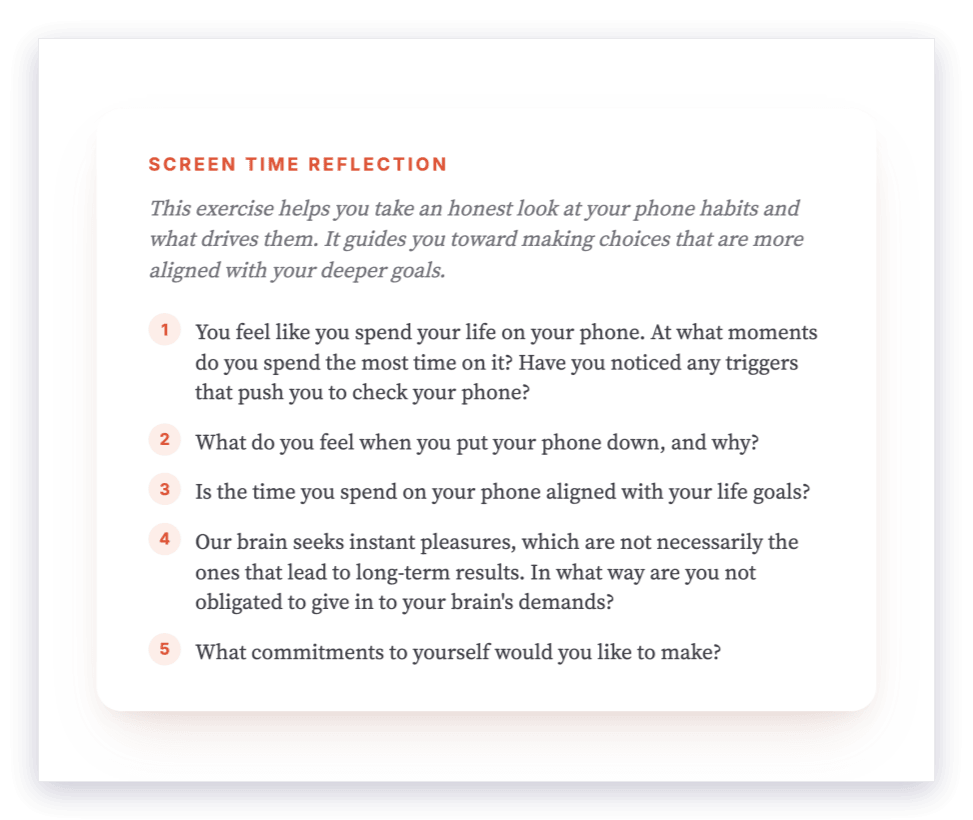
The exercise is built around five sequenced questions. The image above lists them in order with a short framing introduction:
This image is a static preview of the questions only. The full guided exercise, including patient-facing instructions and dedicated space to write answers, is experienced by the patient autonomously in the app, not in this image.
The five questions move through a deliberate progression. Question 1 asks patients to map the moments and triggers that pull them toward their phone, building the kind of behavioral self-monitoring that mirrors current activity inventory work. Question 2 turns attention to the emotional state when the phone is put down, naming what the behavior is actually regulating. Question 3 asks directly whether screen time is aligned with life objectives, opening a values clarification thread without the clinician needing to introduce it. Question 4 offers a brief psychoeducational frame on the brain's reward architecture and asks the patient to reflect on whether they are obliged to follow it, a prompt that connects naturally to cost-benefit analysis and decisional balance frameworks. Question 5 closes with concrete personal commitments, anchoring the reflection in behavioral intention, as in structured goal-setting and habit-building work.
As a concrete clinical support, the exercise externalizes the patient's reasoning and makes it legible. The clinician does not need to extract information through questioning at the next appointment: the patient arrives with written material to work from.
This exercise is available to patients through the SessionFuel patient app, the dedicated mobile interface for patients of clinicians who use SessionFuel: the clinician assigns it as homework, and the patient completes all five questions directly on their phone, independently, between two appointments.
750+ clinical tools
A library built with and for clinicians, ready to use in session and extend between appointments.
Access all the toolsUse it with your patients
Share this tool in the mobile app and follow the work between sessions.
How to integrate this as between-session homework
Which patients it suits. The exercise is well matched to patients who mention distraction, a vague sense of wasted time, or difficulty following through on personal goals. It is equally useful for those already working on work-life balance or life goals, and for patients in whom you suspect an avoidance function behind screen use without having yet named it together.
How to introduce it. A simple frame works well: "Between now and our next meeting, I'd like you to take fifteen minutes with these five questions on your phone and answer them as honestly as you can." Avoid over-explaining the rationale; the exercise is designed to surface the patient's own insight.
What to do with what they bring back. Question 2 (feelings on putting the phone down) and question 3 (values alignment) tend to generate the richest clinical material. The commitments from question 5 can feed directly into setting 6 and 12 month goals or a weekly behavioral review. Where the patient writes about wanting change but finding the phone rewarding, building discrepancy or motivation and ambivalence tools can deepen that thread in the following appointment.
Key insight: Smartphone overuse rarely shifts through awareness alone. This exercise gives patients a structured written space to connect their behavior with their triggers, emotional states, and values, producing clinical material that arrives at the next appointment ready to work with.
Your session continues in your patients' pocket
Use with a patientYour resources, available everywhere
The handouts, exercises, programs and audios above: you choose which ones to make available to your patients, in the mobile app dedicated to them.
And far more than a library
The app goes well beyond resources, to support your patients every day:
Related categories
Explore other clinical resources by category.

Identity
Clinical resources for self-identity work in therapy: CBT, ACT, schema tools for clinicians addressing self-concept, core beliefs, and identity disruption.

Emotions
Clinical resources on emotion regulation: worksheets, coping tools, CBT, REBT, and ACT exercises for therapists working across diagnoses and age groups.

Behaviours
Clinical hub for behaviors in therapy: worksheets and tools for coping, eating disorders, CBT formulation, and maladaptive behavioral patterns.

Build awareness
Clinical worksheets and tools to build awareness in therapy: cognitive distortions, schemas, emotions, ACT and CBT resources for practitioners.

Engage & motivate
Clinical hub: printable worksheets and exercises to build therapeutic engagement and motivation across ACT, CBT, and integrative practice. For clinicians.

ACT
Clinical hub for Acceptance and Commitment Therapy (ACT): worksheets, exercises, programs and audio resources for practitioners using the ACT model.