
Clinical picture. M., a 41-year-old secondary school teacher, presented with hazardous alcohol use and had twice cancelled follow-up appointments after expressing readiness to cut down. In session, the clinician introduced the four-quadrant decisional balance, asking M. to begin with the disadvantages of changing rather than with reasons to stop. M. identified the loss of his main social ritual with colleagues and a genuine fear of managing work stress without his habitual evening drink, naming these aloud without being challenged. Moving through the remaining quadrants, he paused longest over the hidden benefits of not changing, acknowledging that drinking gave him a predictable boundary between the school day and home. By the final quadrant he had articulated, in his own words, that fatigue and a recent hypertension reading were costs he had not previously connected to the pattern, leaving the session with a completed grid rather than a directive to change.
Motivation and Ambivalence: PDF Worksheet, Tools and Exercises
A structured four-quadrant PDF worksheet to help clinicians make ambivalence visible, name the hidden function of staying stuck, and move patients toward a clearer decision in session.
Clinical vignettes
Ambivalence About Alcohol Use
Sustained Ambivalence in Binge Eating
Clinical picture. A., a 29-year-old graduate student, had been in cognitive-behavioural therapy for binge eating for six weeks and described feeling stuck, reporting that she understood the rationale for change but could not act on it consistently. The clinician offered the decisional balance worksheet as a structured way to map the pull in both directions, framing ambivalence as information rather than resistance. A. noted in the second quadrant that binge episodes reliably ended a state of emotional numbness and provided a clear, if temporary, sense of control over something concrete; she described this as the box she had never been asked to fill in before. Completing the third quadrant, she listed two years of disrupted study schedules and a withdrawn social life as ongoing costs, which she had previously minimised. The exercise did not resolve her ambivalence in a single session, but it gave both clinician and patient a shared reference point for the specific function the behaviour was serving, which informed the subsequent treatment focus.
Explaining ambivalence verbally tends to produce polite nodding rather than genuine insight. Patients agree that ambivalence makes sense, then walk out the door no closer to understanding why they keep choosing not to change. This fiche PDF gives the concept a concrete visual form that makes the hidden architecture of the patient's stuck position legible, in session, together.
Use this resource with your patients
Handout, exercises and materials ready to use, right inside SessionFuel.
Why ambivalence resists verbal explanation alone
The sticking point is almost never the idea of ambivalence. Most patients can accept, intellectually, that they want to change and not want to change at the same time. What they cannot do, without a structured prompt, is articulate what the current pattern is doing for them. The advantages of not changing are the least-examined quadrant in any clinical conversation, and often the most clinically loaded.
A simple pros-and-cons list doesn't solve this. As the fiche itself notes, a pros-and-cons list compares option A to option B, whereas the real clinical need is to compare changing to not changing, which is a different cognitive operation entirely. That distinction is precisely what gets lost when the clinician explains it at the oral level alone, and precisely what the visual grid makes unavoidable.
This is the territory where decisional balance tools and motivational interviewing techniques like building discrepancy become most useful, and where a well-structured visual support saves significant session time.
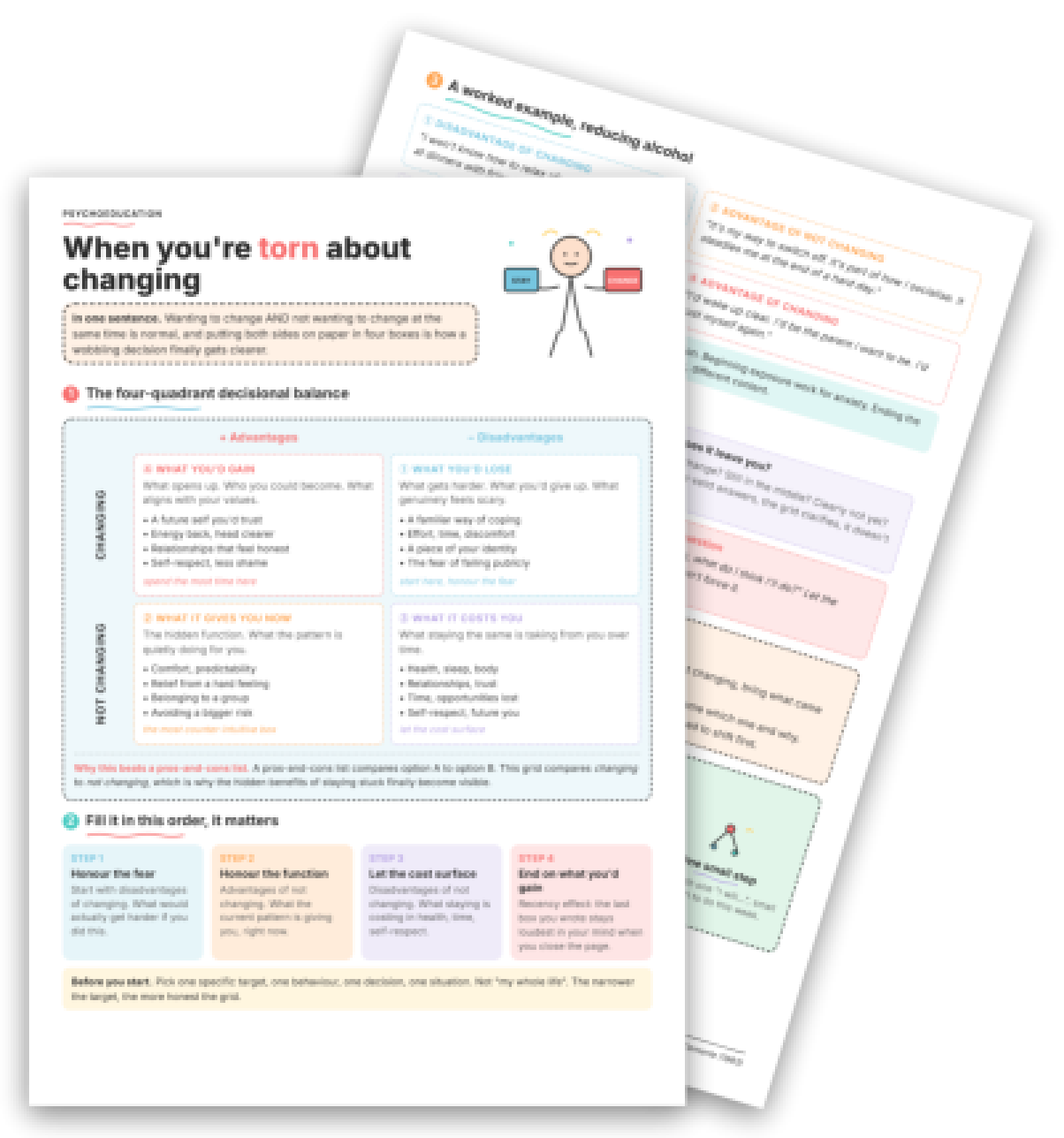
What the fiche contains: a visual grid that externalizes the stuck position
The fiche is built around a four-quadrant decisional balance grid, with quadrants labeled: disadvantages of changing, advantages of not changing, disadvantages of not changing, and advantages of changing. The layout is explicit about fill order, because the sequence matters clinically: start with what the patient would lose, move through the hidden function of staying, surface the ongoing cost, and end on gain. The recency effect is named directly: "the last box you wrote stays loudest in your mind when you close the page."
Each quadrant includes example bullet points (a familiar coping mechanism, energy and identity costs, relationship repair, self-respect) that serve as scaffolding for patients who freeze on a blank page. A worked example on alcohol reduction walks through all four boxes verbatim, which lets you model the level of honesty the exercise requires before the patient fills in their own version. The fiche then includes a reading section with three orienting questions: which quadrant is fullest, where does the grid leave you, and what does "not yet" mean as information rather than failure.
The closing prompt, "Given all of this, what do I think I'll do?", is positioned as a reflective pause, not a decision demand. A "to discuss in session" checklist at the bottom flags the three most clinically rich moments to debrief: when a box was hard to fill, when the patient wanted to argue away one quadrant, and when the grid landed on "not yet."
> Key takeaway: this fiche is a visual support that facilitates the explanation of ambivalence in session, not a questionnaire patients complete alone. The grid externalises what oral dialogue rarely surfaces: the real function the problem behaviour is serving.
750+ clinical tools
A library built with and for clinicians, ready to use in session and extend between appointments.
Access all the toolsWhen and how to introduce the fiche in session
The fiche fits naturally once you have a working alliance and a clear, specific target behaviour. It is not a first-session tool. It works best when the patient is oscillating, expressing simultaneous motivation and resistance, or struggling with avoidance they cannot account for. You can introduce it with a simple frame: "I'd like us to put both sides of this on paper, not because I'm going to talk you into anything, but because it usually tells us something we didn't know before we started."
Walk through the grid together. The advantages-of-not-changing quadrant will often be the thinnest, which is itself a clinical signal: the patient hasn't given themselves permission to name what the pattern provides. Naming it explicitly, as the fiche frames it, does not reinforce the behaviour; it reduces the shame that keeps it opaque. Pairing this work with values clarification or ACT-informed choice-point work can deepen what the grid surfaces.
For patients in addictions or relapse contexts, combine it with relapse prevention planning once the grid has clarified motivation. For those stuck in low motivation due to depression, the Finding Motivation for Change program offers a structured extension. Where a simpler cost-benefit frame is more appropriate for the patient's cognitive level, the cost/benefit analysis worksheet is a lighter entry point. For persistent motivational blocks, the Motivation Loss exercise makes useful between-session homework once the decisional balance has been completed in session.
The fiche doesn't resolve ambivalence for the patient. It makes the ambivalence precise enough to work with, which is the clinician's actual job.
Use it with your patients
Share this tool in the mobile app and follow the work between sessions.
Sources
- Miller, W. R., Rollnick, S. (2023). Motivational Interviewing: Helping People Change and Grow. Guilford Press.
- Miller, W. R. (2022). On Second Thought: How Ambivalence Shapes Your Life. Guilford Press.
- Miller, W. R., Rollnick, S. (2014). Motivational Interviewing and Decisional Balance: Contrasting Responses to Client Ambivalence. Behavioural and Cognitive Psychotherapy, 42(2), 129-141.
- Janis, I. L., Mann, L. (1977). Decision Making: A Psychological Analysis of Conflict, Choice and Commitment. Free Press.
Your session continues in your patients' pocket
Use with a patientYour resources, available everywhere
The handouts, exercises, programs and audios above: you choose which ones to make available to your patients, in the mobile app dedicated to them.
And far more than a library
The app goes well beyond resources, to support your patients every day:
Related categories
Explore other clinical resources by category.

Anxiety
Clinical hub for anxiety disorders: CBT and ACT worksheets, psychoeducation sheets, and exercises for assessment and treatment across the anxiety spectrum.

Mood
Evidence-based worksheets and clinical tools for mood disorders: CBT, ACT, and positive psychology resources for psychologists and therapists.

Emotions
Clinical resources on emotion regulation: worksheets, coping tools, CBT, REBT, and ACT exercises for therapists working across diagnoses and age groups.

Behaviours
Clinical hub for behaviors in therapy: worksheets and tools for coping, eating disorders, CBT formulation, and maladaptive behavioral patterns.

Transitions
Clinical hub for life transitions: tools, worksheets and exercises to support psychosocial adjustment, role change and identity work in practice.

Build awareness
Clinical worksheets and tools to build awareness in therapy: cognitive distortions, schemas, emotions, ACT and CBT resources for practitioners.