
Clinical picture. M., a man in his late forties, presented with a moderate depressive episode marked by social withdrawal and a near-total loss of initiative; he described wanting to return to regular exercise but feeling unable to start. The clinician introduced the psychoeducation program and, between sessions, M. worked through Lesson 1, responding to the guided prompt about contradictory thoughts: he wrote that part of him believed exercise would help, while another part saw no point in trying. Bringing that written response to the next session gave both patient and clinician a concrete anchor for exploring the ambivalence rather than simply reinforcing exhortations to "do more." Over the following two weeks M. completed Lesson 2, listing the costs and benefits of his current inactivity, and began a single short walk three times a week, framing it not as recovery but as a test of the hypothesis that movement might shift his mood slightly.
Finding Motivation for Change: A Clinical Program for Depression
A structured 5-lesson psychoeducation program to help clinicians support depressed patients in rebuilding the energy and conviction to act.
Clinical vignettes
Ambivalence Named, Energy Recovered
Goal Clarification Before Activity Scheduling
Clinical picture. T., a woman in her early thirties, was referred following a second depressive episode; previous attempts at behavioral activation had stalled because she experienced the assigned tasks as arbitrary. Before introducing any activity schedule, the clinician directed her to Lesson 1 of the program, asking her to complete the prompt on what she genuinely wanted to change in her life. T. returned having written about reconnecting with a neglected creative practice, which gave a personally meaningful direction to subsequent planning. Working through the lesson's reflection on the gap between current and desired situation helped her articulate that the distance felt large but not infinite, a shift in framing she had not reached in prior treatment. The clinician noted that grounding behavioral work in the patient's own stated goal reduced the early dropout pattern seen in her previous episode.
Use this resource with your patients
Handout, exercises and materials ready to use, right inside SessionFuel.
The clinical challenge: when the engine will not start
Motivation loss in depression is not laziness. It is a neurobiological and psychological reality, and it creates a cruel paradox: activation is one of the most effective levers against depression, yet the illness erodes precisely the drive that makes activation possible. Explaining this loop verbally, consultation after consultation, rarely lands. Patients nod, then return unchanged. What is hard to convey with words alone is the granular, step-by-step path from "I know I should move" to actually moving. Without a structured scaffold, the gap between intention and action stays invisible. This is exactly what this program addresses. For a sharper look at the self-reinforcing loop driving the problem, The Cycle of Depression offers a strong psychoeducation complement, and pairing it early with Motivation and Ambivalence can make the inner conflict legible before the program even starts.
750+ clinical tools
A library built with and for clinicians, ready to use in session and extend between appointments.
Access all the toolsWhat the program contains
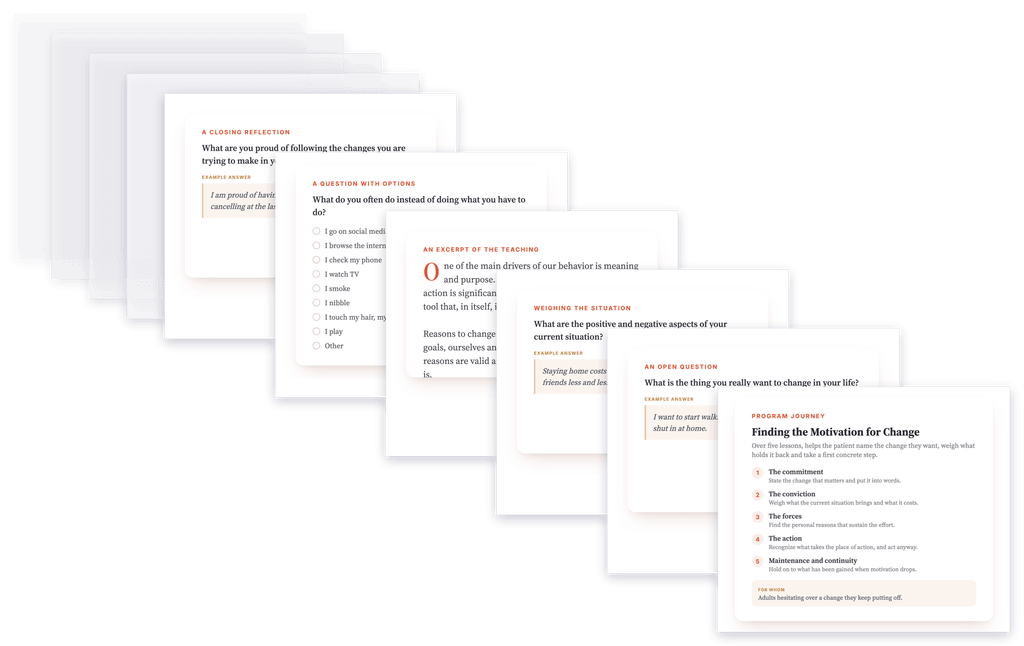
The program unfolds across five sequential lessons, each building on the last.
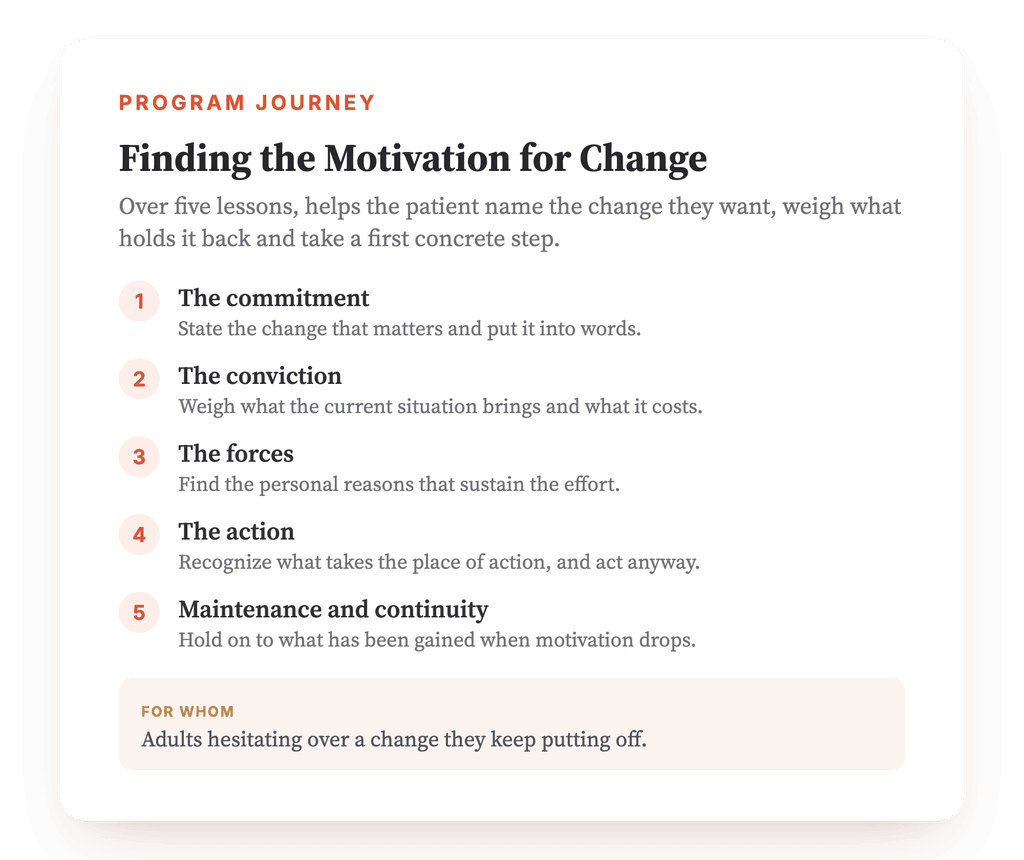
Lesson 1 (Commitment) opens by asking patients to name what they genuinely want to change and to map the gap between where they are and where they want to be. It surfaces ambivalence directly: rather than minimizing the pull of the status quo, it invites patients to articulate contradictory thoughts about change.
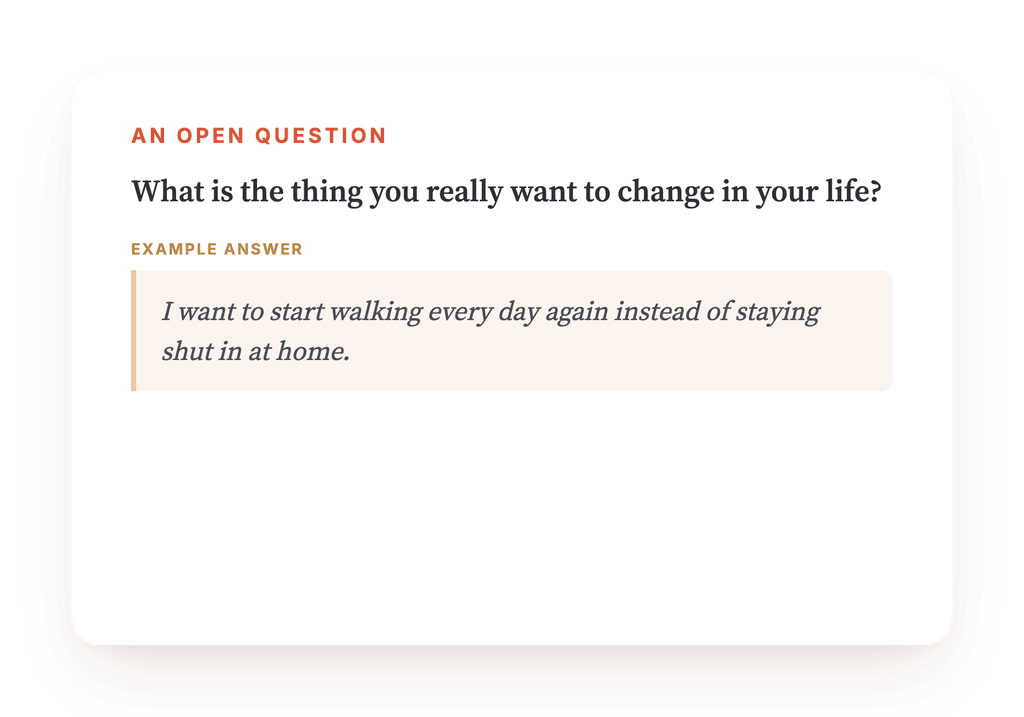
Lesson 2 (Conviction) works the decisional balance in both directions, weighing the real costs and benefits of the current situation and of change. It also maps environmental barriers and supports, and challenges the limiting beliefs that make change feel out of reach. This pairs naturally with Building Discrepancy and Stages of Change as clinical complements.
Lesson 3 (Strengths) shifts the register toward purpose and personal values. Patients identify their "why," connect pride moments to underlying values, and select from a structured list of competencies the strengths they can mobilize. This lesson is notably potent for patients whose self-image has been flattened by depression: see List of 100 Strengths and Qualities for an adjacent resource.
Lesson 4 (Action) tackles the doing: responsibility, goal decomposition into smaller steps, and the procrastination habits that intercept follow-through. A multiple-choice reflection helps patients choose the self-talk anchor they want to rely on when motivation dips. This lesson connects directly to SMART Goals and Procrastination.
Lesson 5 (Maintenance and continuity) reframes the endgame: motivation is not the goal, sustained change is. Patients review progress, conduct a weekly retrospective, and learn to treat obstacles as data rather than failure. Staying Motivated and Celebrating Small Victories in Depression make ideal companions at this stage.
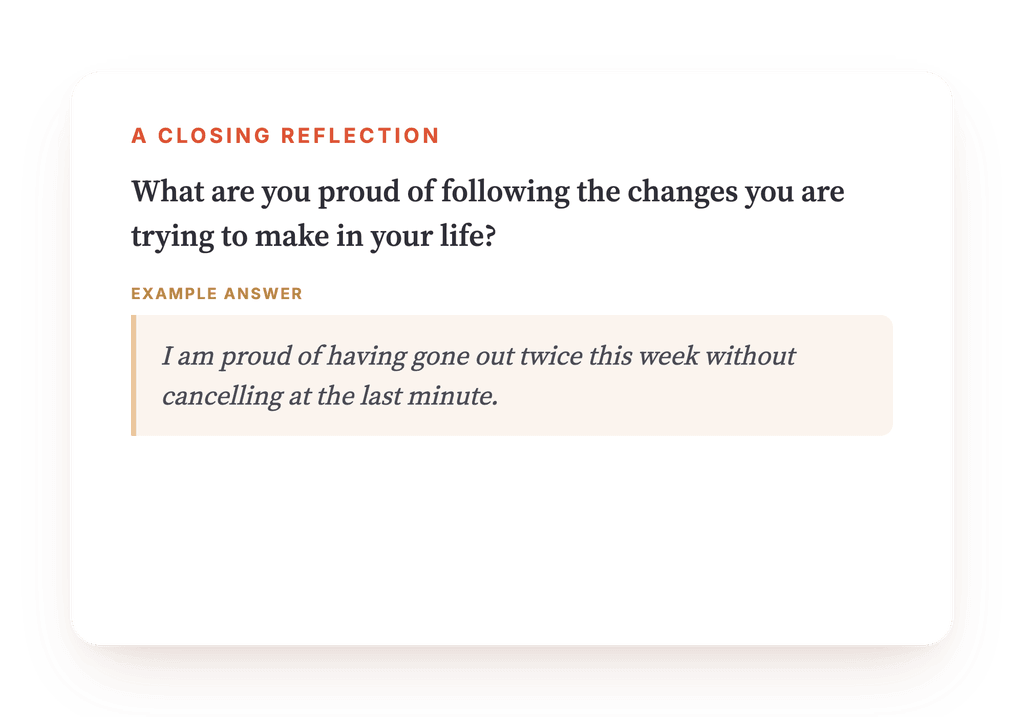
The overview map and sample cards embedded below give a glimpse of the program's architecture, but these aperçus show only a tiny fraction of the full curriculum: the complete program contains far more lessons, guided prompts, reflection steps, and multiple-choice exercises than what is visible here.
Key insight: The core clinical value of this program is that it sequences motivation-building as a cognitive and behavioral curriculum, not a pep talk. Each lesson produces patient-generated material the clinician can work with directly.
This program is available to patients through the mobile application that is the dedicated patient-side interface of SessionFuel: once you assign it in your SessionFuel account, your patient completes each lesson directly on their phone, on their own, between appointments.
Use it with your patients
Share this tool in the mobile app and follow the work between sessions.
How to assign and use it between sessions
This program is designed as autonomous between-session homework. The patient works through one lesson at a time on their own, between two consultations; the clinician assigns each next lesson when they judge the patient ready.
It suits depressed patients who already have some insight into the inertia they are experiencing, and patients at a contemplative or preparatory stage of change. It also works well for anyone stuck in a motivation dip outside of a depressive episode. It is less suited for patients in acute crisis or those who are not yet ready to engage with the concept of change at all.
How to introduce it: frame it simply: "Between now and our next appointment, I am giving you the first lesson of a program that will help us understand where your energy is stuck. Take your time with it. Just bring back what you wrote." No pressure to complete it perfectly.
How to use what the patient brings back: the guided prompts produce written responses you can open directly in your consultation. Lesson 1's ambivalence reflection can seed a full motivational interviewing exchange. Lesson 3's values and strengths outputs make a strong base for behavioral experiments using Best Possible Self or Weekly Activity Scheduling. Lesson 4's procrastination mapping pairs naturally with Activity Menu and Building New Habits. If momentum drops mid-program, the Motivational Dip exercise offers a focused single-step boost between lessons.
Your session continues in your patients' pocket
Use with a patientYour resources, available everywhere
The handouts, exercises, programs and audios above: you choose which ones to make available to your patients, in the mobile app dedicated to them.
And far more than a library
The app goes well beyond resources, to support your patients every day:
Related categories
Explore other clinical resources by category.

Mood
Evidence-based worksheets and clinical tools for mood disorders: CBT, ACT, and positive psychology resources for psychologists and therapists.

Cognition
Printable cognitive therapy worksheets and clinical tools for therapists: CBT, ACT, schema work, defusion, distortions, and belief restructuring.

Engage & motivate
Clinical hub: printable worksheets and exercises to build therapeutic engagement and motivation across ACT, CBT, and integrative practice. For clinicians.

Prevent relapse
Prevention as a therapeutic aim: clinical framing, risk stratification, and printable resources for relapse prevention and early intervention in mental health.

CBT
CBT worksheets, cognitive restructuring exercises & behavioral tools for clinicians. Evidence-based resources for every phase of cognitive behavioral therapy.

Motivational interviewing
Clinical hub for Motivational Interviewing resources: worksheets, exercises and programs to support MI-based behaviour change work in your practice.