
Clinical picture. T., a man in his late thirties, presented with heavy cannabis use and low motivation to change; he described himself as 'not a problem user' and attended the session at his partner's insistence. The clinician introduced the two-column worksheet without argument, asking T. to fill in the 'continue' column first and to write honestly, including what the cannabis genuinely gave him. As T. worked through the six areas, he noted under Family and loved ones that his partner had stopped sharing the evening meal with him, and under Long-term goals that a management application he had prepared eighteen months earlier was never submitted. He sat quietly for a moment before saying, unprompted, that he had not connected those two facts before. No directive conclusion was drawn; the clinician reflected the discrepancy T. himself had named and scheduled a follow-up to revisit both columns.
Building Discrepancy: PDF Worksheet, Tools and Exercises for Motivational Interviewing
A printable PDF worksheet, concrete tools and structured exercises to make ambivalence visible and help patients hear their own reasons for change.
Clinical vignettes
Seeing the Drift on Paper
Finances Column Shifts Ambivalence
Clinical picture. M., a woman in her mid-twenties with alcohol use disorder at a harmful level, had completed several brief interventions without sustained engagement; she reported that she 'knew all the reasons to stop' and found psychoeducation repetitive. The clinician offered the worksheet specifically as a personal document rather than a lecture, asking M. to estimate her weekly spend and enter it in the finances row of the 'continue' column. When M. calculated the annual figure herself and wrote in the 'quit' column what that sum would cover, she identified a driving lesson programme she had deferred for two years. The exercise did not resolve her ambivalence, but it shifted the conversation from abstract risk information to a concrete, self-generated goal she was willing to revisit.
In sessions focused on addictive or compulsive behavior, one of the most reliable stalls is this: the patient can articulate reasons to change and still leave unchanged. The gap between knowing and moving is exactly where building discrepancy, as formulated by Miller and Rollnick, does its work. This PDF worksheet gives you a visual structure to make that gap impossible to ignore, without positioning you as the one arguing for change.
Use this resource with your patients
Handout, exercises and materials ready to use, right inside SessionFuel.
Why Discrepancy Resists Verbal Exploration
Ambivalence is not a deficit in insight. Patients in the contemplation stage hold two competing motivational systems with roughly equal force, and oral exploration tends to flatten that into whichever system is most socially acceptable to voice in your office. The result is a session that produces nods, then no movement.
The deeper problem is reactance. When the clinician names the cost of the behavior, even carefully, the patient's system that defends the behavior activates. The classic MI trap: you find yourself making the case for change while the patient generates counter-arguments. Verbal summaries of a decisional balance rarely resolve this, because the contrast stays abstract and disappears the moment the patient walks out.
Writing externalizes the tension. A two-column map on paper forces both sides to coexist visibly, without the conversation collapsing into one.
750+ clinical tools
A library built with and for clinicians, ready to use in session and extend between appointments.
Access all the toolsWhat the Fiche Contains: A Side-by-Side Visual Map
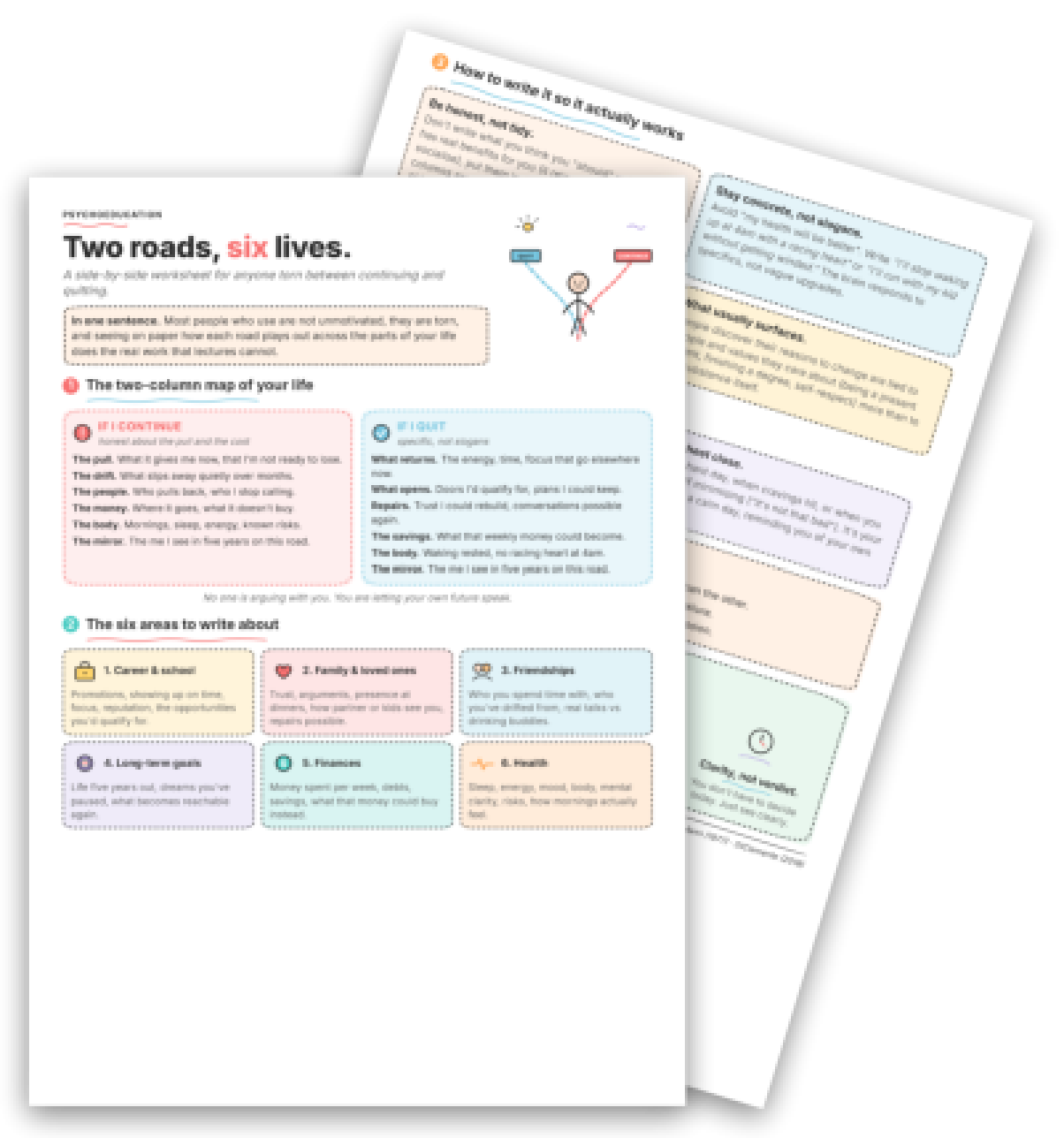
The fiche is structured around a core principle stated plainly at the top: "Most people who use are not unmotivated, they are torn, and seeing on paper how each road plays out across the parts of your life does the real work that lectures cannot." That framing alone takes pressure off the patient before they pick up a pen.
The two-column map asks patients to populate both a "continue" column and a "quit" column across six life domains: career and school, family and loved ones, friendships, long-term goals, finances, and health. Each domain has a specific prompt on both sides. The "continue" column does not ask patients to condemn the behavior; it explicitly invites honesty about the pull, what the substance currently provides. The "quit" column asks for concrete specifics, not slogans: the fiche instructs patients to write "I'll stop waking up at 4am with a racing heart" rather than "my health will be better."
A short section explains why writing changes things: "On paper, the gap between the life you want and the road you're on becomes impossible to ignore." The fiche closes with a single debrief question ("Given everything I just wrote, where does this leave me?") and a brief "to discuss in session" prompt list, so the worksheet actively feeds back into your clinical conversation.
> Key point: This is a visual support that facilitates the explanation of building discrepancy in session, not a questionnaire the patient fills out alone in a waiting room. The layout puts both roads simultaneously in the patient's field of view, producing a contrast effect that no verbal summary replicates.
Use it with your patients
Share this tool in the mobile app and follow the work between sessions.
When and How to Introduce the Fiche
The optimal window is mid-contemplation: after the initial anamnèse has established alliance, once the patient has spontaneously voiced some ambivalence, and before the therapeutic relationship has calcified around repeated no-change outcomes. It fits naturally into a values clarification exercise sequence, or alongside a future inventory tool when the patient struggles to articulate long-term direction.
For introduction, a neutral, curiosity-forward framing works well: "I'd like to try something a bit different today. Instead of us talking through the two sides, I'm going to ask you to write them both down, honestly, including what works about the current situation. Then we'll look at it together." Avoid the word "exercise." Position it as a map, not a test.
In the debrief, the richest clinical material is often asymmetry: one column that was easy to fill and one that stayed almost blank. Patients who finish the sheet feeling more torn deserve explicit normalization, the fiche itself flags this as meaningful, not a failure. For patients with low frustration tolerance or strong avoidance patterns, you may need to sit with the sheet together rather than assign it between sessions.
The fiche pairs well with ACT-based committed action work once discrepancy has been established, with motivational work in depression where behavioral inertia mimics addiction ambivalence, and with decision-making tools when the patient is close to a concrete choice. It does not replace the relational work of MI; it makes the discrepancy concrete enough that the relational work has something to build on.
Your session continues in your patients' pocket
Use with a patientYour resources, available everywhere
The handouts, exercises, programs and audios above: you choose which ones to make available to your patients, in the mobile app dedicated to them.
And far more than a library
The app goes well beyond resources, to support your patients every day:
Related categories
Explore other clinical resources by category.

Identity
Clinical resources for self-identity work in therapy: CBT, ACT, schema tools for clinicians addressing self-concept, core beliefs, and identity disruption.

Behaviours
Clinical hub for behaviors in therapy: worksheets and tools for coping, eating disorders, CBT formulation, and maladaptive behavioral patterns.

Transitions
Clinical hub for life transitions: tools, worksheets and exercises to support psychosocial adjustment, role change and identity work in practice.

Build awareness
Clinical worksheets and tools to build awareness in therapy: cognitive distortions, schemas, emotions, ACT and CBT resources for practitioners.

Engage & motivate
Clinical hub: printable worksheets and exercises to build therapeutic engagement and motivation across ACT, CBT, and integrative practice. For clinicians.

CBT
CBT worksheets, cognitive restructuring exercises & behavioral tools for clinicians. Evidence-based resources for every phase of cognitive behavioral therapy.