
Clinical picture. R., a man in his late thirties, presents with social anxiety and a longstanding pattern of last-minute avoidance that has progressively narrowed his professional network. During a session focused on an upcoming team lunch, the clinician introduces the Choice Point diagram and asks R. to map the situation onto the fork: what shows up inside, and which path he has been taking. R. identifies the hooked path quickly, noting the familiar sequence of a tight chest, a convincing thought that he will bore his colleagues, and a text drafted to cancel. Using the worksheet, the clinician and R. trace a towards move: attending for the first twenty minutes, asking one question, then leaving by choice rather than by anxiety. R. attended the lunch and reported noticing the fork twice during the event, which he described as a small but genuine shift in how he related to the urge to leave.
The Choice Point: PDF Worksheet, Tools and Exercises for ACT Practice
A visual PDF worksheet built on the ACT Choice Point model, with structured tools and exercises to make values-based action concrete and discussable in session.
Clinical vignettes
Spotting the Fork Before Cancelling
Naming the Hook After a Sharp Exchange
Clinical picture. T., a woman in her mid-forties, is in treatment for recurrent low mood and chronic relational conflict; her default response to criticism at home is a prolonged hostile silence that she later regrets. The clinician introduces the Choice Point sheet to map a specific incident in which her partner made a dismissive comment during a stressful evening. T. placed herself firmly on the hooked side: she had gone silent for two days, felt no sense of having chosen it, and experienced the regret the diagram names explicitly. The clinician did not reframe the silence as wrong but invited T. to notice that the worksheet describes exactly that sense of having had no choice as a signal that unhooking is possible. Over the following two weeks T. began naming the hook aloud to herself in the moment, which did not eliminate the silence but reduced its duration and the self-critical spiral that had followed it.
In ACT-informed practice, the Choice Point is one of the model's most clinically useful organising concepts, and one of the hardest to convey at exactly the right level of abstraction. Patients grasp "towards" and "away" quickly in session, then lose the distinction entirely the moment they are actually hooked. This fiche PDF gives the concept a concrete visual structure you can walk through together, so the patient leaves with a reference they can actually hold onto when the fork appears outside your room.
Use this resource with your patients
Handout, exercises and materials ready to use, right inside SessionFuel.
Why the Choice Point resists a purely verbal explanation
Psychological flexibility is not intuitive. When the Choice Point is explained verbally, patients tend to encode it as a motivational principle, "choose the good option", rather than as a defusion and values-clarification skill. The conceptual edge that makes it clinically useful disappears.
Two confusions recur reliably. First, patients conflate acceptance with approval: if "making room" for anxiety means it is somehow welcome, they resist the whole model. Second, they read away moves as failures to be ashamed of, losing the diagnostic information those moves carry about what hooks them. Both confusions surface immediately when the fork is externalised in front of them, which is precisely what this kind of visual ACT framing makes possible. A diagram on paper holds two paths simultaneously in a way a spoken explanation cannot.
750+ clinical tools
A library built with and for clinicians, ready to use in session and extend between appointments.
Access all the toolsWhat the fiche contains: the fork made visible
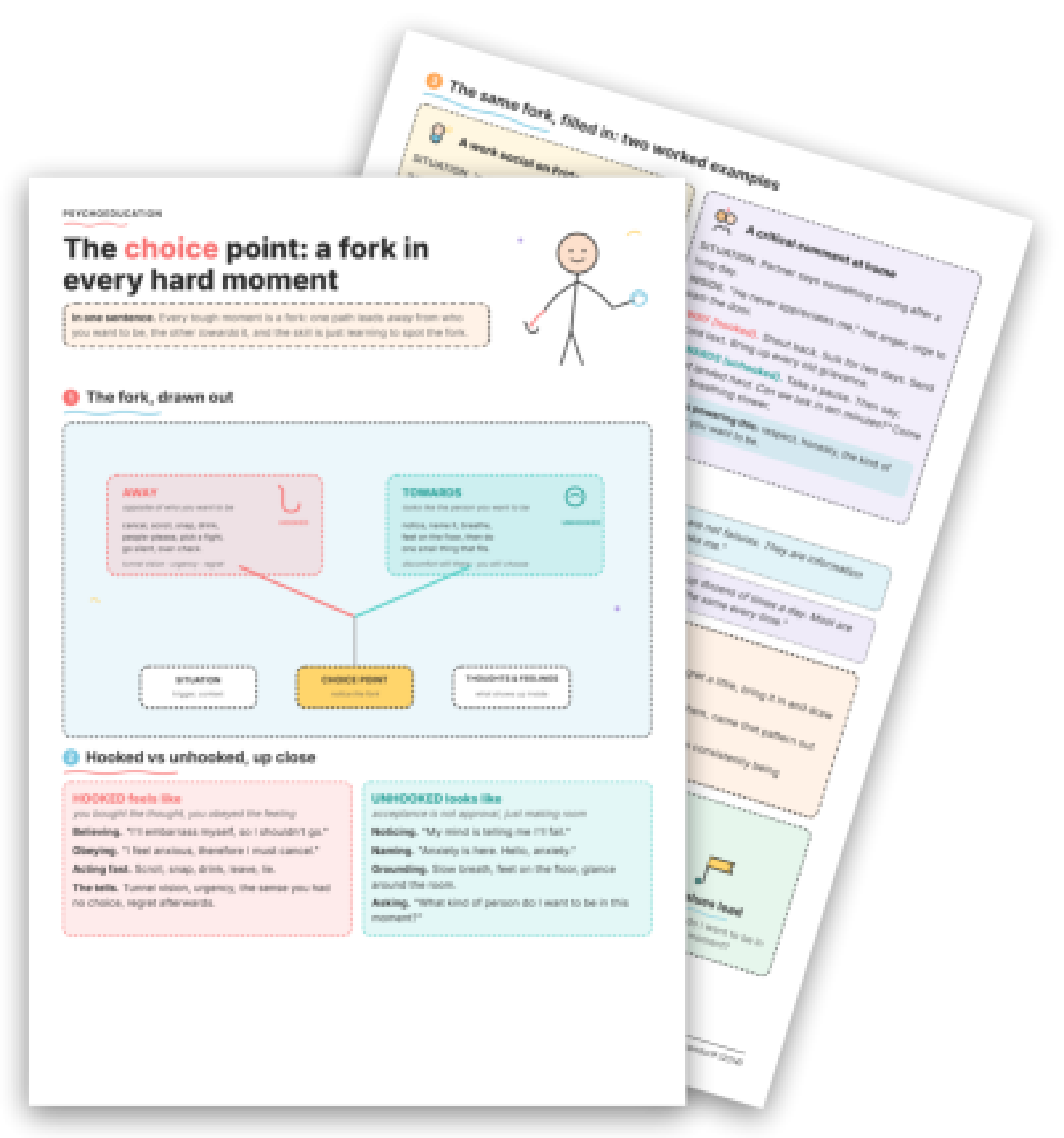
The fiche maps the Choice Point model across four panels. Panel 1 presents the fork itself: from a SITUATION, the patient notices internal content (thoughts and feelings at the choice point), then faces a branching path. The visual separates AWAY from TOWARDS with behavioural examples already printed on each branch, "cancel, scroll, snap, drink, people-please, pick a fight, go silent" on one side; "notice, name it, breathe, feet on the floor, then do one small thing that fits" on the other. Having those examples already visible saves the session from getting stuck on abstract definitions.
Panel 2 sharpens the hooked/unhooked distinction through four paired moves, Noticing, Naming, Grounding, and Asking, set against the hooks of Believing, Obeying, and Acting Fast. The layout makes cognitive defusion visible without requiring the patient to have prior ACT literacy around defusion techniques. Panel 3 grounds all of this in two worked examples (a work social, a cutting comment at home), showing the full fork filled in with values named on the towards side. Panel 4 offers reframes to return to between sessions, including "Away moves are not failures. They are information about what hooks me." A short "To discuss in session" block closes the fiche with three structured prompts the clinician can lift directly.
> Key takeaway: This fiche is a visual support that facilitates the in-session explanation of the Choice Point. It is not a self-assessment to complete alone; it is a shared reference the clinician and patient build meaning around together, in real time.
Use it with your patients
Share this tool in the mobile app and follow the work between sessions.
When and how to introduce it in your work
The fiche fits naturally once you have begun values clarification work or introduced committed action, and the patient starts reporting moments where they acted against their own values. It pairs well with the values-action alignment exercise between sessions, and with the ACT for Depression programme for patients where avoidance is driving low mood.
For patients presenting with a strong avoidance pattern, frame the away-move column explicitly as normalising: "These moves make complete sense when you're hooked. They are not character flaws; they are information." For those building psychological flexibility more broadly, the fiche reinforces the unhooked side as a learnable skill, not a temperament. Patients who struggle to stay grounded when emotionally activated benefit from pairing Panel 2 with a dedicated grounding exercise before they attempt the towards moves. For longer-horizon values work, the 10-Year Goal Projection exercise can extend the "who do I want to be" question the fiche raises into a fuller future-self exploration.
A useful introduction: "Let's draw out what actually happened in that moment, not to judge it, but to see where the fork was." Use Panel 3's worked examples to model the exercise before asking the patient to map their own situation. Debrief by asking which hook showed up, what value was being protected on the towards side, and whether the fork appeared again during the week.
The fiche does not replace a full ACT case formulation. It makes one pivotal concept clear, repeatable, and something the patient can return to between sessions without you present.
Your session continues in your patients' pocket
Use with a patientYour resources, available everywhere
The handouts, exercises, programs and audios above: you choose which ones to make available to your patients, in the mobile app dedicated to them.
And far more than a library
The app goes well beyond resources, to support your patients every day:
Related categories
Explore other clinical resources by category.
Anxiety
Clinical hub for anxiety disorders: CBT and ACT worksheets, psychoeducation sheets, and exercises for assessment and treatment across the anxiety spectrum.

Identity
Clinical resources for self-identity work in therapy: CBT, ACT, schema tools for clinicians addressing self-concept, core beliefs, and identity disruption.

Emotions
Clinical resources on emotion regulation: worksheets, coping tools, CBT, REBT, and ACT exercises for therapists working across diagnoses and age groups.

Cognition
Printable cognitive therapy worksheets and clinical tools for therapists: CBT, ACT, schema work, defusion, distortions, and belief restructuring.

Understand
Clinical hub for the therapeutic aim 'Understand': worksheets and tools to build patient insight across CBT, ACT, schema therapy and more.

Build awareness
Clinical worksheets and tools to build awareness in therapy: cognitive distortions, schemas, emotions, ACT and CBT resources for practitioners.