
Clinical picture. A, a woman in her late thirties, presented with persistent health-related anxiety and a strong conviction that her worry was a sign something was fundamentally wrong with her. She described spending hours each day scanning her body for symptoms, sleeping poorly, and avoiding medical news altogether. The clinician introduced the psychoeducation worksheet partway through the session, inviting A to locate where anxiety first appeared in her body and to identify her habitual thought patterns. A recognised her signature quickly: tight jaw, then looping "what if" thoughts that she had never previously distinguished from one another. Naming this sequence did not resolve the anxiety, though it gave A a concrete observational task between sessions and reduced the sense that her worry was shapeless and uncontrollable.
Exploring Anxiety: PDF Worksheet, Tools and Exercises for Clinical Practice
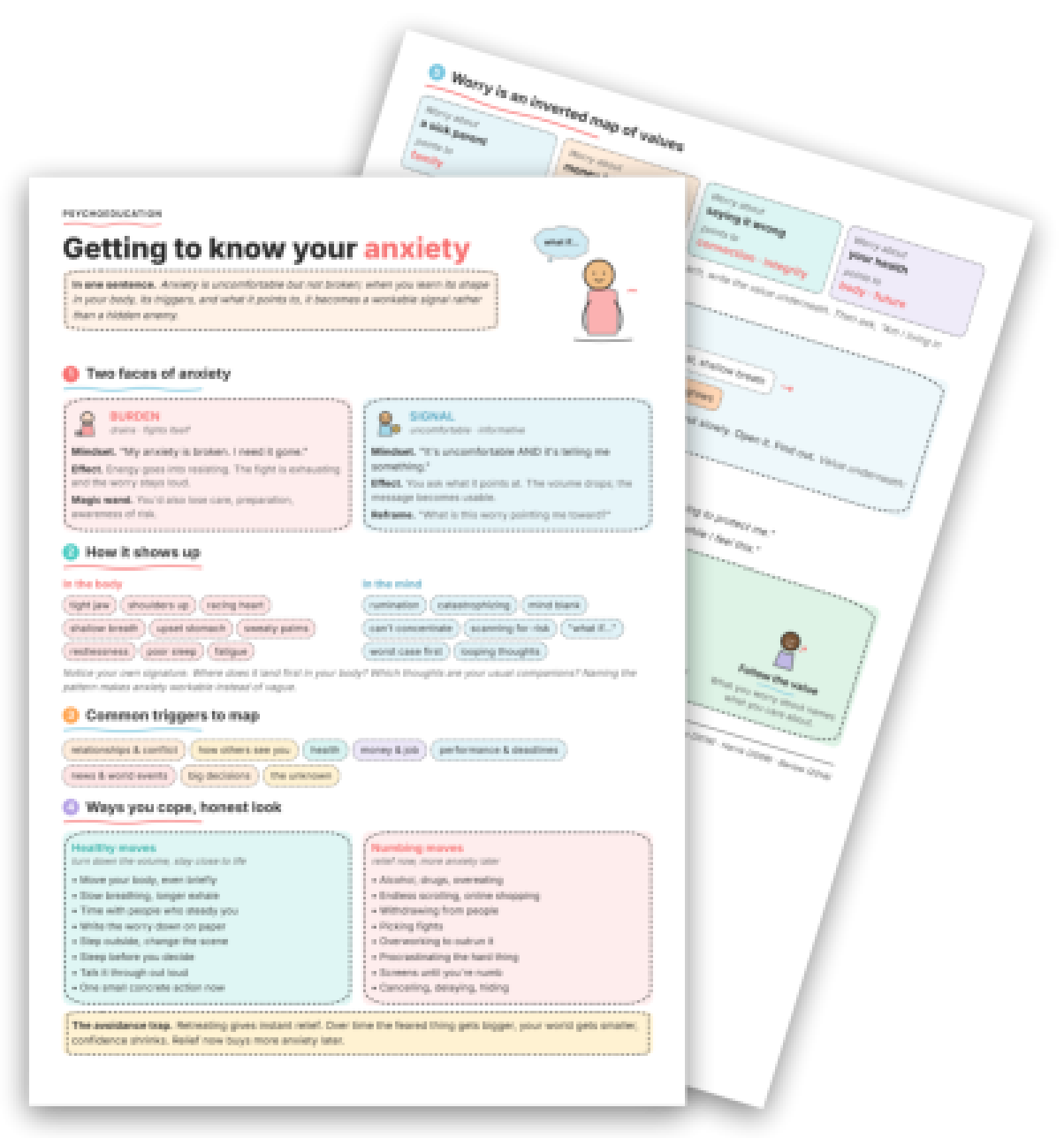
A seven-panel visual fiche PDF to explain anxiety's logic, triggers, coping patterns, and value signals clearly in session, without losing the patient at the first abstraction.
Clinical vignettes
Mapping Anxiety's Signature in Session
Reframing Anxiety as Signal, Not Defect
Clinical picture. T, a man in his mid-forties referred following a period of occupational burnout, opened the session insisting he needed his anxiety "completely gone" before he could return to work. The clinician used the two-faces framework from the worksheet to introduce a distinction between anxiety as burden versus anxiety as signal, asking T what his worry might be pointing toward rather than what it was doing to him. T paused and acknowledged that his anxiety consistently spiked around performance deadlines and fear of professional judgement, information he had not previously organised in that way. He remained sceptical of the reframe, which the clinician noted as clinically appropriate given T's history of being told simply to "think positively." The worksheet provided a shared vocabulary for subsequent sessions focused on trigger mapping and coping audit.
Most patients have heard "anxiety is a signal, not an enemy" more than once. They nod. The concept doesn't stick, because oral explanation alone rarely anchors it somatically, cognitively, and behaviourally at the same time. This fiche PDF does exactly that: it gives you a structured visual support to walk through anxiety's logic in session, panel by panel, so the patient leaves with a concrete map rather than a vague reassurance.
Use this resource with your patients
Handout, exercises and materials ready to use, right inside SessionFuel.
Why Anxiety Is So Hard to Explain in One Session
The core difficulty is that anxiety presents simultaneously on three channels (body, thought, behaviour), and patients tend to enter therapy fixated on only one of them. A patient tracking racing heart and poor sleep rarely connects this spontaneously to avoidance narrowing their world, or to the value underneath the worry. Explaining those links verbally while also managing the alliance, tracking affect, and taking notes is a lot to hold together.
There is also the burden-versus-signal split, which underpins most of the ACT and third-wave CBT work on expérientiel avoidance: patients arrive with the implicit belief that anxiety is broken and must be eliminated. Correcting that framing orally tends to land as platitude. Shown visually, side by side, the two mindsets become something the patient can actually examine rather than resist.
Finally, the values-worry connection is almost always invisible to patients until made explicit. A patient who catastrophises about an unanswered email from their manager rarely sees it as evidence of caring about doing good work and being respected. That reframe is powerful; it also requires scaffolding that a spoken sentence rarely provides.
What the Fiche Contains: Seven Panels That Do the Explaining for You
The fiche is organised into seven numbered sections, each short enough to read in session without losing the thread.
- Panel 1 (Two faces of anxiety) contrasts the "My anxiety is broken, I need it gone" mindset with "It's uncomfortable AND it's telling me something", with the explicit reframe: "What is this worry pointing me toward?"
- Panel 2 (How it shows up) lists somatic markers (tight jaw, shallow breath, restlessness, poor sleep) alongside cognitive ones (rumination, catastrophising, "what if..." loops), helping patients identify their own idiosyncratic signature.
- Panel 3 (Common triggers) offers a quick mapping tool across relational, occupational, health, and existential domains.
- Panel 4 (Ways you cope) makes the adaptive vs maladaptive coping distinction concrete, naming healthy moves (brief movement, slow breathing, writing the worry down) alongside numbing moves (scrolling, withdrawing, overworking), and frames the avoidance trap clearly: "relief now buys more anxiety later."
- Panel 5 (Worry as inverted map of values) pairs recurring worries with the value underneath, and includes a small exercise: list three recurring worries, write the value next to each, then ask "Am I living in service of that value, or only in fear of losing it?"
- Panel 6 walks through a worked example (an unread email from a manager) showing trigger, body response, thought, avoidance, and alternative path in sequence.
- Panel 7 gives the patient four ready phrases to use when anxiety spikes.
> Key point: this fiche is a visual support for in-session explanation, not a self-administered questionnaire. You narrate it; the patient follows visually and responds. The layout does the holding so you can focus on their reactions.
750+ clinical tools
A library built with and for clinicians, ready to use in session and extend between appointments.
Access all the toolsHow and When to Introduce the Fiche
This fiche fits naturally into psychoeducation phase, typically sessions two to four, once the initial anamnesis is done and the alliance is forming. It works across anxiety presentations broadly, including GAD, performance anxiety, and health anxiety, wherever the patient has not yet disentangled what anxiety is from what it does to them.
A low-threshold way to introduce it: "I'd like to go through something with you that puts a lot of what we've been discussing on one page. It's not a test, just a map we can look at together." That framing removes the evaluative charge. Move through the panels at their pace. Pause at Panel 1 to check which mindset they recognise, pause at Panel 2 to let them name their signature, pause at Panel 4 to mark which coping moves they already use.
Useful debrief questions once you have gone through it together:
- Which panel surprised them most?
- Where did they see themselves most clearly?
- What on Panel 5 (the values column) felt true?
The fiche then becomes a reference point across subsequent sessions. Referring back to it by panel number ("this looks like Panel 4 territory again") gives you and the patient a shared shorthand, which speeds up formulation and reduces the need to re-explain from scratch. It pairs well with exercises targeting anxious thoughts directly, with exposure hierarchy building for avoidance work, and with adaptive vs maladaptive coping tools that extend Panel 4 into structured homework.
For patients who need more depth on the avoidance cycle specifically, the Cycle of Avoidance fiche and the Changing Avoidance worksheet extend the work directly. For patients who engage well and are ready to move faster, the four-lesson Anxiety Psychoeducation program provides a fuller autonomous curriculum. Between sessions, the Anxiety Self-Reflection exercise and the Anxiety Check-In tool keep the patient active between appointments, while My Fight Against Anxiety works well as a later-stage progress review. When uncertainty is a central maintaining factor, Embracing Uncertainty builds naturally on Panel 3.
One contraindication worth noting: in a first session with a highly activated or crisis-adjacent patient, moving through all seven panels risks feeling overwhelming or clinical. In that context, use Panel 1 alone to introduce the signal framing, and return to the rest once the window of tolerance is wider.
The fiche does not replace the therapeutic framework; it makes the conceptual explanation visible, shared, and portable, so the patient carries the map with them rather than a memory of what you said.
Use it with your patients
Share this tool in the mobile app and follow the work between sessions.
Sources
- Barlow, D. H. (2002). Anxiety and Its Disorders: The Nature and Treatment of Anxiety and Panic (2nd ed.). Guilford Press.
- Hayes, S. C., Strosahl, K. D., & Wilson, K. G. (2012). Acceptance and Commitment Therapy: The Process and Practice of Mindful Change (2nd ed.). Guilford Press.
- Eifert, G. H., Forsyth, J. P., Arch, J., Espejo, E., Keller, M., & Langer, D. (2009). Acceptance and Commitment Therapy for Anxiety Disorders: Three Case Studies Exemplifying a Unified Treatment Protocol.
Your session continues in your patients' pocket
Use with a patientYour resources, available everywhere
The handouts, exercises, programs and audios above: you choose which ones to make available to your patients, in the mobile app dedicated to them.
And far more than a library
The app goes well beyond resources, to support your patients every day:
Related categories
Explore other clinical resources by category.

Anxiety
Clinical hub for anxiety disorders: CBT and ACT worksheets, psychoeducation sheets, and exercises for assessment and treatment across the anxiety spectrum.

Identity
Clinical resources for self-identity work in therapy: CBT, ACT, schema tools for clinicians addressing self-concept, core beliefs, and identity disruption.

Cognition
Printable cognitive therapy worksheets and clinical tools for therapists: CBT, ACT, schema work, defusion, distortions, and belief restructuring.

Understand
Clinical hub for the therapeutic aim 'Understand': worksheets and tools to build patient insight across CBT, ACT, schema therapy and more.

Build awareness
Clinical worksheets and tools to build awareness in therapy: cognitive distortions, schemas, emotions, ACT and CBT resources for practitioners.

Engage & motivate
Clinical hub: printable worksheets and exercises to build therapeutic engagement and motivation across ACT, CBT, and integrative practice. For clinicians.