
Clinical picture. A, a 34-year-old project manager, presents with generalised anxiety maintained largely by reassurance-seeking: she routinely re-reads sent emails three or four times, asks colleagues to confirm decisions already made, and spends considerable time researching options before committing to minor choices. The psychoeducational sheet on embracing uncertainty was introduced in session to externalise the pattern and name the two stances side by side. A recognised herself immediately in the "intolerant" column and described the exhaustion of living in a perpetual pre-check state. The clinician and A then designed one small experiment for the following week: she would send one low-stakes internal email after a single read-through and log what actually happened against what she had predicted. At the next session she reported that nothing went wrong, and noted, with some surprise, that the anticipatory tension had been worse than the act itself.
Embracing Uncertainty: PDF Worksheet, Tools and Exercises
A visual psychoeducation fiche PDF to explain intolerance of uncertainty in session, name the certainty trap, and introduce graded behavioral experiments.
Clinical vignettes
Reassurance-Seeking in a Working Professional
Avoidance of Novelty in Anxiety with Low Mood
Clinical picture. P, a man in his late 40s with a longstanding pattern of anxiety intertwined with low mood, had gradually restricted his routines to a narrow set of familiar shops, routes, and social contexts, framing this as preference rather than avoidance. The informational sheet was used not as a homework task but as a shared reading exercise within the session, giving P a non-pathologising vocabulary for what had been happening. He connected the "life gets smaller" line to a concrete loss he had noticed over the past two years. The clinician proposed one experiment from the sheet's menu: taking a different route home on two occasions and using the predict-do-notice-learn loop to track his experience. P returned reporting mild discomfort on the first attempt and mild curiosity on the second, which opened a productive discussion about the relationship between behavioural range and mood.
When patients with reassurance-seeking loops, decision paralysis, or compulsive over-planning hear "intolerance of uncertainty" explained verbally, most nod and then change nothing. The mechanism feels invisible to them because their checking and double-checking reads as competence. This fiche PDF gives you a visual structure to make the certainty trap tangible in session, so the patient leaves with a named framework and a concrete first experiment, not just a concept.
Use this resource with your patients
Handout, exercises and materials ready to use, right inside SessionFuel.
Why Intolerance of Uncertainty Is Difficult to Convey Without a Visual Support
Intolerance of uncertainty (IU) is one of the most robust transdiagnostic maintaining factors documented in the literature, central to Generalized Anxiety Disorder, OCD, health anxiety, and perfectionism (Dugas, 2005; Carleton, 2016). Yet in session it resists psychoeducation because the patient's avoidance behaviors masquerade as foresight. Explaining the concept orally tends to produce a brief "yes, that's me" followed by continued reassurance-seeking and over-planning, because the patient has no visual reference for how the mechanism actually works or what the alternative looks like.
What the patient struggles to see is the cost progression: certainty-seeking does not reduce uncertainty, it narrows the life space incrementally. This is the insight that a side-by-side visual layout conveys in a few seconds, whereas a verbal explanation can take most of a session to land, if it lands at all. The fiche also resolves a clinical tension: naming IU as a problem risks feeling invalidating, whereas a visual comparison lets the patient locate themselves without you doing the labeling.
What the Fiche Contains: Five Panels, One Practical Loop
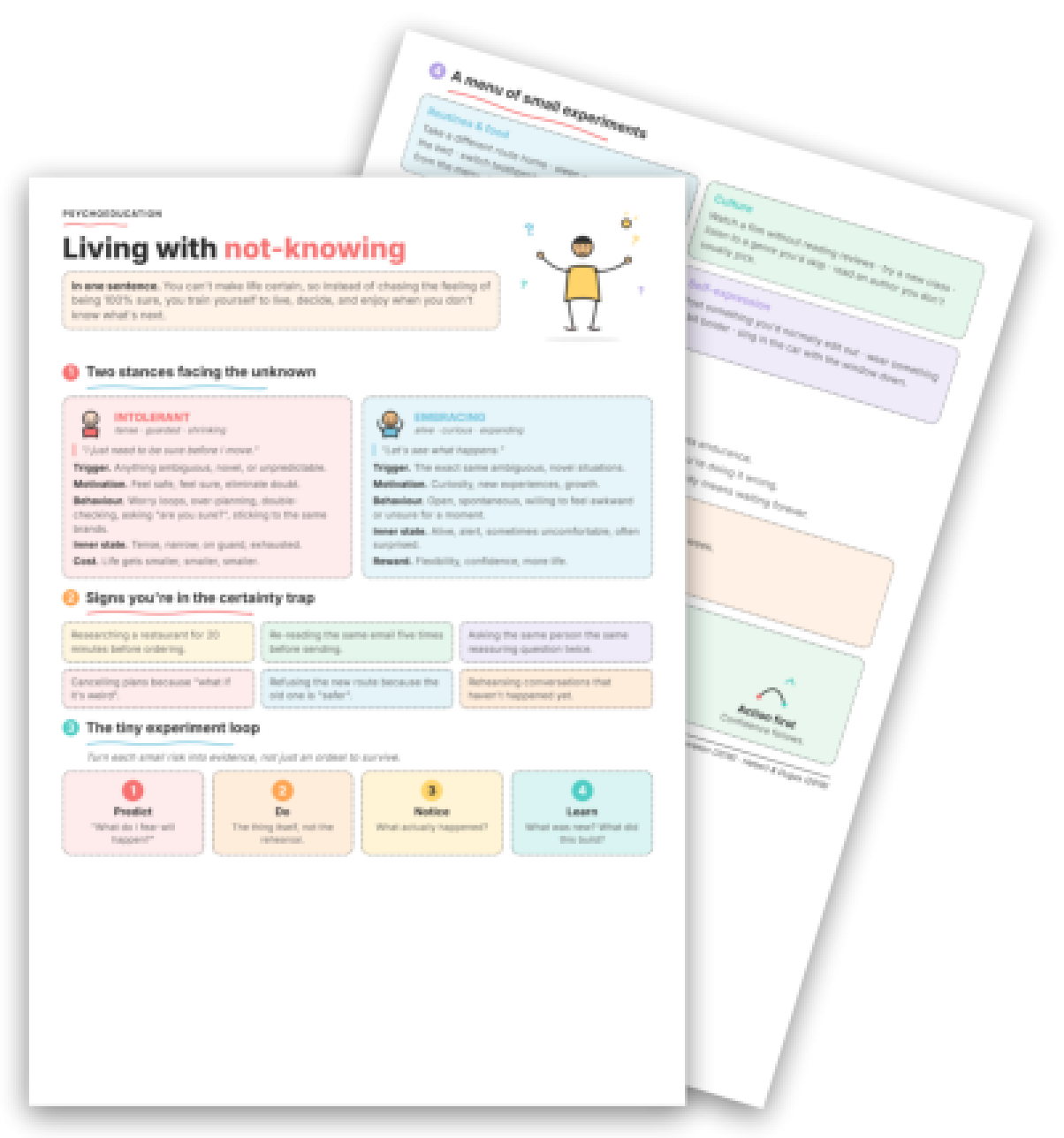
The fiche organizes the psychoeducation into five panels. Panel 1, Two stances facing the unknown, places the INTOLERANT and EMBRACING positions side by side with matching columns for trigger, motivation, behavior, inner state, and outcome. Because the trigger is identical in both columns ("the exact same ambiguous, novel situations"), the visual makes the key cognitive point without commentary: the stimulus is not the problem, the stance is. You can use this panel to initiate a cost-benefit analysis of the patient's current safety behaviors.
Panel 2 lists six concrete behavioral markers of the certainty trap, including "Re-reading the same email five times before sending" and "Asking the same person the same reassuring question twice." Patients typically mark three or four before you finish the list, which strengthens the alliance and reduces defensiveness. This feeds naturally into work on checking behaviors and avoidance cycles.
Panel 3 is the clinical engine: the tiny experiment loop, a four-step cycle (Predict, Do, Notice, Learn) that reframes behavioral experiments as evidence-gathering rather than exposure ordeals. The framing "Turn each small risk into evidence, not just an ordeal to survive" is particularly useful with patients whose prior attempts at change felt like sheer endurance. Panel 4 extends this with a categorized menu of small experiments across routines and food, culture, social situations, and self-expression, providing ready-made starting points calibrated for low-stakes practice.
Panel 5 addresses the cognitive obstacles to initiating experiments at all. The principle "Start ridiculously small. Toothpaste-level small. Reps beat bravery" counters the perfectionism that often co-occurs with high IU. A dedicated To discuss in session block lists three explicit debriefing prompts, including reassurance-seeking relapse and checklist drift, so the fiche actively structures your follow-up work.
> Key point: This fiche is a visual support that facilitates the explanation of intolerance of uncertainty in session. It is not a questionnaire the patient fills out alone; it is a shared in-session scaffold you use to build a common framework, and a reference the patient takes home after the explanation.
750+ clinical tools
A library built with and for clinicians, ready to use in session and extend between appointments.
Access all the toolsWhen and How to Introduce the Fiche
The fiche fits naturally after the anamnèse has confirmed IU as a maintaining factor, typically from the second or third session onward. It is especially indicated for patients presenting with GAD-spectrum worrying, OCD-related compulsive checking, or the need to control every outcome. It also integrates well into ACT-framed work on psychological flexibility, where the INTOLERANT/EMBRACING contrast maps directly onto the experiential avoidance axis.
To introduce it without triggering defensiveness, a workable frame is: "I'd like to show you a diagram that a lot of people find clarifying. You can tell me whether it fits your experience." Walk through Panels 1 and 2 together, then co-select one experiment from Panel 4 that sits clearly within the patient's comfort-to-stretch zone. The four-step loop becomes the template for between-session work, which you can scaffold further with a dedicated uncertainty intolerance exercise or the full four-lesson psychoeducation program depending on case complexity.
One contraindication to flag: with patients in acute crisis or with very high baseline anxiety, the experiment loop can feel immediately overwhelming. In those cases, start with Panels 1 and 2 only, use the fiche to name the mechanism, and defer the experiment menu to a subsequent session once coping resources are better established. For patients with worry-driven attention capture, the Predict step of the loop also provides a clean entry into thought-monitoring work.
Debrief the experiment in the following session using the loop's own language: what did you predict, what did you actually notice, what did you learn? The fiche's To discuss in session prompts make this structure explicit enough that some patients begin self-monitoring between appointments without being asked. That shift, from ordeal-survivor to active evidence-collector, is the behavioral signature that IU work is genuinely progressing.
Use it with your patients
Share this tool in the mobile app and follow the work between sessions.
Sources
- Dugas, M. J., & Robichaud, M. (2007). Cognitive-Behavioral Treatment for Generalized Anxiety Disorder: From Science to Practice. Routledge.
- Robichaud, M., Koerner, N., & Dugas, M. J. (2019). Cognitive Behavioral Treatment for Generalized Anxiety Disorder: From Science to Practice (2nd ed.). Routledge.
Your session continues in your patients' pocket
Use with a patientYour resources, available everywhere
The handouts, exercises, programs and audios above: you choose which ones to make available to your patients, in the mobile app dedicated to them.
And far more than a library
The app goes well beyond resources, to support your patients every day:
Related categories
Explore other clinical resources by category.
Anxiety
Clinical hub for anxiety disorders: CBT and ACT worksheets, psychoeducation sheets, and exercises for assessment and treatment across the anxiety spectrum.

Cognition
Printable cognitive therapy worksheets and clinical tools for therapists: CBT, ACT, schema work, defusion, distortions, and belief restructuring.

Understand
Clinical hub for the therapeutic aim 'Understand': worksheets and tools to build patient insight across CBT, ACT, schema therapy and more.

Exposure
Exposure therapy clinical resources for practitioners: worksheets, hierarchies, and psychoeducation tools for anxiety, PTSD, OCD, and avoidance-based presentations.

Build skills
Skill-building resources for clinicians: printable worksheets and exercises for coping, assertiveness, and communication skills training in therapy.

CBT
CBT worksheets, cognitive restructuring exercises & behavioral tools for clinicians. Evidence-based resources for every phase of cognitive behavioral therapy.