
Clinical picture. J., a nine-year-old referred for a specific phobia of dogs, had begun refusing to walk to school after a neighbour's dog jumped at him six months earlier. His avoidance was reinforcing a cycle in which any canine encounter, however distant, triggered acute distress and retreat. The clinician introduced the fear ladder using the informational sheet, and J. and his mother co-constructed a seven-rung hierarchy ranging from looking at photographs to briefly holding a lead attached to a calm, small dog. Over five weeks of home-based practice, J. progressed to rung four, with each attempt logged using the five-star colouring system; he reported that his predicted outcome ("the dog will bite me") had not matched what actually happened on any trial. By the end of the intervention phase, school attendance had normalised and J. no longer re-routed to avoid residential streets.
Facing Fears in Children: PDF Worksheet, Tools and Exercises
A visual psychoeducation worksheet helping clinicians introduce graded exposure to anxious children and young people, with concrete fear ladder examples and parent coaching guidance.
Clinical vignettes
Fear Ladder for Dog Avoidance
Graded Steps for Social Anxiety in Adolescence
Clinical picture. M., aged fourteen, presented with marked anxiety about speaking in class, to the point of selective mutism in structured school settings; she had been managing this by sitting at the back and signalling incomprehension rather than asking for help. The clinician used the worksheet's speaking-up ladder as a template, collaborating with M. to adjust each rung to her actual school context and to identify two safety crutches she was routinely using: rehearsing answers silently for so long she missed the question, and texting a friend immediately after any social interaction for reassurance. Initial rungs were practised within sessions before being assigned as between-session tasks, and M. was encouraged to record the gap between her predicted embarrassment and what she observed in her peers' reactions. After six rungs, she had raised her hand twice voluntarily in a small tutor group; her self-reported anxiety at the point of speaking had decreased from eight to four out of ten.
Explaining graded exposure to an adult with solid metacognitive capacity is one thing. Translating the same principle to an eight-year-old, or to a fourteen-year-old who has already decided therapy is pointless, is a genuinely different clinical task. This fiche PDF gives you a concrete visual scaffold for that conversation, so the concept of the fear ladder lands rather than evaporates the moment the child leaves the room.
Use this resource with your patients
Handout, exercises and materials ready to use, right inside SessionFuel.
Why the Fear Ladder Resists Verbal Explanation With Young Patients
The core mechanism of graded exposure is not complicated, but the experience of avoidance relief makes it feel irrational to most children and adolescents. When you describe the habituation curve verbally, younger patients hear a contradiction: why would staying with something scary make it smaller? The cycle of avoidance is immediate and rewarding; the therapeutic logic runs against it.
With this age group, two specific sticking points recur. First, waiting to feel ready: children almost universally believe confidence must precede action. Any verbal explanation of "you feel ready after the step, not before" tends to get nodded at and forgotten. Second, safety behaviours: parents reassuring, comfort objects, strategic distractions at the feared moment. These accommodations feel caring to the family and counterproductive to you. Naming them in session without a visual anchor rarely produces change at home.
A support visuel changes what is possible in those conversations.
What the Fiche Contains: A Visual Psychoeducation Tool for In-Session Use
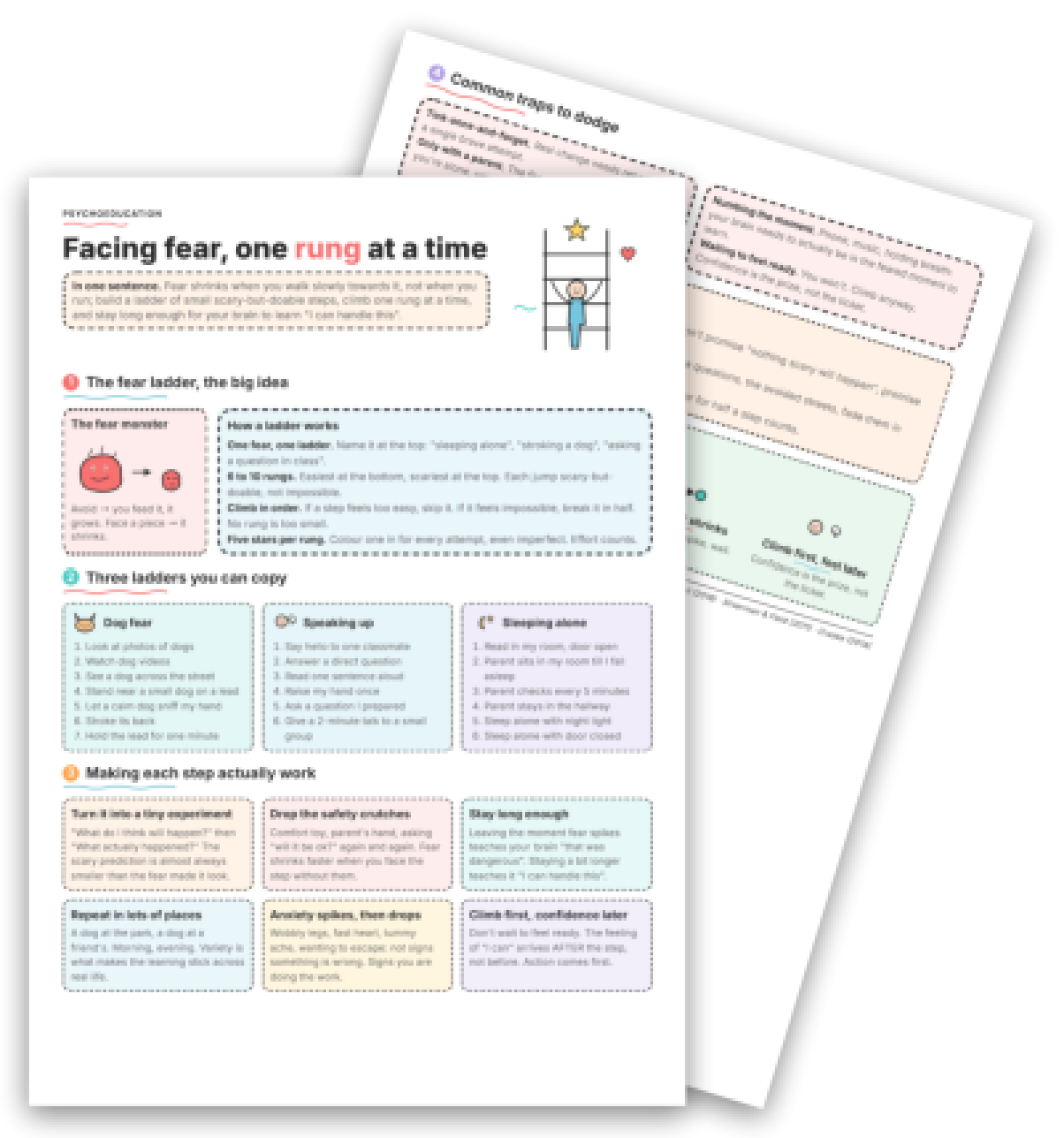
The fiche is structured across four panels, and it functions as an in-session explanation aid, not a worksheet the child completes alone at home.
The opening panel introduces the "fear monster" metaphor, stated directly on the sheet: "Avoid: you feed it, it grows. Face a piece: it shrinks." This single image gives you a shared language before you touch the ladder itself, particularly useful with younger children or with parents who need to understand why reducing accommodations matters.
The second panel explains how a ladder works: one fear named at the top, six to ten rungs with the easiest at the bottom, each step "scary-but-doable, not impossible", and a five-star effort tracker per rung. Three fully worked example ladders are included (dog fear, speaking up in class, sleeping alone), so you can point to a concrete model rather than constructing the hierarchy from scratch mid-session. These examples pair well with Building an Exposure Hierarchy for cases where you want a blank template alongside the worked examples.
The third panel addresses the mechanics of making each step actually work: running a tiny behavioural experiment ("What do I think will happen? What actually happened?"), dropping safety crutches, staying long enough for the anxiety spike to pass, and varying the exposure setting. The phrase "Climb first, confidence later" is printed large, which you can simply point to when a child argues they're not ready. This panel also normalises the physical symptoms of anxiety (wobbly legs, fast heart, stomach ache) as signals of productive work, a message that complements emotion thermometers and CBT for Kids: Thoughts, Feelings & Actions for patients already working on somatic awareness.
A fourth panel covers common traps: ticking a rung once and moving on, practising only with a parent present, numbing the moment with a phone or music, and waiting to feel ready. The parent coaching section at the bottom frames the family's role precisely: "Cheer and plan, don't rescue", and "Drop accommodations gently." This is the section to spend time on during a parent collateral session; it reframes the parent's protective instincts into something clinically useful without pathologising them.
> Key point: This fiche is a visual support that facilitates in-session explanation of the fear ladder principle. The clinician uses it to guide the psychoeducation conversation; the child takes it home as a concrete reference, not as a task to complete independently.
750+ clinical tools
A library built with and for clinicians, ready to use in session and extend between appointments.
Access all the toolsWhen and How to Introduce It
The fiche fits naturally from the second or third session, once the presenting fear is named and the formulation is clear enough to choose a relevant ladder. For younger children (roughly 7-12), walk through the fear monster panel first, then build the ladder together using the blank rung structure as a guide. For adolescents, the three example ladders tend to open the conversation better than starting with theory; most teens find at least one relatable.
When introducing it, a low-labelling framing works well: "I want to show you something that other young people have found useful. It's a kind of map for getting your brain to feel safer." Avoid framing it as homework at the outset.
For families already using accommodation patterns (frequent reassurance, avoided routes, nighttime checking), the parent coaching panel is a natural transition into a family-systems conversation. The Anxiety in Children and Adolescents parent programme and 50 Coping Strategies for Children and Adolescents extend the work between sessions. For cases with significant social anxiety or school avoidance, pairing this fiche with Exploring Social Anxiety or the Exposure Therapy programme gives the full exposure protocol a concrete psychoeducation foundation.
The debrief matters as much as the introduction. In the following session, return to the five-star tracker and ask specifically about the traps panel: safety crutches used, whether the child left at the anxiety spike, whether a parent rescued mid-step. The Graded Exposure Self-Report works as a structured between-session tracking tool alongside the fiche.
The fiche does not replace clinical formulation or exposure planning; it makes both easier to communicate to patients who learn better by seeing than by listening.
Use it with your patients
Share this tool in the mobile app and follow the work between sessions.
Sources
- Kendall, P. C., & Hedtke, K. A. (2006). Coping Cat Workbook, Second Edition. Workbook Publishing.
- National Institute for Health and Care Excellence (NICE) (2013). Social Anxiety Disorder: Recognition, Assessment and Treatment (CG159) - Recommendations.
- Walkup, J. T., Albano, A. M., Piacentini, J., Birmaher, B., Compton, S. N., Sherrill, J. T., Ginsburg, G. S., Rynn, M. A., McCracken, J., Waslick, B., Iyengar, S., March, J. S., & Kendall, P. C. (2020). Clinical Practice Guideline for the Assessment and Treatment of Children and Adolescents With Anxiety Disorders. Journal of the American Academy of Child and Adolescent Psychiatry.
Your session continues in your patients' pocket
Use with a patientYour resources, available everywhere
The handouts, exercises, programs and audios above: you choose which ones to make available to your patients, in the mobile app dedicated to them.
And far more than a library
The app goes well beyond resources, to support your patients every day:
Related categories
Explore other clinical resources by category.

Anxiety
Clinical hub for anxiety disorders: CBT and ACT worksheets, psychoeducation sheets, and exercises for assessment and treatment across the anxiety spectrum.

Exposure
Exposure therapy clinical resources for practitioners: worksheets, hierarchies, and psychoeducation tools for anxiety, PTSD, OCD, and avoidance-based presentations.

Engage & motivate
Clinical hub: printable worksheets and exercises to build therapeutic engagement and motivation across ACT, CBT, and integrative practice. For clinicians.

CBT
CBT worksheets, cognitive restructuring exercises & behavioral tools for clinicians. Evidence-based resources for every phase of cognitive behavioral therapy.

Trauma
Clinical hub on trauma and PTSD: assessment, differential diagnosis, treatment phases, and printable resources for practitioners. 155 chars.

Mood
Evidence-based worksheets and clinical tools for mood disorders: CBT, ACT, and positive psychology resources for psychologists and therapists.