
Clinical picture. T., a woman in her mid-thirties, presented with generalized anxiety organized around a persistent need for certainty before acting: she re-read every outgoing message several times, checked traffic and weather before any drive, and rarely committed to plans without extensive research. The therapist introduced the uncertainty exposure framework, explaining the maintenance loop in which compulsive checking provides brief relief while reinforcing the appraisal of open-ended situations as dangerous. Together they constructed a graduated experiment list, beginning with sending one short email without proofreading and watching a film with no prior review. T. reported moderate discomfort on the first attempts and a reflexive urge to check, which she documented without acting on. By the fourth session she noted that the anticipated catastrophes had not materialized and that the urge to check had lost some of its urgency, though it had not disappeared.
Fear of Uncertainty: PDF Worksheet, Tools and Exercises for Exposure Practice
A printable PDF worksheet with structured uncertainty experiments, a visual control loop, and a graded exposure ladder for clinical use in CBT and GAD treatment.
Clinical vignettes
Graduated Exposure to Unrehearsed Decisions
Delegating Without Monitoring at Work
Clinical picture. P., a man in his late forties referred for occupational burnout, described a pattern of taking back delegated tasks or checking in repeatedly with colleagues under the rationale of "staying informed." His clinician framed this as a behavioural avoidance of uncertainty rather than a management style, and proposed a structured exposure: handing one contained project to a junior colleague with no follow-up contact for three working days. P. agreed to record his anxiety level each hour and to note any checking impulses he chose not to act on. He reported a peak of distress around the second day, followed by a gradual reduction that surprised him. The task was completed adequately by his colleague, and the clinician used the outcome not as proof that things always go well, but as evidence that P. could tolerate the not-knowing interval without it becoming unmanageable.
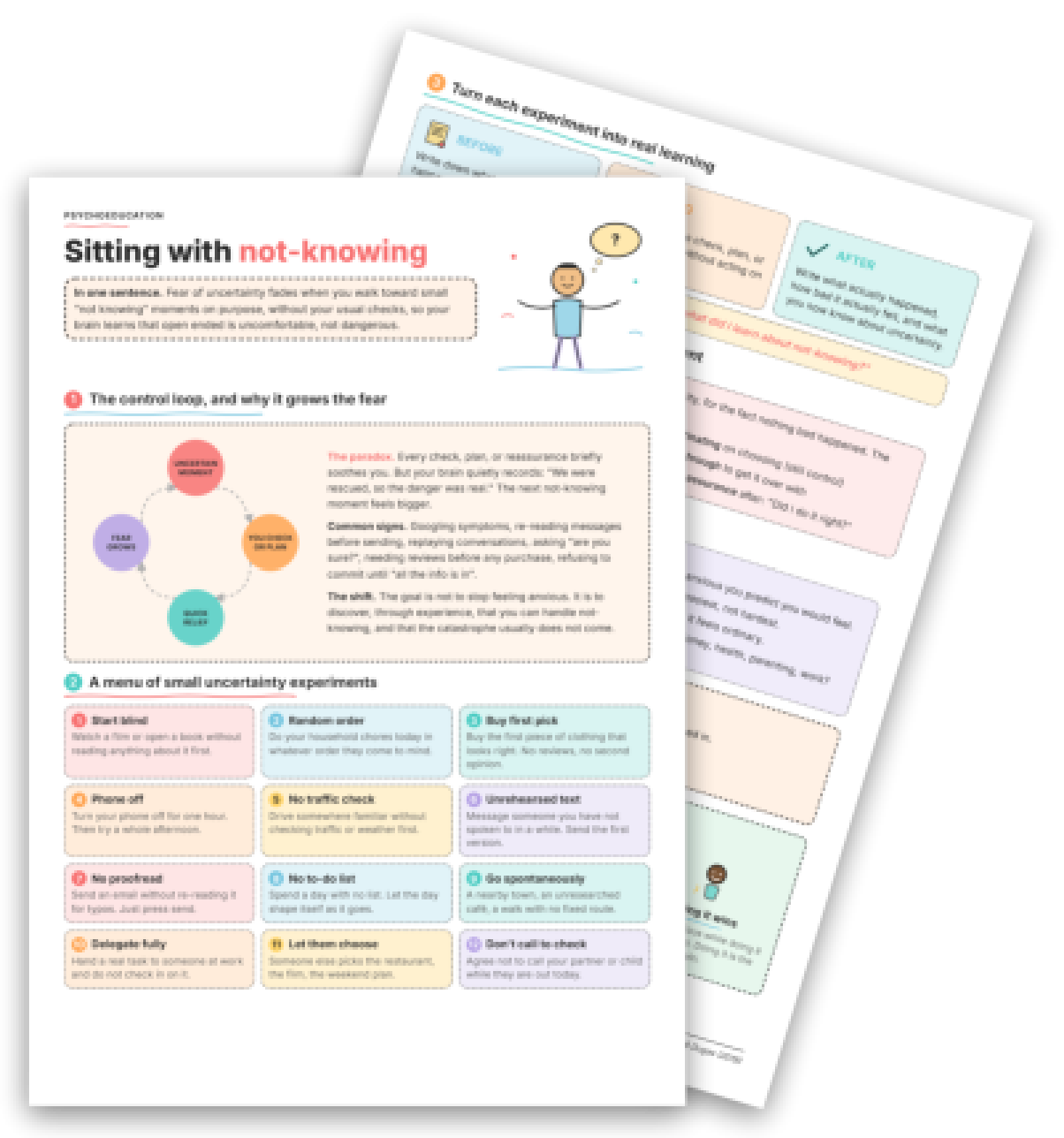
Explaining intolerance of uncertainty to a patient verbally often produces a polite nod and little else. The paradox at the heart of the phenomenon, that every check briefly soothes and simultaneously grows the fear, is genuinely hard to grasp without seeing the loop drawn out. This fiche PDF makes that loop visible in session, and pairs it with a structured set of uncertainty exposure exercises and tools the patient can take home.
Use this resource with your patients
Handout, exercises and materials ready to use, right inside SessionFuel.
Why fear of uncertainty resists verbal explanation
The central clinical difficulty is the reinforcement paradox. Patients present the checking, Googling, re-reading, and reassurance-seeking behaviours as rational and helpful. Told at the oral level that their coping strategies are the problem, most experience cognitive dissonance rather than insight. A diagram changes that dynamic faster than any amount of Socratic questioning alone.
A second sticking point is generalisation. Intolerance of uncertainty cuts across GAD, OCD checking rituals, health anxiety, and certain perfectionism presentations. Without a shared visual anchor, patients struggle to spot the same mechanism across the different life domains where it operates: work decisions, health worries, parenting, relationships. The fiche gives you a common vocabulary for all of them.
> Key point: the fiche is a visual support that facilitates the in-session explanation of fear of uncertainty; it is not a self-administered questionnaire, but a psychoeducation tool the clinician actively uses to make a complex mechanism immediately legible.
750+ clinical tools
A library built with and for clinicians, ready to use in session and extend between appointments.
Access all the toolsWhat the fiche contains: four panels that show what speech alone cannot
The first panel renders the control loop as a four-node cycle: Uncertain Moment → You Check or Plan → Quick Relief → Fear Grows. Seeing this as a closed diagram, rather than hearing it described, is often the moment patients say "oh, so it's like I'm trapping myself." The accompanying text names the common signs, a concrete list ranging from Googling symptoms to "asking 'are you sure?'" and "needing reviews before any purchase," which patients routinely recognise in themselves.
The second panel offers 12 graduated uncertainty experiments, each one concrete and domain-specific: watching a film with no prior research, sending an unrehearsed text, delegating a task without checking in, not calling a partner while they are out. The variety matters clinically: you can select experiments matched to the patient's avoidance profile rather than imposing a generic hierarchy. This pairs naturally with the exposure hierarchy tools you may already be using.
The third panel structures learning from each experiment through a Before / During / After format, with a 0-to-100 prediction rating and a key reorientation: "The key question is not 'did my anxiety go down?' but 'what did I learn about not-knowing?'" This single line does significant clinical work, shifting the frame from habituation to inhibitory learning, consistent with Craske's updated exposure model.
The fourth panel lists six safety behaviours that invalidate the experiment: mental rehearsal, procrastination, impulsive choice to end discomfort, rushing through, a "sneaky check, a quick google 'just to be sure,'" and post-hoc reassurance-seeking. Showing this list visually protects against the most common avoidance patterns that silently neutralise exposure work. A graded ladder (0-100 ratings) then helps the patient build their own personalised hierarchy, with a prompt to identify where in their specific life they avoid not-knowing, including money, health, parenting, and work.
Use it with your patients
Share this tool in the mobile app and follow the work between sessions.
When and how to introduce it in session
The fiche fits naturally after the initial formulation sessions, once the cycle of avoidance and the patient's reassurance-seeking patterns have been mapped. It works across GAD, health anxiety presentations, and high-functioning perfectionism with control behaviours.
A low-stigma introduction: "I want to show you something that might explain why the strategies you've been using haven't given you lasting relief." Display the control loop first, let the patient trace it themselves. Then move to the experiment menu together, selecting two or three experiments rated at moderate discomfort (40 to 60 on their predicted anxiety scale). The intolerance of uncertainty guided exercise and the graded exposure self-report tool can extend this work between sessions.
Debriefing focuses on the Before/After prediction gap, not on whether anxiety decreased. If a patient reports that a safety behaviour slipped in, the "To discuss in session" prompts on the fiche give you a ready debrief frame. One contraindication worth noting: for patients whose checking is embedded in severe OCD rituals, the OCD-specific tools should anchor the treatment plan, with this fiche used as a supplement rather than a primary exposure guide.
The fiche does not replace the clinical formulation; it renders the mechanism concrete enough for the patient to actually believe it, and leaves them with a practical reference between sessions.
Your session continues in your patients' pocket
Use with a patientYour resources, available everywhere
The handouts, exercises, programs and audios above: you choose which ones to make available to your patients, in the mobile app dedicated to them.
And far more than a library
The app goes well beyond resources, to support your patients every day:
Related categories
Explore other clinical resources by category.
Anxiety
Clinical hub for anxiety disorders: CBT and ACT worksheets, psychoeducation sheets, and exercises for assessment and treatment across the anxiety spectrum.

Mood
Evidence-based worksheets and clinical tools for mood disorders: CBT, ACT, and positive psychology resources for psychologists and therapists.

Behaviours
Clinical hub for behaviors in therapy: worksheets and tools for coping, eating disorders, CBT formulation, and maladaptive behavioral patterns.

Cognition
Printable cognitive therapy worksheets and clinical tools for therapists: CBT, ACT, schema work, defusion, distortions, and belief restructuring.

Understand
Clinical hub for the therapeutic aim 'Understand': worksheets and tools to build patient insight across CBT, ACT, schema therapy and more.

Exposure
Exposure therapy clinical resources for practitioners: worksheets, hierarchies, and psychoeducation tools for anxiety, PTSD, OCD, and avoidance-based presentations.