
Clinical picture. A, a woman in her late 40s, presented with a two-year history of marked avoidance: she declined family gatherings near hospitals, muted any news involving death, and reported intrusive thoughts about her own mortality that disrupted sleep several nights a week. She met criteria for a specific phobia with prominent avoidance and described her fear as reaching 9/10 when she imagined passing a cemetery. The clinician introduced a graded exposure hierarchy, beginning at the gentler rungs: A first spent two sessions reading obituary notices at home, rating distress at 20-minute intervals until it dropped by roughly half. After three weeks she completed a 30-minute cemetery walk, reading headstone dates aloud; distress peaked at 7/10 and settled to 3/10 before she left. She reported no new sleep disruption in the following week and agreed to schedule a hospice visit as the next step.
Fear of Death: PDF Worksheet, Tools and Exercises for Exposure Practice
A visual PDF worksheet with a graded exposure ladder, safety behaviour tracker, and in-session discussion prompts to help clinicians guide patients through fear of death work step by step.
Clinical vignettes
Cemetery Walk Reduces Avoidance
Writing One's Own Obituary
Clinical picture. M, a man in his early 60s recently retired, was referred after a cardiologist noted he was cancelling routine follow-up appointments; he acknowledged that anything connected to medical settings now triggered a rapid exit. Initial psychoeducation on the avoidance loop resonated with him, and he and his clinician collaboratively built a hierarchy rated from 4 to 9/10. Mid-hierarchy work involved discussing his own funeral preferences aloud with his adult daughter, which he completed between sessions with moderate distress that habituated across two repetitions. At a steeper rung, the clinician asked M to write a draft obituary in session, remaining with the discomfort rather than revising away from specific details; distress peaked at 8/10 near the midpoint and declined to 4/10 by the end of the 40-minute block. He attended his next cardiology appointment without cancelling, noting the exposure had shifted his sense of what he could tolerate.
Explaining graded exposure to a patient with fear of death is rarely straightforward. The avoidance is diffuse, the triggers are existential rather than situational, and patients frequently confuse the goal of exposure with the expectation of feeling calm, which guarantees early dropout. This PDF worksheet gives you a structured visual to work from in session, so the exposure rationale lands clearly and the patient leaves with a concrete roadmap rather than a vague instruction to "think about death more."
Use this resource with your patients
Handout, exercises and materials ready to use, right inside SessionFuel.
Why Fear of Death Resists Oral Explanation
Thanatophobia and death anxiety present differently from circumscribed phobias. The avoidance is often invisible to the patient: no will ever drawn up, conversation topics quietly redirected, hospital visits declined, symptom-checking that masquerades as health diligence. When you try to describe this pattern verbally, many patients do not recognise it as avoidance at all. They hear a description of what they see as sensible caution.
The second sticking point is the avoidance relief cycle. Clinicians routinely explain it, patients say they understand it, and then safety behaviours persist anyway because the felt logic of the loop was never made concrete. The same problem affects the concept of habituation: telling someone their anxiety will plateau and soften is abstract. Showing them a diagram of the wave rising, peaking, and softening is something else entirely.
You can pair this worksheet with the Death Anxiety PDF worksheet for the psychoeducation phase, and with a graded exposure list exercise for patients who need to build their own hierarchy from scratch. The Cycle of Avoidance worksheet works well as a primer before introducing this fiche.
What the Worksheet Contains
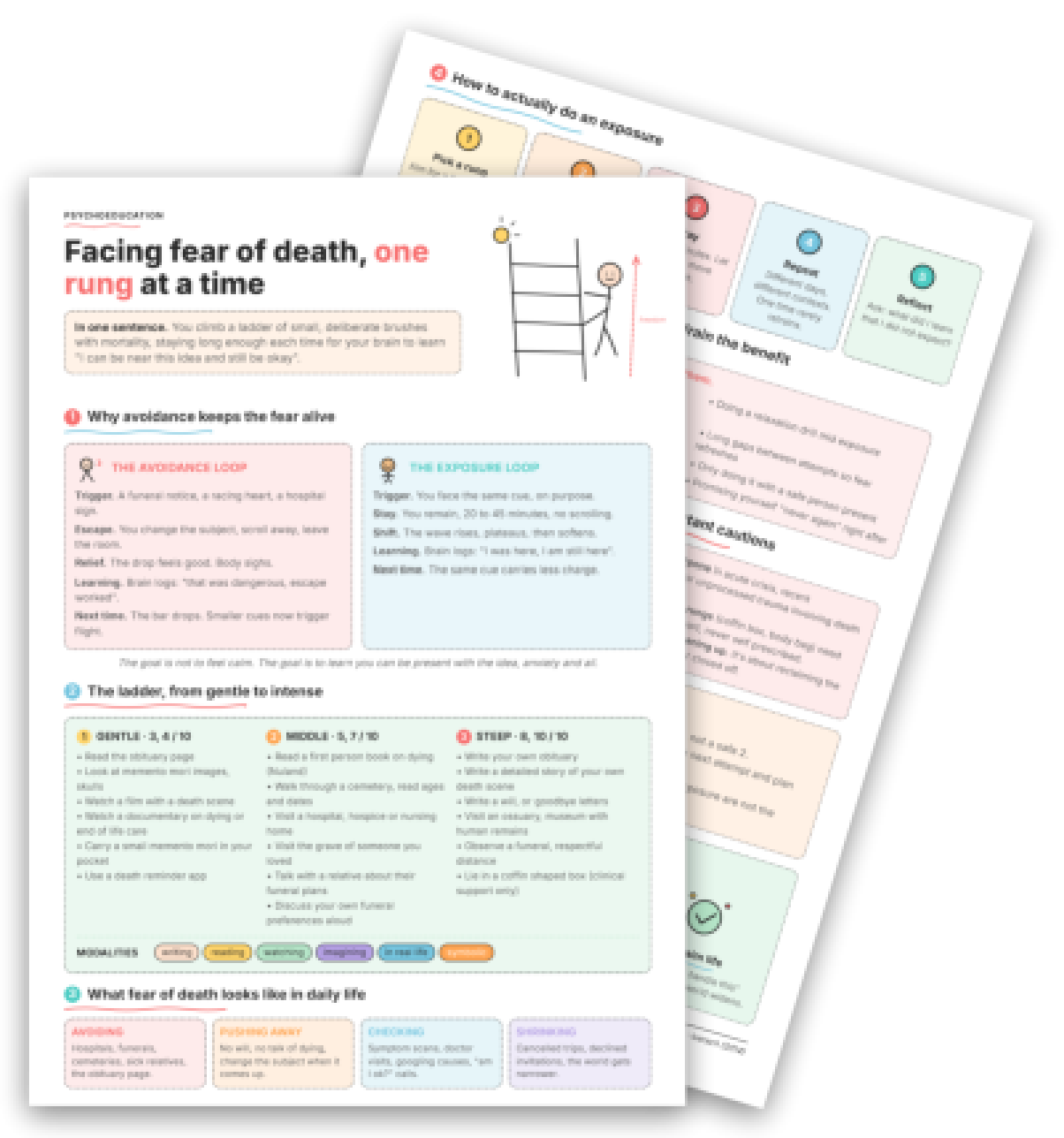
The fiche is structured across seven clearly labelled panels.
Panel 1 renders the avoidance loop and the exposure loop as parallel sequences, side by side. Trigger, response, physiological consequence, and brain learning are named at each step. The contrast is immediate: "Brain logs: 'that was dangerous, escape worked'" versus "Brain logs: 'I was here, I am still here.'" Patients who have sat through verbal explanations of this mechanism often find the visual formulation is the first version that actually sticks.
Panel 2 is the three-rung ladder: gentle exposures rated 3-4/10 (obituary page, memento mori images, documentary on end-of-life care), middle-range exposures at 5-7/10 (walking a cemetery, visiting a grave, discussing funeral preferences aloud), and steep exposures rated 8-10/10 (writing one's own obituary, drafting goodbye letters, observing a funeral). Six modalities are listed across the ladder: writing, reading, watching, imagining, in vivo, and symbolic. Having the full range visible lets you and the patient calibrate together rather than negotiate from memory.
Panel 3 maps the four behavioural presentations of death anxiety in daily life: avoiding, pushing away, checking, and shrinking. Many patients recognise themselves more clearly in this panel than in any diagnostic description.
Panel 4 breaks down the five-step exposure protocol concretely: pick a rung (aim for a 5 or 6), set rules, stay 20 to 45 minutes, repeat across different contexts, then reflect with a precise question: "What did I learn that I did not expect?"
Panel 5 tackles safety behaviours directly, named in the fiche as "the leaky bucket." The eight listed behaviours (mid-exposure relaxation drills, reassurance calls afterwards, mental rituals, doing exposures only with a safe person present) are the exact habits that drain learning. Naming them visually reduces the shame patients feel when you identify them in session.
Panels 6 and 7 provide inner reframes and clinical cautions, including the contraindications you need: acute grief, unprocessed trauma involving death or confinement, and any steep rung requiring professional presence (coffin simulation). A "To discuss in session" checklist closes the fiche.
> Key point: this worksheet is a visual support for in-session explanation, not an autonomous self-help handout. Use it to guide the psychoeducation conversation, then leave it with the patient as a between-session reference.
750+ clinical tools
A library built with and for clinicians, ready to use in session and extend between appointments.
Access all the toolsWhen and How to Propose It
This fiche fits most naturally at the transition from psychoeducation to active exposure work, once the understanding of death anxiety signs is established and you have a working formulation. For patients with comorbid health anxiety, it complements the CBT model of health anxiety without duplicating it.
You might introduce it with: "I'd like to show you a map of what we're going to be doing together. It makes it easier to see the full picture before we start." This framing positions the worksheet as a shared clinical tool, not a task the patient carries alone.
For patients who catastrophise the exposure process itself, combining the fiche with the anticipatory fear decatastrophising exercise before the first rung is attempted reduces premature dropout. For those with significant safety behaviour patterns, the reassurance-seeking exercise run concurrently addresses the leaky bucket in more depth.
One firm contraindication: do not hand the worksheet to a patient who is in acute bereavement or who has recent unprocessed trauma linked to death or confinement. For those patients, grief work takes priority. The fiche says this plainly, which makes it easier to name the delay without it feeling like a refusal to help.
Debrief focuses on one question: what rung did the patient identify as their 5 or 6, and what would make them reach for a safety behaviour during it? That conversation, with the ladder visible between you, is where the real exposure planning begins.
Use it with your patients
Share this tool in the mobile app and follow the work between sessions.
Sources
- Menzies, R. E., & Veale, D. (2022). Free Yourself from Death Anxiety: A CBT Self-Help Guide for a Fear of Death and Dying. Jessica Kingsley Publishers.
- Lu, J., Yang, Y., Chen, H., Ma, H., & Tan, Y. (2024). Effects of different psychosocial interventions on death anxiety in patients: a network meta-analysis of randomized controlled trials. Frontiers in Psychology, 15, 1362127.
- Nuland, S. B. (1994). How We Die: Reflections on Life's Final Chapter. Knopf.
- Menzies, R. E., & Menzies, R. G. (2021). Mortals: How the Fear of Death Shaped Human Society. Allen & Unwin.
Your session continues in your patients' pocket
Use with a patientYour resources, available everywhere
The handouts, exercises, programs and audios above: you choose which ones to make available to your patients, in the mobile app dedicated to them.
And far more than a library
The app goes well beyond resources, to support your patients every day:
Related categories
Explore other clinical resources by category.
Anxiety
Clinical hub for anxiety disorders: CBT and ACT worksheets, psychoeducation sheets, and exercises for assessment and treatment across the anxiety spectrum.

Mood
Evidence-based worksheets and clinical tools for mood disorders: CBT, ACT, and positive psychology resources for psychologists and therapists.

Understand
Clinical hub for the therapeutic aim 'Understand': worksheets and tools to build patient insight across CBT, ACT, schema therapy and more.

Exposure
Exposure therapy clinical resources for practitioners: worksheets, hierarchies, and psychoeducation tools for anxiety, PTSD, OCD, and avoidance-based presentations.

CBT
CBT worksheets, cognitive restructuring exercises & behavioral tools for clinicians. Evidence-based resources for every phase of cognitive behavioral therapy.

Trauma
Clinical hub on trauma and PTSD: assessment, differential diagnosis, treatment phases, and printable resources for practitioners. 155 chars.