
Clinical picture. A, a 34-year-old project manager, presented with marked social anxiety centred on being perceived as incompetent during team meetings. He routinely gripped a pen, avoided eye contact, and rehearsed every sentence in advance, which he recognised as exhausting but could not relinquish. The clinician introduced the informational sheet on fear of appearing anxious, and together they mapped his safety behaviours onto the predict-monitor-hide-relief loop, making explicit that his brain had never been allowed to test the actual prediction. As a first rung exposure, A agreed to hold his coffee cup without steadying it during a brief catch-up with a colleague, deliberately letting any visible shake remain. He reported that his hand trembled slightly, the colleague said nothing, and he rated the experience as far less catastrophic than anticipated, providing usable evidence against the core prediction.
Fear of Appearing Anxious: PDF Worksheet, Tools and Exercises
A visual PDF worksheet, practical tools and graded exercises to help clinicians explain symptom-exposure logic and break the safety-behaviour loop in social anxiety.
Clinical vignettes
Letting the Tremor Show at Work
Disclosing Visible Blushing in Session
Clinical picture. M, a 28-year-old postgraduate student, described a longstanding pattern of avoiding seminars and wearing high-collared clothing to conceal blushing, which she believed would lead peers to view her as weak or unstable. During psychoeducation, the clinician used the sheet to illustrate how concealment preserved the fear untested and discussed how safety behaviours function as confounds that prevent disconfirmatory learning. A graduated exposure was agreed: M would, during the following seminar, allow herself to blush visibly without applying extra make-up or adjusting her collar, and would record her prediction beforehand and the actual outcome afterwards. She returned reporting that she had blushed, two peers had continued the discussion without reaction, and her post-exposure distress rating was substantially lower than her pre-exposure prediction, narrowing the evidential gap the sheet had described.
Social anxiety's most treatment-resistant variant isn't the fear of the situation itself; it's the fear of being seen anxious within it. That distinction is easy to articulate verbally in session and reliably hard for patients to actually metabolise without a visual anchor. This fiche PDF gives you one, built directly on the Clark & Wells (1995) maintaining model.
Use this resource with your patients
Handout, exercises and materials ready to use, right inside SessionFuel.
Why the Fear of Appearing Anxious Resists Verbal Explanation
The Clark & Wells model of social anxiety predicts exactly this clinical impasse: self-focused attention, symptom monitoring, and safety behaviours maintain the fear far more efficiently than the feared situation ever could. Patients grasp the principle when you explain it. What they rarely grasp, without seeing it mapped spatially, is that their own props and workarounds are the mechanism keeping the fear alive.
The deeper difficulty is that the avoidance cycle is self-confirming: every time the patient "gets through" a social moment by gripping the water bottle, rehearsing every sentence, or wearing long sleeves in summer, their brain logs "the strategy worked," not "the feared outcome didn't happen." The fear survives each interaction untouched. Describing this loop verbally produces a nod; a diagram produces recognition.
What the Fiche Contains, and What the Visual Shows That Words Don't
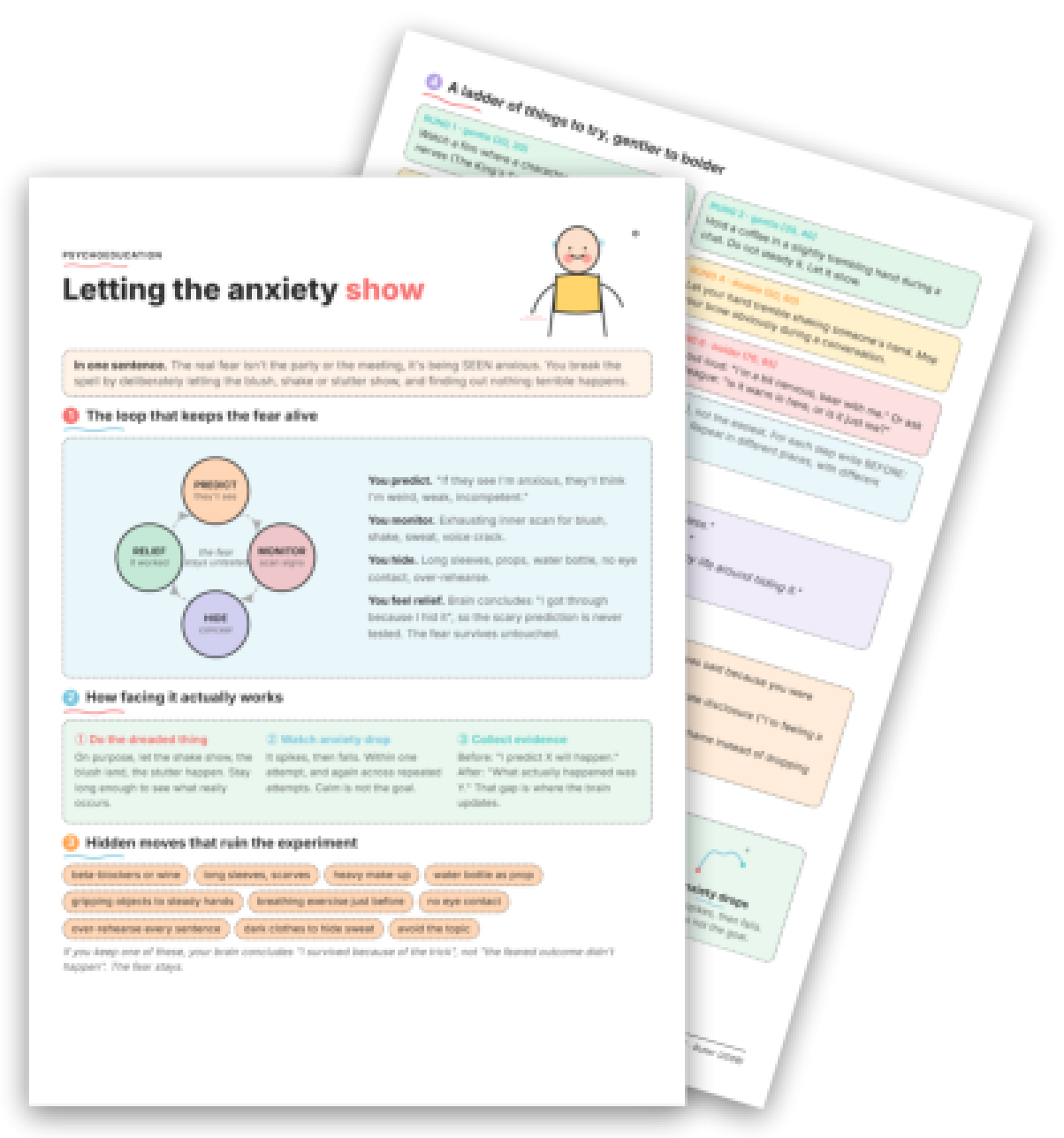
The fiche opens with one framing sentence: "The real fear isn't the party or the meeting, it's being SEEN anxious." Seven sections then build the full clinical picture, grounded in the social anxiety symptom profile most practitioners are already mapping.
Section 1 renders the maintaining loop as a four-step visual cycle: predict, monitor, hide, relief, repeat. Patients who have heard this cycle described can now see their own sequence in it rather than processing a general principle.
Section 2 lays out how exposure actually works in three numbered steps: doing the feared thing on purpose, staying long enough to watch anxiety spike and then fall, and recording the predict-vs-actual gap. That before/after structure maps cleanly onto behavioural experiment logic and gives patients a concrete data-collection frame.
Section 3 is the section patients most need to see printed. It catalogues the safety behaviours that invalidate the exposure: beta-blockers, the water bottle as prop, heavy make-up, dark clothes to hide sweat, gripping objects to steady hands, over-rehearsed sentences. The visual checklist makes it much harder to overlook items. Patients who report they "did the exposure" can run through the list themselves between sessions.
Section 4 provides a six-rung exposure hierarchy, with two SUDS-style ratings per rung, from watching a character struggle visibly with nerves on screen (Rung 1) to saying out loud "I'm a bit nervous, bear with me" (Rung 6). This integrates directly with building a personalised exposure hierarchy and allows clinician and patient to locate a starting point before the session ends. The instruction to write a BEFORE prediction and an AFTER record for each rung makes the graded exposure self-report explicit from the outset.
Sections 5 to 7 offer four coping statements, a short list of situations to bring back to session, and four visual reminders: "Be seen," "Predict vs actual," "Drop the props," "Anxiety drops." These panels are designed to stay visible between appointments, not to be completed once and filed.
> To retain: this fiche is a visual support that facilitates in-session explanation of symptom-exposure logic; it is not a self-administered questionnaire, but a psychoeducation anchor the clinician uses actively during the consultation, then leaves with the patient as a concrete reference.
750+ clinical tools
A library built with and for clinicians, ready to use in session and extend between appointments.
Access all the toolsWhen and How to Introduce It
The fiche fits naturally once the formulation has identified social anxiety or performance anxiety and the maintaining loop has been mapped collaboratively. Introducing it before the patient understands why their coping habits sustain the fear risks them reading it as a behavioural prescription rather than a conceptual shift.
A low-friction framing: "I'd like to show you something that captures what we've been describing. You don't need to do anything yet; I just want us to look at this loop together." Walk through Section 1, then move to Section 3 and ask which safety behaviours on the list resemble their own. That question alone produces more usable clinical material than extended open questioning.
For patients already engaged in structured exposure work, the Section 4 hierarchy fine-tunes their current ladder and adds the predict/actual recording structure. For patients earlier in treatment, it previews where the work is heading without front-loading the demand.
One limit worth naming: when acute shame is prominent, as in the defectiveness schema, framing "being seen anxious" as the therapeutic goal can spike overwhelm before the alliance is ready to hold it. In those cases, build relational safety first, and use the fiche once the patient can tolerate self-disclosure as a concept rather than a threat. A complementary anticipatory fear decatastrophizing exercise can help calibrate readiness.
The fiche doesn't replace the therapeutic frame; it makes the explanation land, and it leaves a reference in the patient's hands that doesn't require you to be in the room.
Use it with your patients
Share this tool in the mobile app and follow the work between sessions.
Sources
- Clark, D. M., & Wells, A. (1995). A cognitive model of social phobia. In R. G. Heimberg, M. R. Liebowitz, D. A. Hope, & F. R. Schneier (Eds.), Social Phobia: Diagnosis, Assessment, and Treatment (pp. 69-93). Guilford Press.
- Wells, A. (1997). Cognitive Therapy of Anxiety Disorders: A Practice Manual and Conceptual Guide. John Wiley & Sons.
Your session continues in your patients' pocket
Use with a patientYour resources, available everywhere
The handouts, exercises, programs and audios above: you choose which ones to make available to your patients, in the mobile app dedicated to them.
And far more than a library
The app goes well beyond resources, to support your patients every day:
Related categories
Explore other clinical resources by category.
Anxiety
Clinical hub for anxiety disorders: CBT and ACT worksheets, psychoeducation sheets, and exercises for assessment and treatment across the anxiety spectrum.

Understand
Clinical hub for the therapeutic aim 'Understand': worksheets and tools to build patient insight across CBT, ACT, schema therapy and more.

Exposure
Exposure therapy clinical resources for practitioners: worksheets, hierarchies, and psychoeducation tools for anxiety, PTSD, OCD, and avoidance-based presentations.

CBT
CBT worksheets, cognitive restructuring exercises & behavioral tools for clinicians. Evidence-based resources for every phase of cognitive behavioral therapy.

Trauma
Clinical hub on trauma and PTSD: assessment, differential diagnosis, treatment phases, and printable resources for practitioners. 155 chars.

Mood
Evidence-based worksheets and clinical tools for mood disorders: CBT, ACT, and positive psychology resources for psychologists and therapists.