
Clinical picture. M., a 38-year-old project manager, had avoided air travel for six years following a flight through severe turbulence; she now declined work trips and paid significant costs to travel by train. The clinician introduced the informational sheet and worked with M. to rate each ladder rung, placing YouTube take-off videos at around 35 and a short domestic hop near 80. Over eight weeks of weekly sessions and between-session practice, M. progressed to watching cabin-view turbulence footage without gripping her phone, having first identified grip-and-brace as her primary safety behaviour. She completed a 90-minute flight at week twelve; her subjective distress peaked at 65 during take-off and settled to 30 before landing, without sedation.
Fear of Flying: PDF Worksheet, Tools and Exercises for Clinical Practice
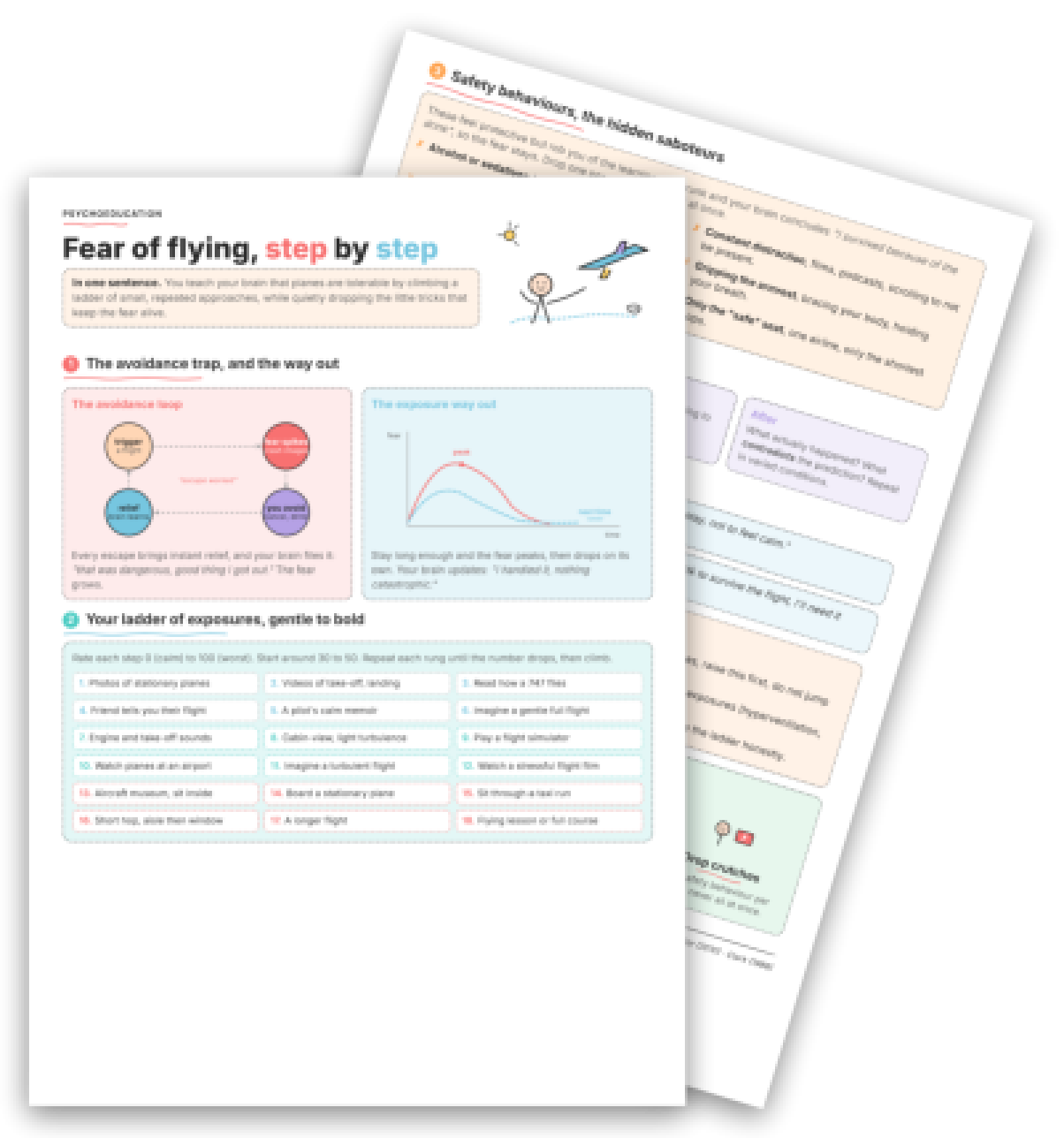
A visual PDF worksheet clinicians can use in session to explain the avoidance loop, build a graded exposure ladder, and dismantle safety behaviours that keep flight phobia alive.
Clinical vignettes
Graduated Ladder With Safety Behaviour Fading
Psychoeducation Shifting a Stuck Conceptualisation
Clinical picture. R., early fifties, had attended a fear-of-flying group course two years prior but reported no lasting benefit; he attributed this to "willpower running out at the gate." In session, the clinician used the avoidance loop diagram from the sheet to locate where R.'s pattern broke down: he had been using alcohol at the departure lounge, so his brain had never registered the flight itself as survivable. R. was initially reluctant to relinquish that coping strategy and the sheet's framing of safety behaviours as "hidden saboteurs" opened a productive discussion rather than a directive instruction. He agreed to trial one short hop without pre-flight alcohol as an explicit experiment, returning the following week reporting surprise that the anxiety had peaked and then subsided without chemical assistance.
Explaining graded exposure for flight phobia in words alone tends to leave patients nodding without moving. The abstract case for "approach the feared stimulus" dissolves the moment they picture the boarding gate. This PDF worksheet on fear of flying gives you a concrete visual scaffold to use during the session itself, so the explanation lands, and the patient leaves with a printed reference they can return to between appointments.
Use this resource with your patients
Handout, exercises and materials ready to use, right inside SessionFuel.
Why Fear of Flying Resists Explanation in Session
Avoidance-maintained phobias share a maddening feature: each escape episode feels like evidence that avoidance worked. Patients arrive having already generated elaborate safety architectures (alcohol before boarding, only window-free seats, reassurance loops with cabin crew) and have often held them for years. When you explain inhibitory learning or the cycle of avoidance verbally, the conceptual grasp rarely survives the anticipatory anxiety of the next booking.
Two specific mechanisms make flight phobia particularly resistant to oral psychoeducation. First, the fear is episodic and prospective: unlike social anxiety, where the patient encounters triggers daily, the feared situation may recede for months, leaving avoidance unchallenged and the learning never updated. Second, safety behaviours (sedatives, white-knuckling, constant window-checking) are so entrenched that patients rarely identify them as problems; they experience them as rational precautions. Without a shared visual language for both the avoidance loop and the hidden cost of those precautions, it is difficult to get traction on either.
What the Fiche Contains, and What the Visual Does That Words Cannot
The PDF worksheet opens with two diagrams that do the heavy lifting. The first traces the avoidance loop: trigger → fear spikes → escape → relief → "brain learns: escape worked". The second diagram shows the exposure curve: fear peaks, then drops on its own when the patient stays long enough. Having both on paper, side by side, means you can point to the exact moment the brain files a false lesson, rather than asking the patient to hold that logic in working memory while already dysregulated.
The core of the fiche is an 18-rung exposure ladder, rated 0-100 (SUD scale), moving from "Photos of stationary planes" at the bottom to "Flying lesson or full course" at the top. The fiche instructs patients to "start around 30 to 50. Repeat each rung until the number drops, then climb." This graduated structure maps directly onto the building an exposure hierarchy framework you may already be using, and gives patients a personalised artefact to annotate across weeks.
A dedicated section on safety behaviours names six specific crutches (alcohol or sedatives, constant distraction, gripping the armrest, reassurance-checking the wing or crew, refusing to look out the window, only the "safe" seat) and explains the mechanism concisely: "Fly drunk and your brain concludes 'I survived because of the drink', so the fear stays." Showing this on paper shifts the conversation from "you shouldn't do that" to a shared analysis of why the behaviour defeats the exposure. Pair this with the adaptive vs. maladaptive coping fiche if your patient needs the broader framework first.
The worksheet also includes a before/during/after structure for each exposure: write a specific prediction with a probability before, stay long enough for something to shift during, then check the actual outcome against the prediction after. This is the behavioural experiment format that challenging anxious thoughts work often relies on, applied here to in-vivo situations.
Finally, a "To discuss in session" box flags three clinical decision points: prior traumatic incident with flashbacks (address that before ladder work), panic-driven somatic fear (consider adding interoceptive exposures), and difficulty dropping a safety behaviour independently (pace the ladder honestly rather than pushing).
> Key takeaway: The fiche is a visual support for in-session explanation, not a self-guided homework booklet. The diagrams, the rated ladder, and the safety-behaviour checklist are tools you work through with the patient, then leave with them as a printed anchor.
750+ clinical tools
A library built with and for clinicians, ready to use in session and extend between appointments.
Access all the toolsWhen and How to Introduce the Fiche
This worksheet fits best after a thorough functional analysis, once avoidance is established as the maintaining factor and the patient has accepted the exposure rationale in principle. Introducing it before that consensus is in place risks having the ladder read as a threat list.
For patients who also present with panic disorder or significant health anxiety, address those fear of body sensations first; otherwise the early rungs will already be too hot. If anticipatory cognitions are prominent, a session of decatastrophizing the feared flight scenario before moving to ladder construction often reduces the starting SUD ratings enough to make the lower rungs genuinely accessible.
To introduce it without over-medicalising: "I want to show you a map of how this works, two diagrams that explain why avoidance has kept the fear alive, and a step-by-step path out. We'll build your version of the ladder together." After the session, use a graded exposure self-report to track SUD ratings across trials, and revisit the safety-behaviour section each time the patient reports a spike that doesn't follow the expected habituation curve.
The fiche does not replace the formulation or the therapeutic frame. It makes the rationale for exposure visible, gives the patient a vocabulary for what they are about to do, and sends them home with a reference that belongs to them, not to the session alone.
Use it with your patients
Share this tool in the mobile app and follow the work between sessions.
Sources
- Gamito, P., Oliveira, J., Santos, N., Pacheco, J., Morais, D., Saraiva, T. (2023). Efficacy of Virtual Reality-Based Exposure Therapy for the Treatment of Fear of Flying: A Systematic Review. The Cognitive Behaviour Therapist.
- Gottlieb, A., Doniger, G. M., Hussein, Y., Noy, S., Plotnik, M. (2021). The Efficacy of a Virtual Reality Exposure Therapy Treatment for Fear of Flying: A Retrospective Study. Frontiers in Psychology.
Your session continues in your patients' pocket
Use with a patientYour resources, available everywhere
The handouts, exercises, programs and audios above: you choose which ones to make available to your patients, in the mobile app dedicated to them.
And far more than a library
The app goes well beyond resources, to support your patients every day:
Related categories
Explore other clinical resources by category.

Anxiety
Clinical hub for anxiety disorders: CBT and ACT worksheets, psychoeducation sheets, and exercises for assessment and treatment across the anxiety spectrum.

Build awareness
Clinical worksheets and tools to build awareness in therapy: cognitive distortions, schemas, emotions, ACT and CBT resources for practitioners.

Exposure
Exposure therapy clinical resources for practitioners: worksheets, hierarchies, and psychoeducation tools for anxiety, PTSD, OCD, and avoidance-based presentations.

CBT
CBT worksheets, cognitive restructuring exercises & behavioral tools for clinicians. Evidence-based resources for every phase of cognitive behavioral therapy.

Trauma
Clinical hub on trauma and PTSD: assessment, differential diagnosis, treatment phases, and printable resources for practitioners. 155 chars.

Mood
Evidence-based worksheets and clinical tools for mood disorders: CBT, ACT, and positive psychology resources for psychologists and therapists.