
Clinical picture. A., a woman in her late thirties, presented with panic disorder and agoraphobia; she had completed several previous courses of exposure with limited durability, always carrying a water bottle and positioning herself near exits. Reviewing her history, the clinician noted that habituation had occurred within sessions but predictions about catastrophe had never been explicitly tested or disconfirmed. Using the informational sheet as a shared reference, they reframed the goal: rather than waiting for SUDS to fall, A. would write a specific prediction before each trial and compare it to what actually happened. When A. entered a busy supermarket without her water bottle or an identified exit, she rated her prediction of fainting at 85% likelihood; she did not faint, and reviewing the gap between prediction and outcome became the explicit end-point of the session. At three-month follow-up she reported sustained gains, attributing them to finally having evidence that her alarm system could be wrong.
Exposure Therapy Effectiveness: PDF Worksheet, Tools and Exercises
A visual psychoeducation fiche to shift patients from waiting out fear to actively building inhibitory learning during exposure work, ready to use in session.
Clinical vignettes
Dropping Safety Behaviours Mid-Hierarchy
Combining Cues to Deepen Inhibitory Learning
Clinical picture. T., a man in his mid-forties with health anxiety and interoceptive sensitivity, had made modest progress facing dizziness in the clinic office but consistently avoided combining triggers, never practising when fatigued or in unfamiliar surroundings. The clinician introduced the concept of stacking feared cues: first inducing dizziness alone via spinning, then repeating the exercise while standing in a busy corridor, and later while fatigued after a short run. T. was asked to label sensations aloud during each trial rather than reattribute or slow his breathing, a shift he found uncomfortable but did not abandon. Across four sessions conducted in three different locations and two distinct physiological states, his confidence that dizziness signalled danger decreased more than it had across the prior six weeks of routine single-context work. The variability appeared to prevent the learning from being filed as context-specific, and gains held at a six-month review.
The habituation model is so thoroughly baked into patient culture that "wait until the fear goes down" feels like common sense. When a patient leaves session reporting that their SUDS never dropped, they read this as failure, and the exposure programme starts to erode. This PDF worksheet on exposure therapy effectiveness gives you a concrete visual support to reframe the entire rationale in real time, without losing session momentum.
Use this resource with your patients
Handout, exercises and materials ready to use, right inside SessionFuel.
Why the SUDS Model Keeps Tripping Up Exposure Work
The obstacle is rarely motivation. It is the implicit model patients carry. Most arrive expecting the feared stimulus to be endured until subjective distress falls. Craske et al. (2014) crystallised the problem clearly: it is not fear reduction that drives durable outcomes, it is prediction violation. When the gap between anticipated catastrophe and actual outcome is wide enough, new inhibitory learning competes successfully with the original fear memory. Habituation may or may not occur, and when it doesn't, patients (and sometimes clinicians) conclude the exposure failed.
This is genuinely hard to convey orally, mid-session, while a patient is monitoring their chest tightness for signs of relief. Clinicians often inadvertently collude, asking "has it come down?" rather than "what did your brain just learn?" The cycle of avoidance perpetuates partly because patients never get a cleaner model of what success looks like. That is the gap this fiche PDF addresses directly.
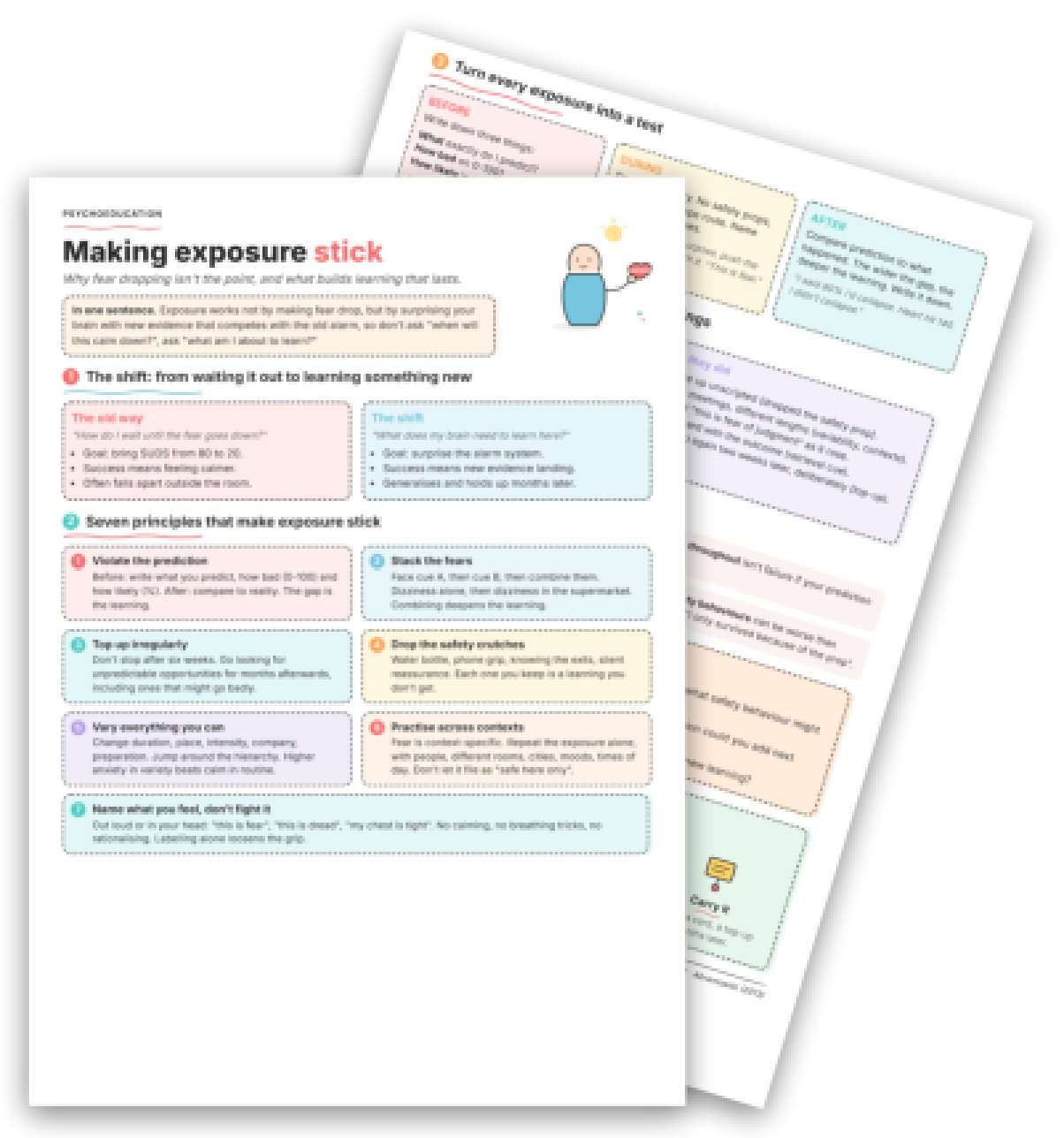
What's Inside the Fiche: Seven Principles, Laid Out Visually
The fiche opens with a side-by-side visual contrast between the old habituation frame and the inhibitory learning frame: left column, "How do I wait until the fear goes down?"; right column, "What does my brain need to learn here?" Showing a patient this panel in two seconds of shared attention is more efficient than three minutes of spoken explanation.
The centrepiece is a numbered list of seven principles that make exposure stick, grounded in Craske and colleagues' work:
- Violate the prediction, write the feared outcome before, compare to reality after; "the gap is the learning"
- Stack the fears, combine cues already faced separately (dizziness alone, then dizziness in the supermarket)
- Top up irregularly, unscheduled return exposures over months, including ones that might go badly
- Drop safety crutches, water bottle, phone grip, knowing the exits; "each one you keep is a learning you don't get"
- Vary everything, place, duration, intensity, company; randomness beats the calm of routine
- Practise across contexts, fear is context-specific, so the graded exposure list needs to cross settings, not just levels
- Name what you feel, don't fight it, labelling aloud ("this is fear", "my chest is tight") without breathing tricks or rationalising
A third panel structures every exposure as a before / during / after test: write the prediction with severity (0-100) and likelihood (%), do the exposure fully without props, then compare outcome to prediction. A worked social-anxiety example (meeting, unscripted speech, voice shaking slightly, nobody laughing) walks through exactly how the written record is completed. The final panel is a four-word mnemonic: Surprise, Stack, Vary, Carry it, a retrieval cue the patient can take away.
> Key point: this fiche is a visual support that facilitates the explanation of exposure principles in session; it is not a form patients complete alone at home. The before/during/after structure becomes a shared clinical artefact you build together, not homework you assign and collect.
750+ clinical tools
A library built with and for clinicians, ready to use in session and extend between appointments.
Access all the toolsWhen and How to Introduce It
The fiche fits naturally at the point where you are transitioning from psychoeducation about habituation to active exposure planning, typically after the first exposure hierarchy is drafted and the patient has done one or two attempts that "didn't work." That moment of discouragement is the clearest clinical opening.
A low-pressure introduction: "Before we run this next one, I want to show you a different way of thinking about what counts as success, it shifts what we're actually measuring." Then place the fiche between you, point to the two-column panel, and let the contrast land visually before you say anything else.
For patients with health anxiety or panic disorder, the prediction-violation format pairs directly with interoceptive exposure exercises, hyperventilating on purpose, pushing heart rate to 140, then recording the exact outcome against the written prediction. For social anxiety, it complements the Clark and Wells model by making safety-behaviour removal feel logical rather than arbitrary. The structured post-exposure self-report can extend the before/during/after format into between-session tracking once the rationale is established.
A relevant limit: patients with severe cognitive avoidance or active dissociation may need grounding work stabilised before the prediction-violation frame is fully usable. And if the concept of exposure itself is still new, the structured exposure therapy programme gives a fuller onboarding curriculum to run alongside this fiche.
The fiche does not replace the clinical formulation or the exposure hierarchy. What it does is give you a shared visual language for what exposure is actually for, so patients stop measuring the wrong thing, and start noticing what their brain is genuinely learning.
Use it with your patients
Share this tool in the mobile app and follow the work between sessions.
Sources
- Craske, M. G., Treanor, M., Zbozinek, T. D., Vervliet, B. (2022). Optimizing exposure therapy with an inhibitory retrieval approach and the OptEx Nexus. Behaviour Research and Therapy, 152, 104069.
Your session continues in your patients' pocket
Use with a patientYour resources, available everywhere
The handouts, exercises, programs and audios above: you choose which ones to make available to your patients, in the mobile app dedicated to them.
And far more than a library
The app goes well beyond resources, to support your patients every day:
Related categories
Explore other clinical resources by category.

Anxiety
Clinical hub for anxiety disorders: CBT and ACT worksheets, psychoeducation sheets, and exercises for assessment and treatment across the anxiety spectrum.

Exposure
Exposure therapy clinical resources for practitioners: worksheets, hierarchies, and psychoeducation tools for anxiety, PTSD, OCD, and avoidance-based presentations.

Prevent relapse
Prevention as a therapeutic aim: clinical framing, risk stratification, and printable resources for relapse prevention and early intervention in mental health.

CBT
CBT worksheets, cognitive restructuring exercises & behavioral tools for clinicians. Evidence-based resources for every phase of cognitive behavioral therapy.

Trauma
Clinical hub on trauma and PTSD: assessment, differential diagnosis, treatment phases, and printable resources for practitioners. 155 chars.

Mood
Evidence-based worksheets and clinical tools for mood disorders: CBT, ACT, and positive psychology resources for psychologists and therapists.