
Clinical picture. A, a woman in her late twenties, presented with a three-year history of emetophobia that had progressively narrowed her diet to a handful of "safe" foods and led her to avoid public transport, restaurants, and social eating. During the initial session her SUDS rating for watching a film containing a vomiting scene was 85. The clinician introduced the fear ladder collaboratively, placing text-based exposures near the bottom, and A agreed to begin by reading a short fictional passage describing a character feeling nauseated, without using mints or leaving the room. By the third session she reported tolerating the passage with SUDS dropping from 60 to 28 within fifteen minutes, and she identified hand sanitiser use as a safety behaviour she was ready to target next.
Fear of Vomiting (Emetophobia): PDF Worksheet, Tools and Exercises
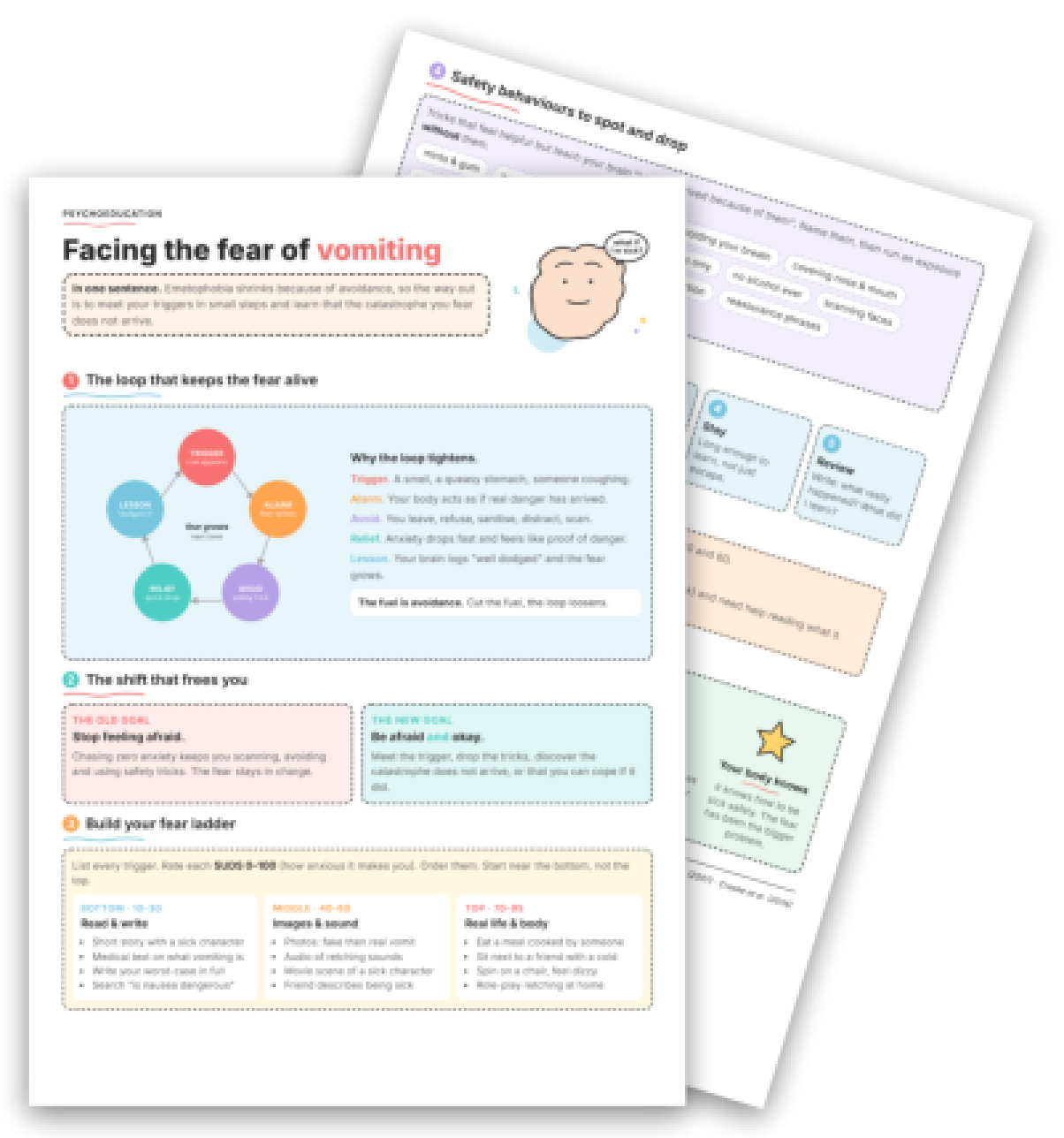
A structured PDF worksheet with a maintenance loop diagram, tiered fear ladder, safety behaviour checklist, and a five-step exposure protocol to support emetophobia treatment in session.
Clinical vignettes
Graduated Exposure for Chronic Avoidance
Dropping Safety Behaviours Mid-Ladder
Clinical picture. M, a man in his mid-forties, had sought reassurance from his GP repeatedly over perceived nausea and restricted his food intake to small portions prepared only by himself, meeting criteria for emetophobia with secondary health anxiety. The clinician used the avoidance loop diagram to help M recognise that his portion restriction had become a safety behaviour maintaining the fear rather than reflecting genuine risk. An exposure was designed at the mid-ladder level: M ate a full meal prepared by his partner while deliberately refraining from taking an antacid afterwards. Post-exposure he noted residual SUDS of 35, down from an anticipated 80, and remarked that the catastrophe he had predicted, becoming uncontrollably ill, had not occurred.
Emetophobia is one of the specific phobias where psychoeducation most often stalls: patients understand the rationale for exposure intellectually, then find twenty reasons why their situation is different. This fiche PDF gives you a shared visual structure to cut through that impasse and make the logic of graduated exposure immediately legible in session.
Use this resource with your patients
Handout, exercises and materials ready to use, right inside SessionFuel.
Why emetophobia resists verbal explanation alone
The maintenance cycle in emetophobia is tight and self-sealing. Safety behaviours (mints, hand sanitiser, tiny portions, scanning exits, reassurance phrases) produce fast relief and are therefore neurologically indistinguishable, from the patient's perspective, from having genuinely "dodged" danger. When you describe this mechanism verbally, patients often agree, then promptly attribute their relief to the safety behaviour rather than to the absence of actual catastrophe.
A second difficulty: the goal shift. Moving from "stop feeling anxious" to "be anxious and discover I cope" sounds paradoxical in words. Patients with emetophobia have often built their entire daily routine around the first goal. Stating the second goal aloud is rarely enough to dislodge it. A visual contrast, seen on paper, carries different weight.
There is also a frequent overlap with health anxiety and OCD (the OCD worksheet and the health anxiety checklist can help you map that comorbidity before you start exposure work). Emetophobia patients often have intrusive "what if I'm sick?" cognitions that function like obsessions, making the cycle of avoidance harder to break without a concrete map.
What the fiche contains: a visual support for in-session explanation
The fiche is a psychoeducation support you work through with the patient, not a self-administered questionnaire.
It opens with a five-node loop diagram (Trigger → Alarm → Avoid → Relief → Lesson) that makes the maintenance mechanism visible at a glance. The caption, "The fuel is avoidance. Cut the fuel, the loop loosens," gives you a ready formulation to hand the patient as a take-home phrase.
A two-panel contrast then externalises the goal shift: the left panel names the old goal ("Stop feeling afraid") and spells out its cost; the right panel names the new goal ("Be afraid and okay") in plain language. Seeing both on the same page helps patients locate themselves, and choose.
The fear ladder (Section 3) is pre-populated with three SUDS tiers and concrete emetophobia-specific items:
- Bottom tier (10-30 SUDS): reading a short story with a sick character, writing a worst-case scenario in full, searching "is nausea dangerous"
- Middle tier (40-60): viewing photos of fake then real vomit, listening to audio of retching sounds, having a friend describe being sick
- Top tier (70-95): sitting next to a friend with a cold, spinning on a chair to induce dizziness, role-playing retching at home
This pre-populated scaffold saves considerable session time compared to building a hierarchy from scratch, and complements a blank exposure hierarchy template when you want the patient to add idiosyncratic items.
Section 4 lists fifteen named safety behaviours (covering avoidance, compulsion, and reassurance categories) for the patient to recognise and gradually relinquish. Section 5 lays out a five-step exposure protocol (Pick, Predict, Drop tricks, Stay, Review) grounded in inhibitory learning theory (Craske et al., 2014), where the "Predict" and "Review" steps are designed to disconfirm expectancies explicitly. Sections 6 and 7 flag what to bring back to session and consolidate the key reminders.
> Key takeaway: the fiche is a visual support that makes the emetophobia maintenance loop and the exposure rationale clear in session; it gives the patient a concrete reference to take away, not a form to complete alone.
750+ clinical tools
A library built with and for clinicians, ready to use in session and extend between appointments.
Access all the toolsWhen and how to introduce it in session
The fiche fits naturally after the formulation is shared, once the patient grasps that avoidance is maintaining the fear. A useful framing: "I'd like to show you a diagram that maps exactly what we've just been describing, so we have a common picture to work from."
It is particularly useful with patients who have tried exposure before and abandoned it, since the explicit attention to safety behaviours often reveals why previous attempts failed. Pair it with the graded exposure list exercise for between-session hierarchy building, and use the post-exposure self-report tool to structure debriefing at subsequent appointments.
For patients where the avoidance is broad and the ladder feels overwhelming, start with the changing avoidance worksheet first, then return to this fiche once motivation for approach is consolidated. The exposure therapy program and the fear psychoeducation program provide the surrounding clinical curriculum when you need a fuller between-session structure.
One contraindication to note: if active vomiting phobia is entangled with a restrictive eating pattern, the food-based ladder items (Section 3 top tier) require careful sequencing alongside the eating disorder formulation before you proceed.
The fiche does not replace the clinical framework. It makes the exposure rationale visible, gives the patient a reference they can re-read between sessions, and anchors the vocabulary you will use throughout treatment.
Use it with your patients
Share this tool in the mobile app and follow the work between sessions.
Sources
- Veale, D. (2009). Cognitive behaviour therapy for a specific phobia of vomiting. The Cognitive Behaviour Therapist.
- Keyes, A., & Veale, D. (2021). Free Yourself from Emetophobia: A CBT Self-Help Guide for a Fear of Vomiting. Jessica Kingsley Publishers.
- Christie, A. S., Russ, D., & Veale, D. (2024). Emetophobia: Understanding and Treating Fear of Vomiting in Children and Adults. Jessica Kingsley Publishers.
Your session continues in your patients' pocket
Use with a patientYour resources, available everywhere
The handouts, exercises, programs and audios above: you choose which ones to make available to your patients, in the mobile app dedicated to them.
And far more than a library
The app goes well beyond resources, to support your patients every day:
Related categories
Explore other clinical resources by category.

Anxiety
Clinical hub for anxiety disorders: CBT and ACT worksheets, psychoeducation sheets, and exercises for assessment and treatment across the anxiety spectrum.

Understand
Clinical hub for the therapeutic aim 'Understand': worksheets and tools to build patient insight across CBT, ACT, schema therapy and more.

Exposure
Exposure therapy clinical resources for practitioners: worksheets, hierarchies, and psychoeducation tools for anxiety, PTSD, OCD, and avoidance-based presentations.

CBT
CBT worksheets, cognitive restructuring exercises & behavioral tools for clinicians. Evidence-based resources for every phase of cognitive behavioral therapy.

Trauma
Clinical hub on trauma and PTSD: assessment, differential diagnosis, treatment phases, and printable resources for practitioners. 155 chars.

Mood
Evidence-based worksheets and clinical tools for mood disorders: CBT, ACT, and positive psychology resources for psychologists and therapists.