
Clinical picture. M., a woman in her late thirties, presented for a second opinion on a longstanding anxiety disorder. She had never used the words obsession or compulsion to describe her experience. Before her intake appointment, the clinician sent the Am I Experiencing OCD? informational sheet as preparatory reading. At the following session M. arrived with the sheet annotated in pencil, having circled the contamination and reassurance examples; she said quietly, "I thought everyone did this." The clinician used her annotations as a structured entry point into a collaborative symptom review, which led to a more specific formulation than the previous generalised anxiety diagnosis had captured.
OCD: PDF Worksheet, Tools and Exercises for Clinical Practice
A printable PDF worksheet with visual tools and structured exercises to explain the OCD loop, name obsessions and compulsions, and open the clinical conversation.
Clinical vignettes
Worksheet Prompts First Disclosure
Normalising Without Minimising
Clinical picture. T., a man in his mid-twenties, had been researching his symptoms online for months before seeking help, and arrived convinced he had "the scary kind" of OCD because of recurrent intrusive harm-related images. The clinician introduced the sheet's side-by-side obsessions and compulsions section to illustrate that ego-dystonic harm thoughts are a recognised, common presentation rather than a sign of dangerous intent. T. was visibly relieved by this framing, though the clinician was careful to note that the sheet was a starting point for assessment, not a reassurance ritual in itself. Naming that distinction early helped both parties monitor for reassurance-seeking as treatment progressed.
Patients who meet criteria for OCD rarely arrive naming it. They describe thoughts they cannot shake, behaviours they hide from everyone close to them, and an exhausting sense that something is wrong with them, not with a mechanism. This fiche PDF gives you a visual scaffold to open that conversation without pathologising prematurely, and to make the OCD cycle clinically legible within a single session.
Use this resource with your patients
Handout, exercises and materials ready to use, right inside SessionFuel.
Why OCD Resists Oral Explanation
The loop is structurally counterintuitive. A patient who has checked the stove eleven times this morning does not intuitively grasp that the checking is what keeps the fear alive. Explaining the obsession-compulsion cycle verbally can produce a polite nod and zero conceptual shift. What is even harder to convey through speech alone is the self-reinforcing architecture: the ritual teaches the brain that the intrusion was genuinely dangerous, which guarantees a stronger signal next time.
Shame compounds this at every level. When the obsessional content involves harm urges, taboo sexual imagery, or blasphemous thought, many patients spend years convinced they are uniquely monstrous. A visual that names these categories matter-of-factly, alongside contamination and doubt, normalises the content without minimising the distress.
Differential framing is also a recurring clinical challenge. Patients conflate OCD intrusions with worry about real-life problems, which is why differentiating OCD from Generalized Anxiety Disorder or health anxiety in early sessions often requires more than verbal explanation. A structure that shows the difference is faster and less likely to feel like a lecture.
What the Fiche Contains: Four Panels, One Clear Mechanism
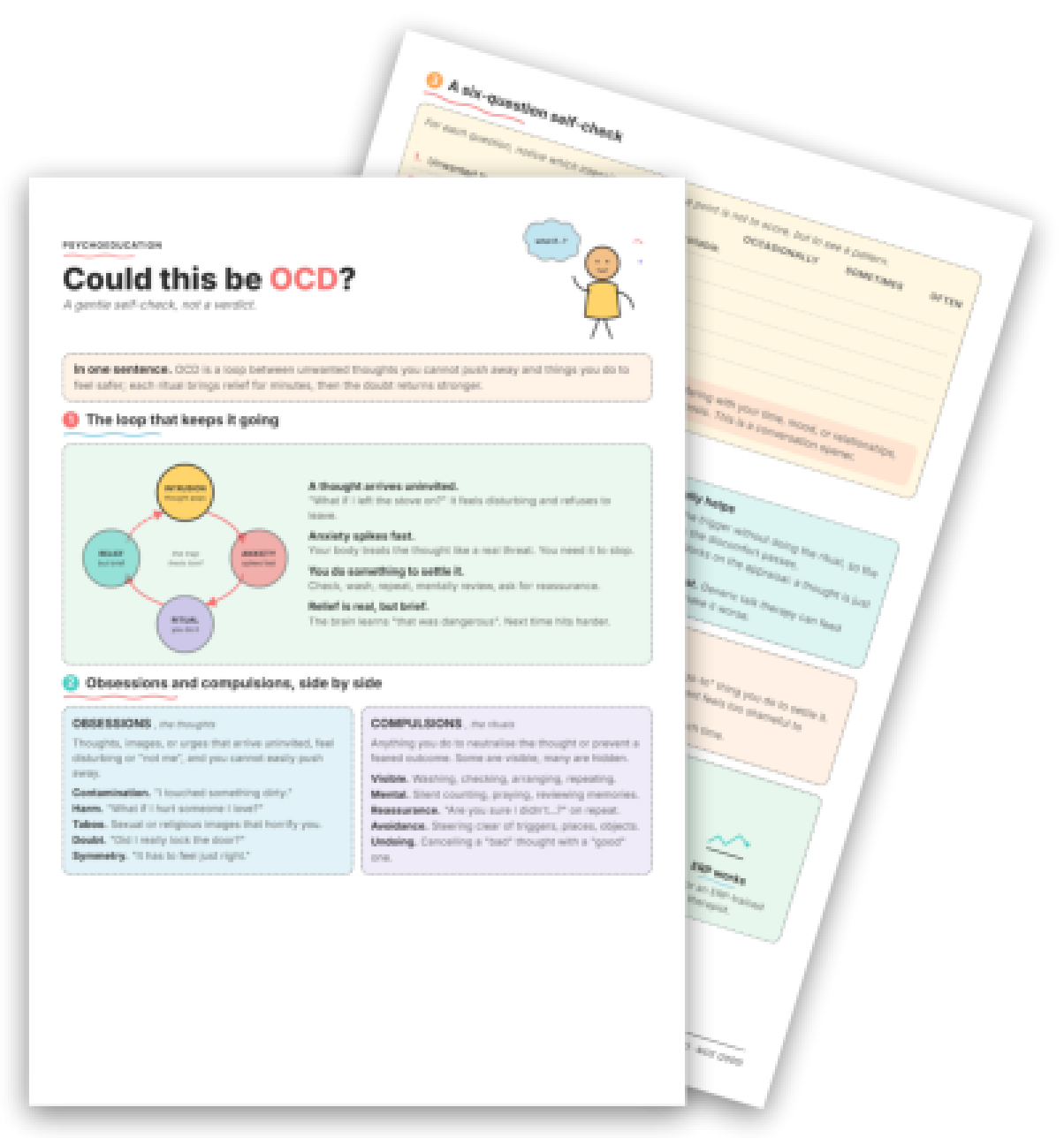
The fiche is organised around four sequential panels, each doing clinical work the verbal explanation tends to rush past.
- The loop diagram (panel 1): a four-step cycle, Intrusion → Anxiety → Ritual → Relief, labelled explicitly "the trap feeds itself." Showing this visually externalises the mechanism. The compulsion stops looking like weakness and starts looking like a predictable behavioural outcome.
- Obsessions and compulsions, side by side (panel 2): subtypes listed by category (contamination, harm, taboo, doubt, symmetry) against compulsion forms (visible, mental, reassurance-seeking, avoidance, undoing). Mental compulsions are named explicitly, which is important: silent counting, memory reviewing, and covert undoing are frequently invisible in anamnesis until the patient sees them listed and recognises themselves.
- The six-question self-check (panel 3): rated across Occasionally / Sometimes / Often, covering intrusive thoughts, suppression attempts, time consumed by rituals, washing, checking, and subjective distress. The fiche frames it precisely: "The point is not to score, but to see a pattern." This positions the exercise as a conversation opener, not a diagnostic verdict.
- What OCD is not / What actually helps (panel 4): dismantles common misconceptions (perfectionism, a tidy-desk preference, a personal flaw) and names ERP and CBT for OCD as the evidence-based responses. It also carries a clinical warning worth showing the patient directly: "Generic talk therapy can feed reassurance and make it worse."
> Key point: this fiche is a visual support that facilitates the explanation of OCD in session, not a self-administered screener. You present it, you walk through the panels together, and the patient leaves with a named mechanism rather than a vague sense of being "a bit OCD."
A "To discuss in session" checklist closes the document, with three concrete prompts around thought recurrence, hidden behaviours, and shrinking reassurance relief. These work cleanly as a debriefing scaffold immediately after you present the fiche.
Clinical library
750+ clinical tools
A library built with and for clinicians, ready to use in session and extend between appointments.
Access all the toolsSeveral resource types
Psychoeducation handouts
Understand at a glance
Interactive exercises
To do and fill in
Interactive programs
A structured path
Audios
Meditation and relaxation
Psychometric tests
Automatic scoring
When and How to Introduce It in Session
The fiche fits most naturally in the first or second session, once your anamnesis gives you sufficient reason to suspect the OCD cycle but before the patient has fully named it themselves. A low-inference framing reduces resistance: "I'd like to show you a diagram that describes a pattern some people recognise in themselves. Tell me what, if anything, sounds familiar."
For patients where reassurance-seeking is the dominant compulsion, panel 2 carries particular weight. Seeing reassurance listed explicitly as a compulsion, not a coping strategy, is often a first-order reframe that justifies the whole session. For those whose intrusive thoughts feel ego-dystonic and uncontrollable, the loop diagram removes moral weight from the ritual and opens space for the thought is just a thought reframe central to CBT for OCD.
After presenting the fiche, move directly into the "To discuss in session" prompts to identify which obsessional theme the patient is willing to name first. From there, the exercise on challenging obsessional reasoning, the compulsion stopping-criterion tool, and the weekly compulsion check-in build the structured ERP groundwork session by session. Practitioners working with an ACT frame can integrate cognitive defusion techniques to reinforce the thought is not a threat message, and intolerance of uncertainty work sits naturally alongside ERP for patients whose doubt obsessions dominate.
One limit worth naming: if a patient is in acute decompensation or presents with significant ego-syntonic features, introducing the loop diagram before stabilisation may amplify distress rather than contain it. In those cases, prioritise somatic regulation before any psychoeducation.
The fiche does not replace building a formal exposure hierarchy or a structured exposure therapy program. It gives the patient the conceptual scaffolding that makes those next steps clinically credible, and leaves them with a concrete visual to return to between sessions.
Use it with your patients
Share this tool in the mobile app and follow the work between sessions.
Sources
- Goodman, W. K., Price, L. H., Rasmussen, S. A., Mazure, C., Fleischmann, R. L., Hill, C. L., Heninger, G. R., & Charney, D. S. (1989). The Yale-Brown Obsessive Compulsive Scale: I. Development, use, and reliability. Archives of General Psychiatry, 46(11), 1006-1011.
- National Institute for Health and Care Excellence (NICE) (2005). Obsessive-compulsive disorder and body dysmorphic disorder: treatment (CG31).
- Abramowitz, J. S., Deacon, B. J., & Whiteside, S. P. H. (2019). Exposure Therapy for Anxiety: Principles and Practice (2nd ed.). Guilford Press.
Patient mobile app
Your session continues in your patients' pocket
Use with a patientYour resources, available everywhere
The handouts, exercises, programs and audios above: you choose which ones to make available to your patients, in the mobile app dedicated to them.
Psychoeducation handoutsInteractive exercisesInteractive programsAudiosPsychometric tests
And far more than a library
The app goes well beyond resources, to support your patients every day:
Standardized tests
Therapy journal
Gamification
Wellbeing challenges
Introspection prompts
Therapist homework
Related categories
Explore other clinical resources by category.

Anxiety
Clinical hub for anxiety disorders: CBT and ACT worksheets, psychoeducation sheets, and exercises for assessment and treatment across the anxiety spectrum.
CBT
CBT worksheets, cognitive restructuring exercises & behavioral tools for clinicians. Evidence-based resources for every phase of cognitive behavioral therapy.
Trauma
Clinical hub on trauma and PTSD: assessment, differential diagnosis, treatment phases, and printable resources for practitioners. 155 chars.

Mood
Evidence-based worksheets and clinical tools for mood disorders: CBT, ACT, and positive psychology resources for psychologists and therapists.

Identity
Clinical resources for self-identity work in therapy: CBT, ACT, schema tools for clinicians addressing self-concept, core beliefs, and identity disruption.

Emotions
Clinical resources on emotion regulation: worksheets, coping tools, CBT, REBT, and ACT exercises for therapists working across diagnoses and age groups.