
Clinical picture. M., a 47-year-old secondary school teacher, was referred following a benign cardiac arrhythmia detected incidentally eight months prior. He reported spending two to three hours daily checking his pulse, scanning symptom websites, and rehearsing what his funeral might look like. Sleep was disrupted; he had quietly withdrawn from social commitments and had not returned to his GP for a follow-up, fearing a worse finding. In session, the clinician introduced the psychoeducational worksheet as a structured way to name what was happening before moving to formulation. Working through the 11-item self-check together, M. identified endorsements across all four clusters, including pronounced avoidance of medical settings and daily intrusive imagery, which helped him recognise the pattern as clinically significant rather than simple post-illness caution. He left the session with language to describe his experience and a shared rationale for why further assessment was warranted.
Death Anxiety: PDF Worksheet, Tools and Exercises for Clinical Practice
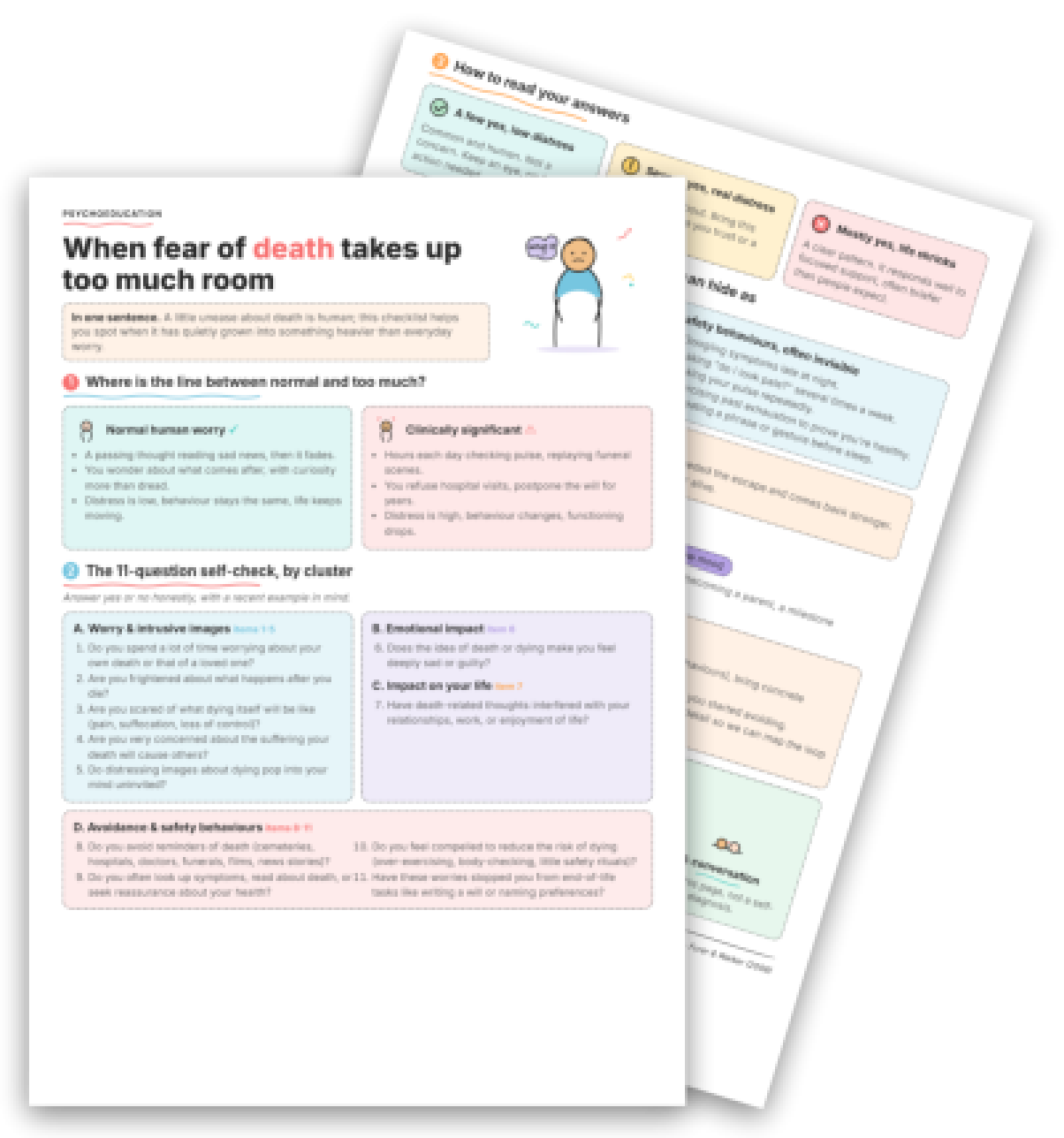
A printable PDF worksheet with an 11-item clustered checklist, a visual normal-to-clinical continuum, and a session-ready avoidance taxonomy to help patients recognize and begin working with death anxiety.
Clinical vignettes
Reassurance Loops After a Health Scare
Grief-Adjacent Death Worry in Older Adult
Clinical picture. P., a 68-year-old retired nurse whose spouse had died fourteen months earlier, presented with persistent low mood and what she described as "thinking too much about the end." She was uncertain whether her preoccupation with her own death was ordinary grief or something requiring clinical attention, and she was reluctant to pathologise what felt to her like a reasonable response to loss. The clinician offered the informational sheet not as a diagnostic instrument but as a map to help P. locate herself on the normal-to-clinical continuum. Reviewing the clusters, P. noted that her worry remained episodic, her distress was moderate rather than severe, and her daily functioning was largely preserved; she had endorsed only two items, both in the worry cluster. The exercise was useful precisely in the other direction: it affirmed that her experience sat within the expectable range, allowing the work to stay focused on bereavement processing rather than shifting toward an anxiety framework prematurely.
Death anxiety sits in a clinical grey zone that makes psychoeducation genuinely awkward: patients rarely arrive saying "I am afraid of dying." They present with compulsive body-checking, treatment-resistant worry, avoidance that looks like procrastination, or panic attacks that cluster around medical appointments. This PDF worksheet gives you a structured, visual entry point into a conversation most patients have never had explicitly.
Use this resource with your patients
Handout, exercises and materials ready to use, right inside SessionFuel.
Why Death Anxiety Resists Oral Explanation in Session
The first obstacle is definitional. Death anxiety as a clinical construct spans intrusive images, anticipatory dread, avoidance, and safety behaviours, and patients rarely recognize all four dimensions as part of the same pattern. Add the normalization trap: both patient and clinician can rationalize the fear as "just human," and the avoidance quietly consolidates.
The second obstacle is shame. A purely verbal walk-through of safety behaviours (pulse-checking, late-night symptom Googling, repetitive reassurance-seeking) tends to land as accusatory unless the patient sees the behaviour listed neutrally alongside others' similar habits. And explaining the normal-to-clinical continuum orally is particularly prone to anchoring bias: patients fixate on the least distressing version of their experience and stop listening. The fiche short-circuits both problems by making the continuum and the taxonomy visible before the patient has to self-label.
Presentations that deserve close attention include those overlapping with OCD-style checking, health anxiety and somatic preoccupation, panic clusters around bodily threat, and entrenched reassurance-seeking loops. In each case, death anxiety may be the organizing process behind the surface symptom picture.
750+ clinical tools
A library built with and for clinicians, ready to use in session and extend between appointments.
Access all the toolsWhat the Worksheet Contains
The fiche runs across five sections, each serving a distinct clinical function, and it is designed to be read together with the patient in session, not completed autonomously at home.
Panel 1 presents a two-column contrast between "normal human worry" ("a passing thought reading sad news, then it fades") and "clinically significant" responses ("hours each day checking pulse, replaying funeral scenes"). Showing this comparison visually before the checklist prevents the self-assessment from feeling like a diagnosis and gives both parties a shared referent.
Panel 2 is the core instrument: an 11-question self-check organized into four named clusters. Cluster A (items 1-5) covers worry and intrusive images. Cluster B (item 6) targets emotional impact. Cluster C (item 7) assesses functional interference. Cluster D (items 8-11) maps avoidance and safety behaviours, from cemetery avoidance to compulsive pulse-taking. The cluster structure matters clinically: a patient loading heavily on cluster D calls for a very different formulation than one concentrated in clusters A-B.
Panel 3 offers three interpretive bands tied to distress level and functioning, so the patient receives an immediate, non-pathologizing reading rather than a raw score. Panel 4 makes the avoidance and safety behaviour taxonomy visual: "changing the channel when a character gets ill" or "repeating a phrase or gesture before sleep" rarely register as anxiety-maintaining until a patient sees them listed side by side. The section closes with a concise restatement of the maintenance loop: "each escape or reassurance brings fast relief, then the fear learns it needed the escape." That one line often does more clinical work than ten minutes of verbal explanation.
Panel 5 maps the most common comorbid presentations (health anxiety, panic, OCD-style checking, generalised anxiety, low mood) and the typical spike triggers (bereavement, a family diagnosis, milestone birthdays, a heavy news cycle). A final "To discuss in session" block converts the checklist into three targeted prompts, flagging which clusters warrant detailed in-session exploration.
> Key point: This worksheet is a visual psychoeducation tool that facilitates the explanation of death anxiety in session. The five-section layout lets you move through the continuum, the checklist, and the avoidance taxonomy together, building shared language around a topic patients often find too charged to raise unprompted.
Use it with your patients
Share this tool in the mobile app and follow the work between sessions.
When and How to Introduce It
The fiche fits most naturally into an early formulation session, once the clinical picture suggests death anxiety as an organizing feature but before the patient has named it themselves. Pair it with an anxiety self-assessment if the full anxiety profile is still being mapped, or with the fear psychoeducation program once the formulation is established and psychoeducation is the next step.
A low-pressure introduction: "I'd like us to look at something together, not to label your experience, but to see which parts of this map fit." Hand the sheet across and read through it jointly. This prevents the evaluative gaze from feeling unilateral.
Debrief cluster D first when avoidance is prominent. The concrete list of safety behaviours produces the fastest recognition, anchors the behavioural formulation, and opens the door naturally to exposure rationale. From there, a structured exposure hierarchy or work on automatic avoidance patterns follows logically. For patients whose checking loops are most salient, the structured exercise on reassurance-seeking and the guided fear exercise make strong complements.
One limit worth naming: patients in acute grief or facing a terminal diagnosis in themselves or a close family member need careful scaffolding before the normal-to-clinical framing is useful. In those contexts, the continuum risks pathologizing an appropriate response to real loss. Use clinical judgment about sequencing.
The worksheet does not replace formulation. Its value is relational and psychoeducational: it externalizes the fear, normalizes what is normative, and leaves the patient with a concrete map to return to between sessions.
Your session continues in your patients' pocket
Use with a patientYour resources, available everywhere
The handouts, exercises, programs and audios above: you choose which ones to make available to your patients, in the mobile app dedicated to them.
And far more than a library
The app goes well beyond resources, to support your patients every day:
Related categories
Explore other clinical resources by category.

Anxiety
Clinical hub for anxiety disorders: CBT and ACT worksheets, psychoeducation sheets, and exercises for assessment and treatment across the anxiety spectrum.

CBT
CBT worksheets, cognitive restructuring exercises & behavioral tools for clinicians. Evidence-based resources for every phase of cognitive behavioral therapy.
Trauma
Clinical hub on trauma and PTSD: assessment, differential diagnosis, treatment phases, and printable resources for practitioners. 155 chars.

Mood
Evidence-based worksheets and clinical tools for mood disorders: CBT, ACT, and positive psychology resources for psychologists and therapists.

Identity
Clinical resources for self-identity work in therapy: CBT, ACT, schema tools for clinicians addressing self-concept, core beliefs, and identity disruption.

Emotions
Clinical resources on emotion regulation: worksheets, coping tools, CBT, REBT, and ACT exercises for therapists working across diagnoses and age groups.