
Clinical picture. M., a woman in her late twenties, presents with longstanding social anxiety characterized by anticipatory rumination, muscle tension, and recurrent sleep disruption before any professional or social gathering. The clinician introduces the five-question exercise as a structured between-session task, inviting her to write freely about her symptoms, the daily cost of her worry, and the triggers she had learned to sidestep. At the following session, M. returned with detailed written responses and, notably, had identified for the first time that her habit of cancelling social plans was maintaining rather than relieving her distress. This mapping formed the basis for a shared case formulation and opened a productive discussion about whether her anxious predictions had, in practice, ever protected her from the outcomes she feared.
Anxiety Self-Assessment: A Structured Patient Exercise
A five-question guided exercise helping patients map symptoms, triggers, avoidance patterns, and the real utility of anxious thinking.
Clinical vignettes
Mapping Avoidance in Social Anxiety
Recognising Utility of Worry in GAD
Clinical picture. T., a man in his mid-forties referred for generalised anxiety disorder, described his chronic worry as a form of preparation, reporting that he had never seriously questioned whether the habit was actually useful. The clinician proposed the guided exercise ahead of their third session, drawing his attention in particular to the final question about the functional value of anxious thinking. T. came back having written at length about how his anticipatory thoughts had rarely matched real events, and acknowledged that his protective rituals, checking work emails repeatedly late at night, had not reduced the threats he anticipated. This shift in perspective, modest but concrete, allowed the therapeutic work to move toward behavioural experiments rather than remaining at the level of psychoeducation.
What Makes Anxiety Hard to Articulate in the Consulting Room
Anxiety is one of the most common presentations in clinical practice, and yet patients frequently arrive with only a vague sense of their own experience. They know something feels wrong. They cannot always say what, or how much it costs them each day, or what they have already built around it to stay functional. A verbal exploration in session often stays at the surface: the patient answers in broad strokes, and the clinician leaves without a precise picture of symptoms, functional impact, triggers, and existing avoidance architecture.
Asking a patient to map their anxiety aloud, on the spot, also activates the very state you are trying to examine, which tends to compress the reflective space you need. Written, autonomous self-examination changes that dynamic. It gives the patient time, distance, and structure to go further than they would in a live conversation.
Use this resource with your patients
Handout, exercises and materials ready to use, right inside SessionFuel.
What the Exercise Contains
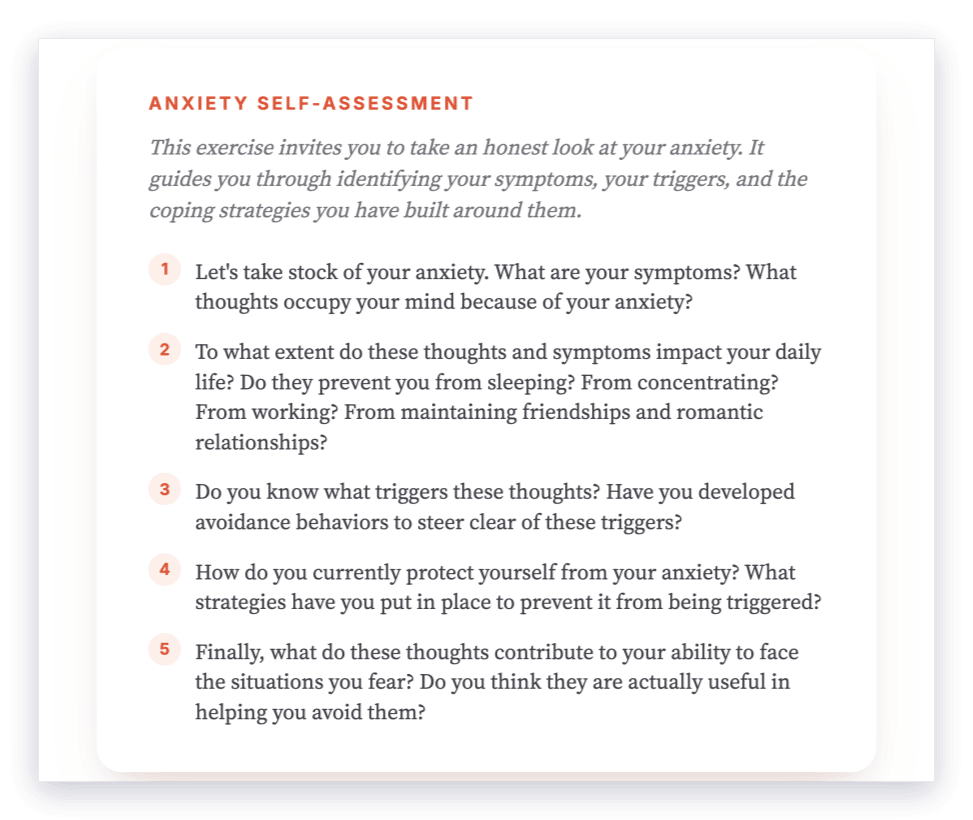
The tool is built around five questions that move the patient from raw description toward a functional analysis of their anxiety:
- Symptoms and intrusive thoughts: What does anxiety actually produce, in body and in mind?
- Daily impact: How much does it cost, concretely, across sleep, concentration, work, and relationships?
- Triggers and initial avoidance: Are the triggers known? Has the patient already organised life around avoiding them?
- Current protective strategies: What mechanisms are already in place to prevent anxiety from firing?
- Perceived utility of anxious thoughts: Do these thoughts help the patient face feared events, or do they primarily serve avoidance?
That fifth question is clinically precise. It asks the patient to assess the functional value of their own cognitive patterns, which opens a direct entry point for later restructuring work with tools like Challenging Anxious Thoughts or Restructuring Anxious Thoughts.
The image above lists all five questions in sequence:
This image is a static preview of the question list only. The full guided exercise, including patient-facing instructions and space to write responses, is experienced by the patient on their own inside the app. It is not accessible from this image.
This exercise is available to patients through the mobile application that is the dedicated patient-side interface of SessionFuel: once you assign it from your SessionFuel account, your patient receives it directly on their phone and completes it autonomously, between sessions, at their own pace.
Key clinical insight: The fifth question is the pivot of the whole exercise. When a patient genuinely examines whether their anxious thinking helps them cope or simply helps them avoid, they have already begun cognitive work before the next session even starts.
750+ clinical tools
A library built with and for clinicians, ready to use in session and extend between appointments.
Access all the toolsUse it with your patients
Share this tool in the mobile app and follow the work between sessions.
How to Assign It as Between-Session Homework
Assign this exercise between two sessions, once a basic shared vocabulary around anxiety is in place. It suits a wide range of presentations: patients with generalised anxiety, specific phobias, social anxiety, or any picture where avoidance is a structuring feature. It works especially well early in treatment as a structured intake complement, and again mid-treatment when you suspect the avoidance map has grown without being fully named.
To introduce it, frame it plainly: "Before our next meeting, I would like you to take some time to write about your anxiety. There are five questions and no right answers." That framing reduces performance pressure and signals that the work is exploratory, not evaluative.
When the patient returns, the written responses give you concrete clinical material. Question 3 on triggers and avoidance connects naturally to The Cycle of Avoidance and to Changing Avoidance. Question 4 frequently surfaces safety behaviors that can be mapped with Safety Behaviors or CBT Maintaining Processes. The impact data from question 2 can anchor a later Coping Strategy Effectiveness review and give the patient a baseline they can actually compare against.
For patients whose self-assessment reveals strong trigger uncertainty, pairing with Intolerance of Uncertainty is a logical next step. Where compulsive control patterns appear in question 4, Compulsive Control: A Guided Exercise for Anxiety Work extends the reflection directly. If reassurance-seeking surfaces, Reassurance-Seeking offers a focused follow-up between the next two sessions. Later in treatment, once the patient has built enough coping ground to look back, My Fight Against Anxiety can serve as a structured progress review that draws on everything this initial mapping started.
Your session continues in your patients' pocket
Use with a patientYour resources, available everywhere
The handouts, exercises, programs and audios above: you choose which ones to make available to your patients, in the mobile app dedicated to them.
And far more than a library
The app goes well beyond resources, to support your patients every day:
Related categories
Explore other clinical resources by category.

Anxiety
Clinical hub for anxiety disorders: CBT and ACT worksheets, psychoeducation sheets, and exercises for assessment and treatment across the anxiety spectrum.

Build awareness
Clinical worksheets and tools to build awareness in therapy: cognitive distortions, schemas, emotions, ACT and CBT resources for practitioners.

CBT
CBT worksheets, cognitive restructuring exercises & behavioral tools for clinicians. Evidence-based resources for every phase of cognitive behavioral therapy.

Trauma
Clinical hub on trauma and PTSD: assessment, differential diagnosis, treatment phases, and printable resources for practitioners. 155 chars.

Mood
Evidence-based worksheets and clinical tools for mood disorders: CBT, ACT, and positive psychology resources for psychologists and therapists.

Identity
Clinical resources for self-identity work in therapy: CBT, ACT, schema tools for clinicians addressing self-concept, core beliefs, and identity disruption.